
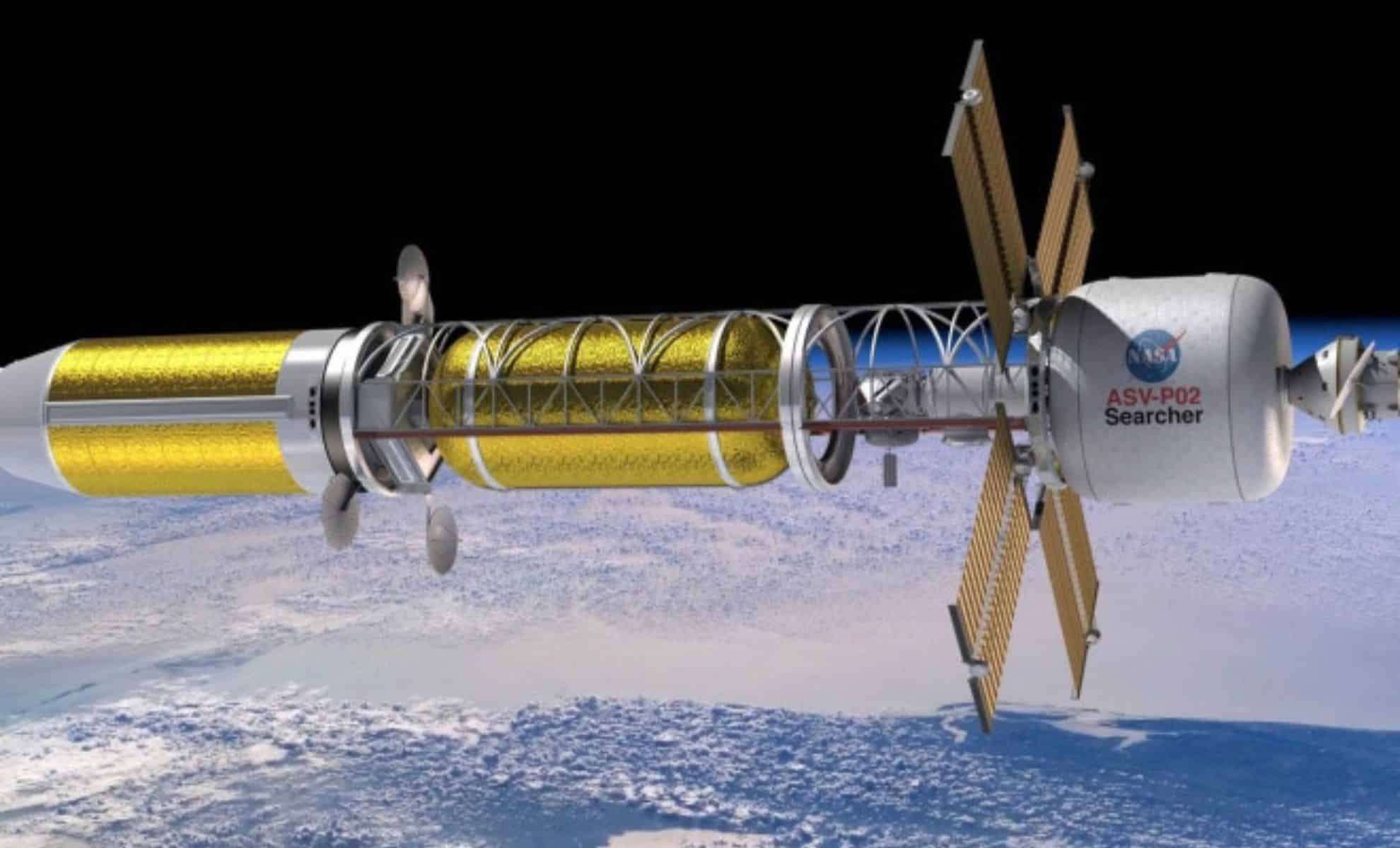
Innovative strides in nuclear thermal propulsion (NTP) technology might drastically reduce the duration of manned Mars missions, potentially slashing travel time by 50% compared to conventional chemical rockets.
Collaboration between NASA and the Defense Advanced Research Projects Agency (DARPA) aims to advance this propulsion method, which could also improve spacecraft maneuverability. Yet, creating reactors suitable for these nuclear-powered rockets involves substantial engineering obstacles that remain under active investigation.
Unlocking the Benefits of Nuclear Thermal Propulsion in Space Exploration
Current space missions mostly depend on chemical rockets that generate thrust through the combustion of propellants like hydrogen and oxygen. Although dependable, these rockets are limited by slower speeds and the need for large oxygen supplies that add extra mass to spacecraft. Consequently, traveling to Mars can take many months to over a year.

In contrast, nuclear thermal propulsion harnesses the powerful energy from nuclear fission to superheat propellants, such as hydrogen, which then exit the engine at extremely high velocity, producing superior thrust. This approach achieves nearly double the specific impulse of chemical rockets—the efficiency measurement of propellant utilization. As Dan Kotlyar, nuclear engineering associate professor at the Georgia Institute of Technology, states, “Nuclear propulsion would expel propellant from the engine’s nozzle very quickly, generating high thrust,” enabling faster arrival times.
The increased effectiveness of NTP is especially valuable for Mars expeditions, where astronauts face extended exposure to cosmic radiation and microgravity, both of which can be hazardous. By reducing travel time to just a few months, nuclear rockets could significantly lessen these health risks.
Engineering Nuclear Reactors Tailored for Space Travel
Despite these advantages, developing reliable nuclear reactors capable of producing sufficient thrust in the space environment presents daunting challenges. Unlike chemical engines, nuclear propulsion systems must sustain extremely high operating temperatures while safely handling radioactive fuel like uranium-235.
In such systems, a fission reaction generates heat by bombarding uranium nuclei with neutrons, causing them to split and release vast amounts of thermal energy. Although the principles are well-established in terrestrial nuclear plants, adapting reactors for space requires making them compact, lightweight, and able to endure hotter conditions than traditional counterparts. Kotlyar highlights this difficulty, noting, “Nuclear thermal propulsion systems have about 10 times more power density than a traditional light-water reactor.”
One design consideration involves using high-assay low-enriched uranium (HALEU) as fuel instead of the highly enriched uranium employed in earlier models. HALEU lowers proliferation risks but is less efficient, meaning more fuel mass onboard the spacecraft—an issue engineers aim to mitigate by developing advanced materials that optimize fuel utilization.
Nuclear-Powered Propulsion: Past Innovations and Future Prospects
The concept of nuclear propulsion has a long history. From 1955 to 1973, entities including NASA, General Electric, and Argonne National Laboratories developed and conducted ground tests on roughly 20 nuclear thermal engines. These used highly enriched uranium, which posed security concerns. Modern projects like NASA and DARPA’s DRACO (Demonstration Rocket for Agile Cislunar Operations) seek to create safer, more efficient engines powered by HALEU fuel.
The DRACO initiative aims to demonstrate a working nuclear thermal rocket in space as soon as 2027, marking a pivotal step forward. Industry leaders such as Lockheed Martin and BWX Technologies are partnering to develop the propulsion system hardware for these innovative spacecraft.
Tackling the Key Technical Barriers
Prior to launching nuclear propulsion systems, numerous technical issues must be resolved. Dan Kotlyar and his team at Georgia Tech are focused on creating accurate simulations and models to optimize reactor performance. These computational efforts help predict engine behavior across scenarios like ignition, shutdown, and handling extreme thermal and pressure dynamics.
In addition, Kotlyar’s group is advancing computational tools that require less processing power, aiming to facilitate the eventual development of autonomous control systems for nuclear engines—critical for extended missions where astronauts cannot manually intervene. As Kotlyar explained, “My colleagues and I hope this research can one day help develop models that could autonomously control the rocket.”
In summary, nuclear thermal propulsion shows exciting promise to revolutionize Mars exploration by significantly speeding travel times. While the technology remains under development with formidable design challenges, continued research and upcoming demonstrations by NASA and collaborators are bringing this futuristic vision closer to reality, potentially ushering in a new era of efficient solar system exploration.
- Categories:
- Astronomy ,
- Science ,
- Nasa











0 comments
Sign in to Comment