
Researchers propose that the solar system’s massive gas giants might offer a novel path to probing dark matter by analyzing subtle ultraviolet emissions in their atmospheres. Published in Physical Review Letters, this work sets some of the toughest constraints yet on how dark matter might engage with ordinary matter, highlighting the potential of planets like Jupiter and Saturn to act as natural cosmic observatories.
Exploring Fresh Avenues to Detect the Universe’s Hidden Mass
Dark matter continues to baffle astronomers as one of the universe’s great unsolved puzzles. Though it constitutes a major share of cosmic mass, no dark matter particle has been observed directly so far. Instead, astronomers look for indirect traces emerging from interactions involving dark matter and normal matter.
Led by Carlos Blanco at Princeton University, the team investigated whether the immense gravitational fields of giant planets might capture dark matter particles roaming the solar system.

These gas giants traveling through the galaxy could trap dark matter inside them. Should these particles eventually collide and annihilate, the resulting energy might induce atmospheric chemical changes that produce detectable light emissions.
Prior research by Blanco and Rebecca Leane from the SLAC National Accelerator Laboratory focused on infrared signals tied to H₃⁺ molecules formed after hydrogen ionization. Their new study broadens the search to ultraviolet phenomena observable in all the large planets.
“The natural next question was whether there’s a signature that works on every giant planet at once,” Blanco says. “Ultraviolet airglow, a phenomenon that humans have wondered about since Aristotle, turned out to be the answer.”
Ultraviolet Airglow as a Universal Indicator of Dark Matter
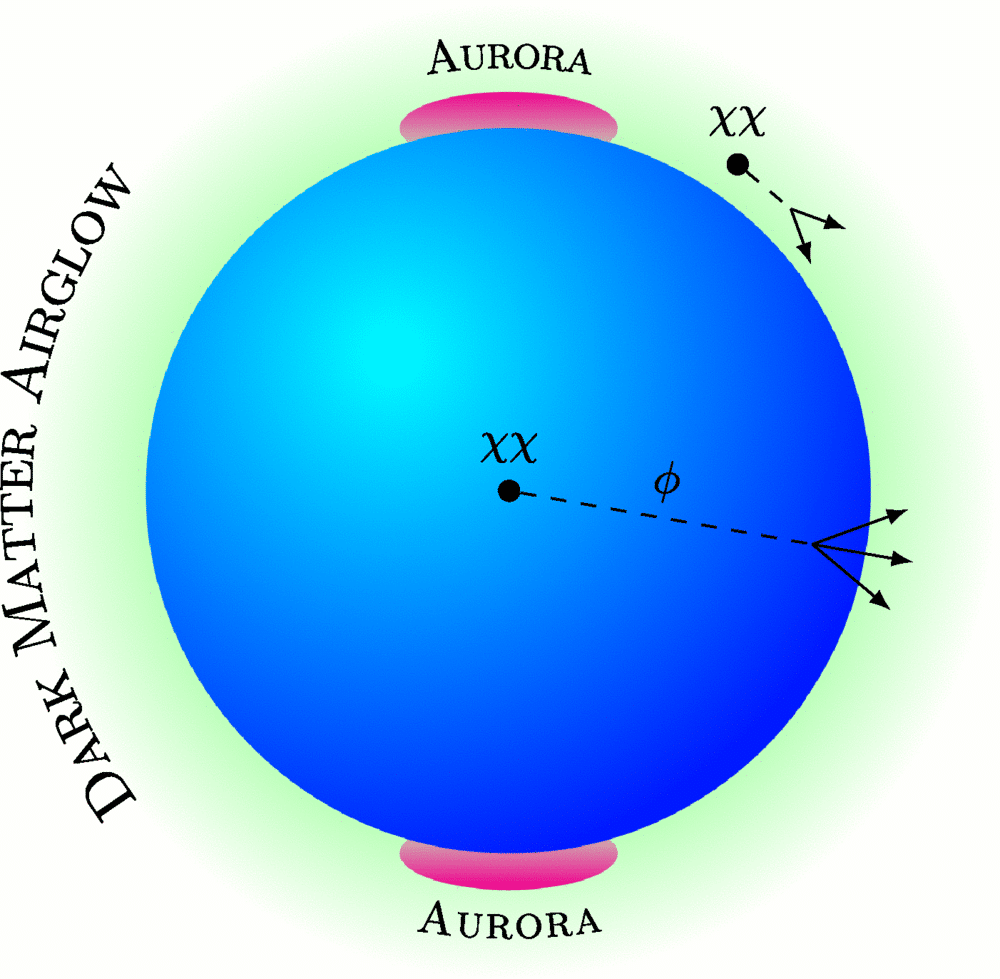
The team proposed that energy released from dark matter annihilation might create high-energy electrons, exciting hydrogen molecules in the atmospheres of giant planets. This excitation would cause hydrogen to emit ultraviolet light, offering a possible common signature detectable from orbiting spacecraft.
Unlike infrared signals linked to specific chemical processes, ultraviolet airglow stands out as a universal marker across different planetary atmospheres. The scientists investigated whether excess ultraviolet brightness could be distinguished from the background atmospheric glow.
“Alongside ionizing photons, ionizing electrons can also cause molecular hydrogen to glow in the ultraviolet, a signature we can search for in every giant planet at once,” Blanco explains.
Isolating a dark matter signature poses a challenge due to naturally occurring ultraviolet emissions in these planets’ atmospheres. The research needed to determine if any additional ultraviolet light detected might originate from dark matter particle interactions.
The study utilized ultraviolet data gathered by spacecraft flybys, as expected signals are extremely weak. Observations from Voyager 1, Voyager 2, and New Horizons during their encounters with Jupiter, Saturn, Uranus, and Neptune were key to this investigation.
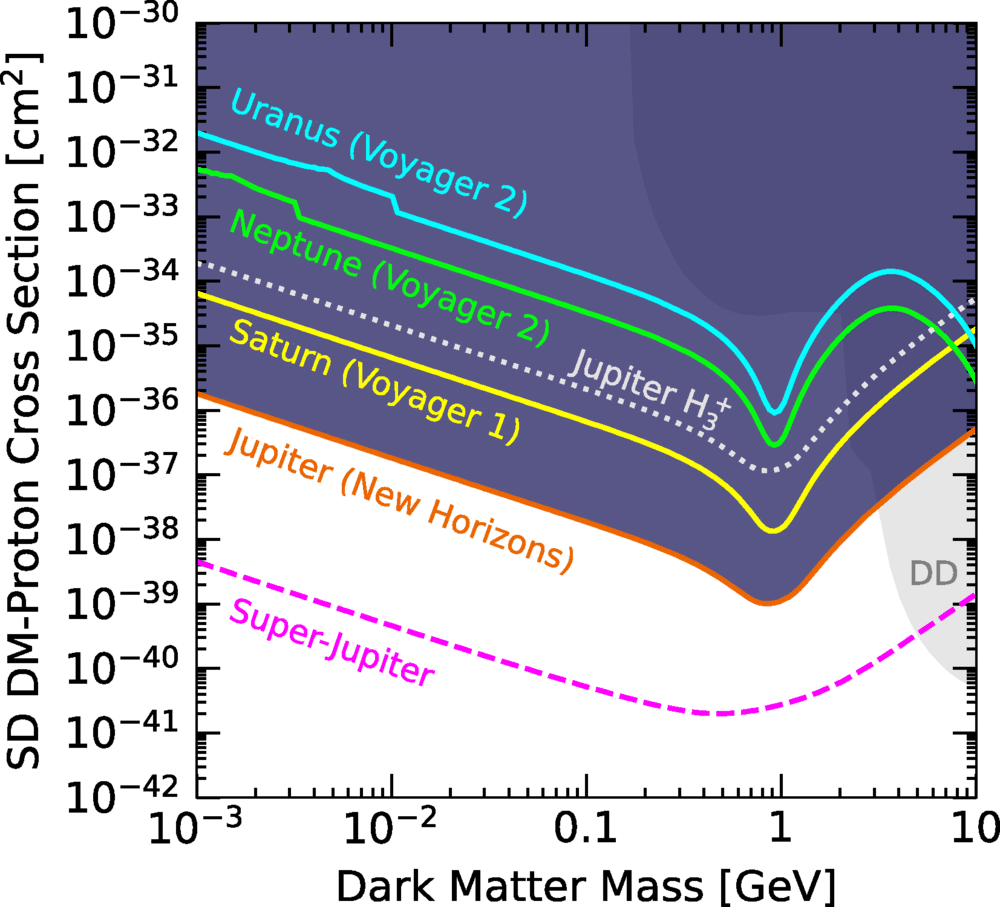
By aligning their theoretical models with the actual ultraviolet measurements, the team set stringent upper bounds on the interaction strengths between dark matter and ordinary matter, marking some of the tightest constraints to date using planetary atmospheres.
Space Missions Bolster the Role of Planets as Dark Matter Sensors
Published in Physical Review Letters, this investigation broadens dark matter research beyond underground laboratories on Earth. Conventional detectors search for rare particle events but may miss some dark matter types that lose significant energy passing through Earth’s crust.
Giant planets provide a complementary environment, with their massive hydrogen-rich atmospheres and potent gravitational pulls potentially revealing elusive dark matter interactions unreachable by terrestrial experiments.
“The sensitivity peaks for dark matter near the mass of the proton, which transfers energy most efficiently to the hydrogen these planets are made of,” Blanco explains. “Because the four giant planets differ in size, temperature and composition, each one probes different dark matter masses and models.”
Each gas giant offers a unique testing ground. Enormous Jupiter may capture particles differently than the icy and cooler Uranus or Neptune, widening the scope of dark matter candidates that can be investigated.
Additional research is needed to understand how dark matter behaves once trapped inside these planets, including the influence of internal temperatures on particle retention and the resulting ultraviolet emissions.
Future observations will play a crucial role in assessing planet-specific efficiency in holding dark matter and refining the interpretive models for airglow data.
Upcoming Space Probes Could Transform Giant Planets Into Dark Matter Observatories
Prospective missions may enhance tests of this ultraviolet approach. The European Space Agency’s JUICE mission, set to orbit Jupiter in 2031, carries advanced ultraviolet instruments for detailed atmospheric studies.
Similarly, missions to Uranus could revisit the ice giant for the first time since the 1986 Voyager 2 encounter, providing fresher ultraviolet measurements critical for dark matter research.
The concept also extends to exoplanets. Massive planets orbiting distant stars, especially those larger than Jupiter, might manifest even stronger ultraviolet signals, serving as exceptional dark matter detectors beyond our solar system.
“Future ultraviolet telescopes could search for this glow in massive exoplanets, where a nearby Super-Jupiter would be an exceptionally sensitive dark matter detector.”
This innovative perspective recasts giant planets not just as objects of interest but as instrumental tools in unraveling one of modern physics’ greatest enigmas. Although dark matter remains unseen, these ultraviolet studies chart a promising path toward unveiling the universe’s invisible framework.
- Categories:
- Astronomy



0 comments
Sign in to Comment