
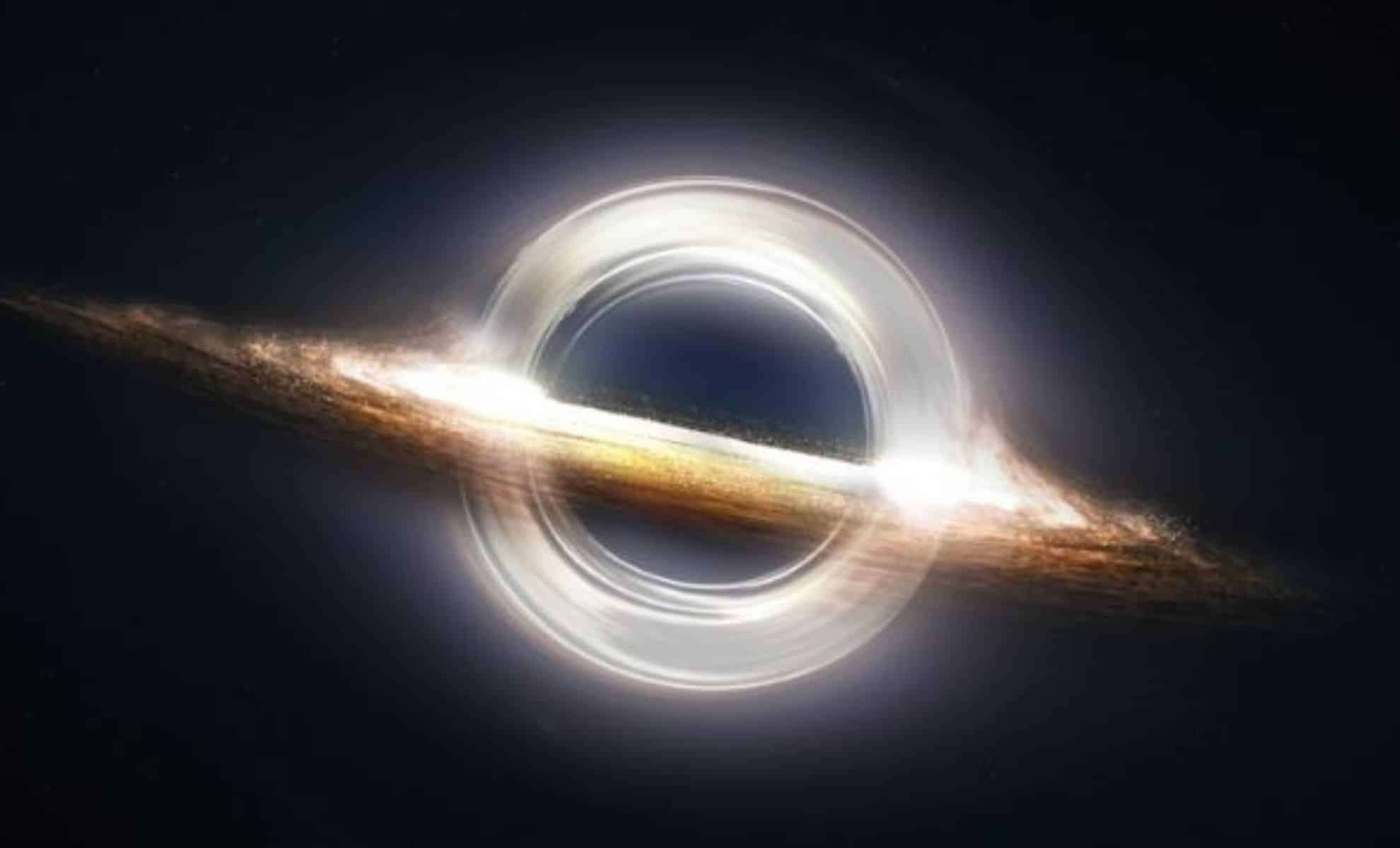
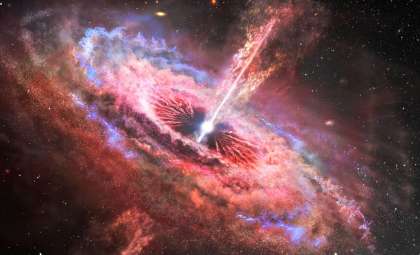
Black holes have long fascinated scientists as powerful cosmic phenomena where gravity is so strong that even light cannot escape.
Now, a groundbreaking hypothesis offers a provocative alternative, proposing that these massive objects might not be black holes after all. Instead, they could be “frozen stars”, dense celestial bodies that replicate many features attributed to black holes but avoid the problematic concept of singularities.
The research, led by Ramy Brustein, a physicist at Ben-Gurion University in Israel, aims to resolve perplexing conflicts in physics, including Stephen Hawking’s information paradox.

Classical Black Holes and Their Theoretical Dilemmas
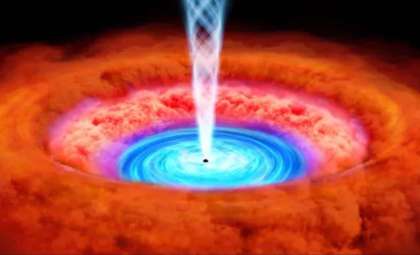
Traditionally, black holes are described within the framework of Einstein’s general relativity, which introduces the concept of singularities—infinitely dense points where conventional physics ceases to apply. Surrounding the singularity lies the event horizon, the invisible boundary beyond which no signal or particle can return. This model supports explanations for a wide range of astronomical phenomena but also raises serious theoretical issues.
A major puzzle is the black hole information paradox first pointed out by Hawking. According to quantum theory, information must be conserved, yet black holes, through Hawking radiation, could lose mass and eventually vanish, seemingly erasing the information that fell inside them—a violation of quantum rules.
As French astrophysicist Jean-Pierre Luminet noted in 2016, “The irretrievable loss of information conflicts with one of the basic postulates of quantum mechanics… physical systems that change over time cannot create or destroy information, a property known as unitarity.”
Introducing Frozen Stars: A New Contender
Brustein and his team suggest a fresh perspective by hypothesizing that black holes might actually be “frozen stars”—compact objects that exhibit black hole-like characteristics but lack the troublesome singularity and event horizon. “Frozen stars are a type of black hole mimickers: ultra-compact astrophysical objects that are free of singularities, lack a horizon, but yet can mimic all of the observable properties of black holes,” Brustein explained to Live Science.
This concept leverages quantum mechanics, specifically the Heisenberg uncertainty principle, which dictates a trade-off between the precision of position and momentum measurements. The team proposes that this uncertainty generates quantum pressure, halting matter’s collapse before a singularity can form.
In contrast to classic black holes, frozen stars would not possess an event horizon, allowing, in theory, for light and particles to escape. However, their gravitational grip would remain extreme, effectively capturing most nearby matter. Crucially, this avoids the paradox of lost information by eliminating the singularity.
Implications for Cosmology and Physics
Frozen stars represent a significant departure from Einstein’s general relativity, hinting that our current gravitational theories may require revision. Though these entities closely resemble black holes in their gravitational and radiative behaviors, as Brustein points out, “We have shown how frozen stars behave as (nearly) perfect absorbers although lacking a horizon and act as a source of gravitational waves.”
This model elegantly addresses classical black hole paradoxes while aligning with observed phenomena, such as the emission of radiation akin to Hawking radiation—but without the conceptual challenges posed by singularities. It offers a path toward unifying quantum physics with classical gravity.
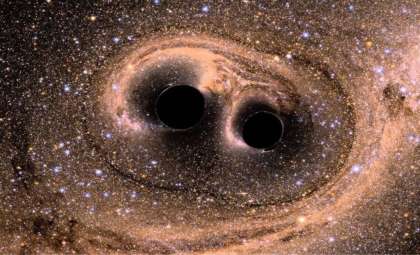
Distinguishing frozen stars from traditional black holes could become feasible through upcoming gravitational wave observations stemming from cosmic collisions, as these waves may carry signatures unique to each object type.
Advancing Black Hole Exploration
Though still hypothetical, the frozen star concept marks an intriguing advance in efforts to reconcile general relativity and quantum mechanics. Should this theory hold true, it could necessitate profound modifications to Einstein’s gravitational framework and reshape our comprehension of the universe’s largest and smallest structures. As Brustein noted, “If they actually exist, they would indicate the need to modify in a significant and fundamental way Einstein’s theory of general relativity.”
Future experimental breakthroughs, especially in gravitational wave astronomy, will be key to validating this theory. Confirming the existence of frozen stars could revolutionize our understanding of black holes, suggesting that the cosmos is far more enigmatic than previously imagined.
Ongoing research may ultimately lead to one of the most significant paradigm shifts in astrophysics since Einstein’s era.
- Categories:
- Astronomy ,
- News ,
- Physics






0 comments
Sign in to Comment