
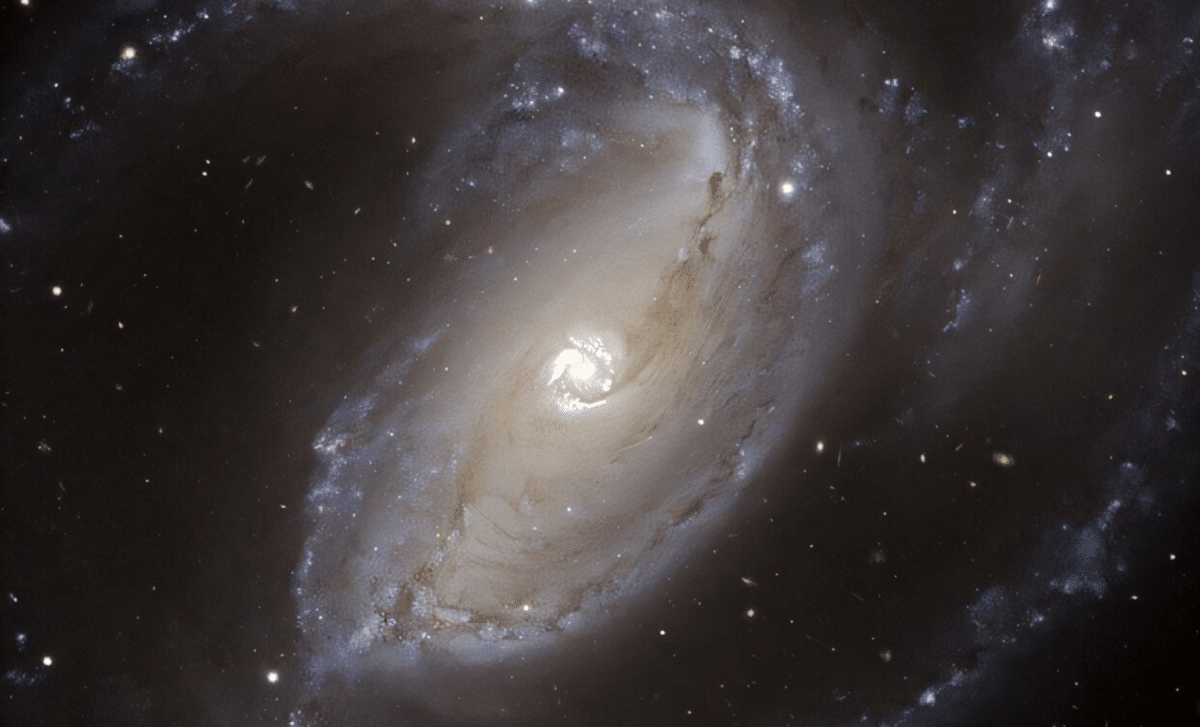
Researchers have identified the farthest nuclear disk ever detected within a galaxy, showing that sophisticated galactic formations existed just 4.5 billion years after the Big Bang. This breakthrough, featured in Monthly Notices of the Royal Astronomical Society, reshapes our understanding of early galaxy assembly.
Webb Unveils Early Stages of Galactic Formation
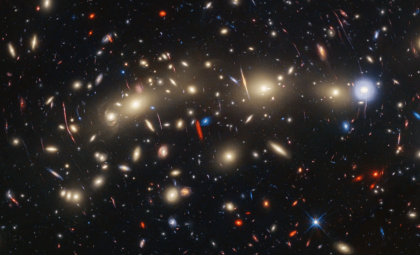
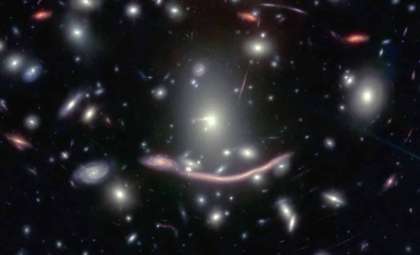
Scientists from Durham University utilized the powerful capabilities of the James Webb Space Telescope to observe a galaxy as it existed shortly after the universe's infancy, roughly 4.5 billion years post-Big Bang. Webb’s exceptional sensitivity and resolution revealed fine details that were previously unattainable.
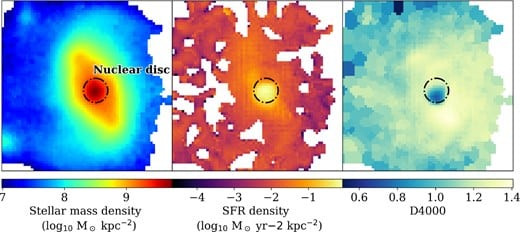
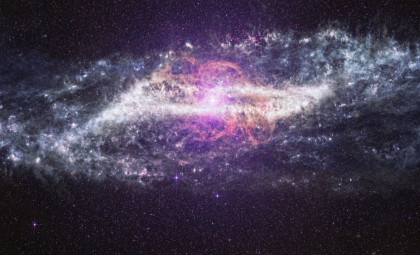
At this galaxy's core, the team discovered a dense, star-forming nuclear disk—a rotating structure dense with stars located near the galaxy's center. While typical in mature, nearby galaxies, this marks the earliest direct detection of such a feature in cosmic history.

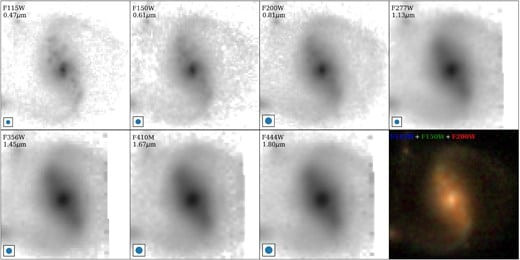
This discovery indicates that galaxies could establish intricate internal structures more rapidly than previously believed, suggesting some galaxies evolved in ways more akin to those we see in the present universe than to gradual formation theories.
By employing detailed JWST observations, the researchers distinguished the galaxy's various parts, clearly pinpointing the active, young star-forming nuclear disk. This active growth area confirms the structure is not a remnant, but a region of vigorous star creation.
These findings, detailed in Monthly Notices of the Royal Astronomical Society, demonstrate that early galaxies were capable of forming complex structures previously thought to be reserved for much older systems.
Stellar Bar Mechanism Fuels Early Galaxy Development
The observed nuclear disk likely originated through the action of an extended stellar bar traversing the galaxy. These bars, common in modern spiral galaxies, serve to funnel gas and stars toward the galactic core, promoting new structural growth.
Astronomers have historically examined stellar bars’ impacts on local galaxies, hypothesizing their presence in the early universe but lacking direct evidence that they influenced galaxy evolution at such epochs until now.
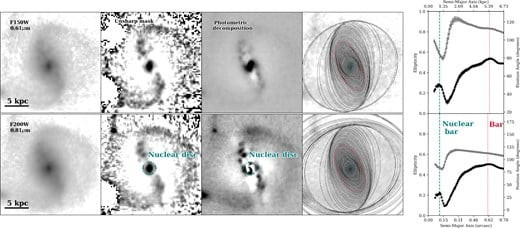
This new capture reveals how the stellar bar likely transported matter inward, fostering the dense central region where ongoing star formation thrives.
Lead author Zoe Le Conte of Durham University emphasized the importance of this finding in changing views on galaxy development, stating: “The extraordinary images and novel results from the James Webb Space Telescope continue to reveal that mature galaxies exist much earlier than we previously thought.”
The nuclear disk’s features—compact configuration, youthful star population, and organized growth—mirror those found in contemporary galaxies, suggesting advanced galactic maturity occurred remarkably early.
Revising the Timeline of Galactic Evolution
This detection adds further proof that the early universe was a dynamic period marked by rapid internal assembly within galaxies. Finding a well-formed nuclear disk so soon after the Big Bang challenges previous models about how quickly galaxies evolved.
The galaxy’s growth appears governed by internal dynamics, such as matter migration induced by the stellar bar and concentrated star formation in the nucleus, rather than by random accumulation of material.
These results imply that mechanisms shaping galaxies today were active billions of years ago, indicating a continuity in galactic evolution from the earliest times to the current epoch.
JWST’s unprecedented observations are enabling astronomers to delve deeper into cosmic history, revealing the speed at which galaxies acquired familiar structures. Ongoing studies aim to investigate material flows within this galaxy, providing insights into the nuclear disk’s origin and the stellar bar’s efficiency in channeling matter centrally.
- Categories:
- Astronomy


0 comments
Sign in to Comment