
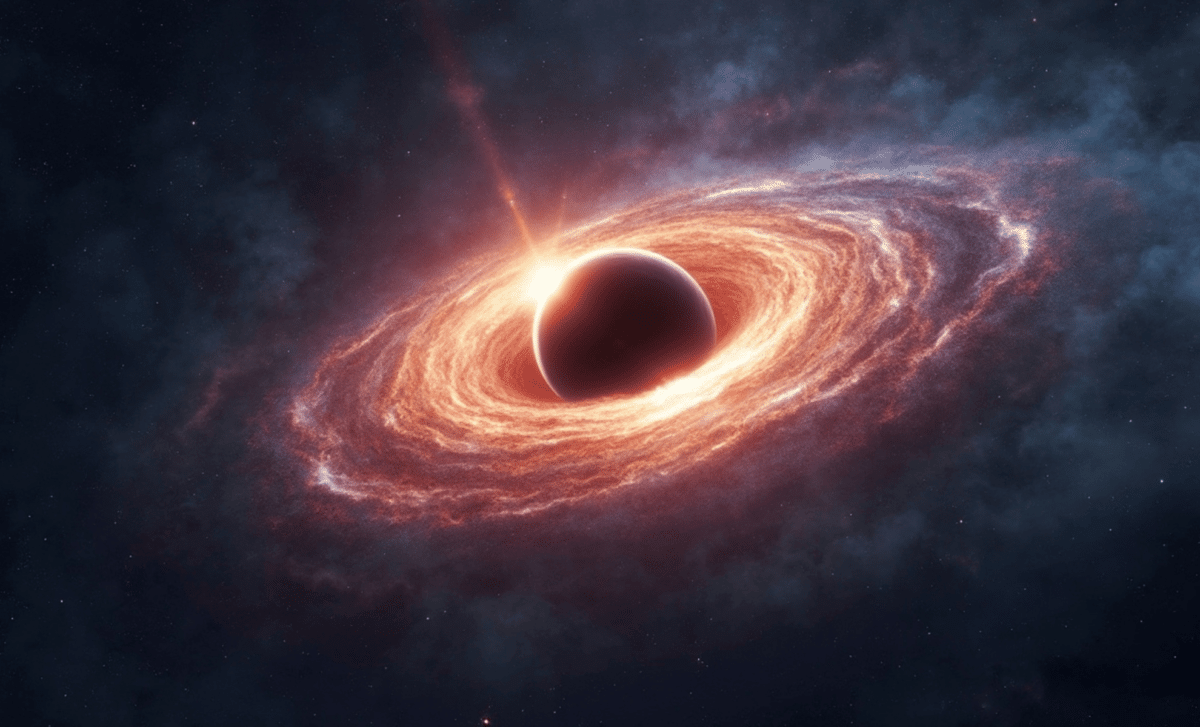
In 2023, scientists encountered an exceptionally energetic neutrino whose origin defied all known astrophysical phenomena. Researchers at the University of Massachusetts Amherst now propose a revolutionary explanation: this neutrino may be the result of a primordial black hole (PBH) detonation, remnants from the universe’s infancy. Their findings, published in Physical Review Letters, not only clarify the neutrino’s source but could also deepen our understanding of dark matter and Hawking radiation, revealing fresh perspectives on the cosmos’s enigmas.
Astonishing Detection of an Ultra-High-Energy Neutrino
The neutrino identified by the KM3NeT Collaboration in 2023 exhibited energies vastly exceeding those produced by terrestrial particle accelerators, being 100,000 times more powerful than particle collisions at the Large Hadron Collider. This unprecedented energy level left experts puzzled, as common cosmic sources such as supernovae or cosmic rays failed to account for it. Investigating this anomaly, the team from UMass Amherst introduced an innovative hypothesis: the neutrino might originate from an explosive event tied to a primordial black hole.
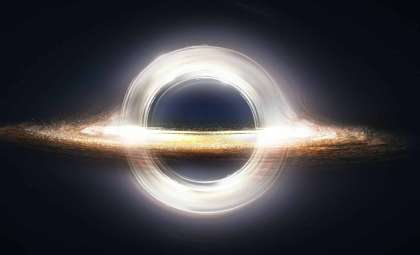
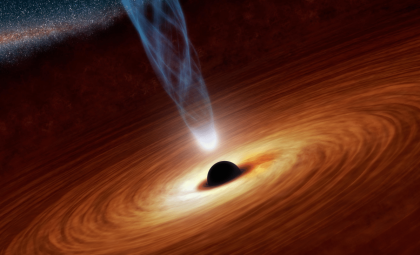
Primordial black holes differ from those formed through stellar collapse, theorized to have emerged shortly after the Big Bang. Their significantly smaller masses and densities enable unique behaviors and potentially violent ends. According to the UMass study, as PBHs steadily lose mass through Hawking radiation, they become unstable and might ultimately explode, releasing energy bursts that could produce neutrinos of such immense energies.

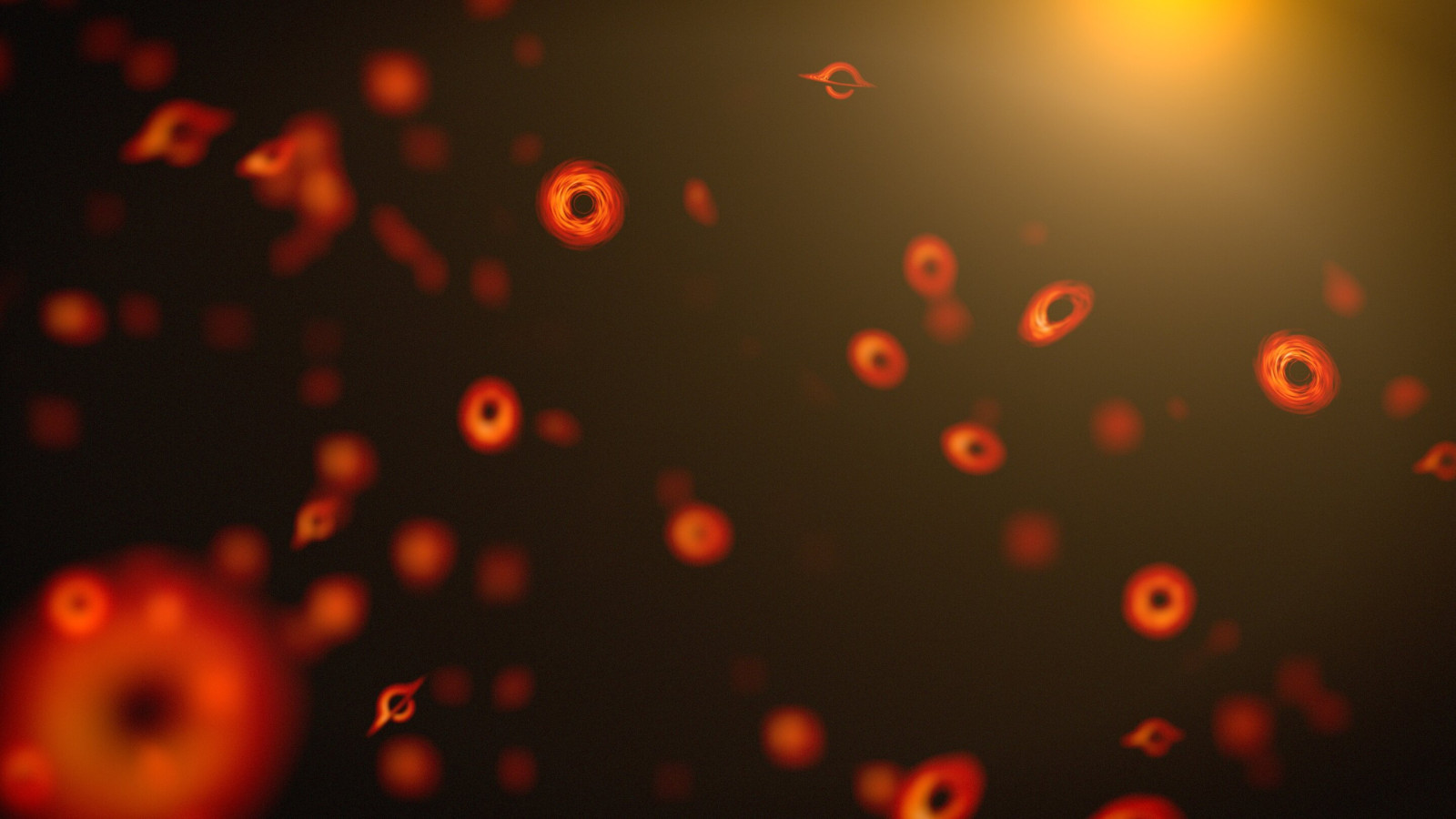
Hawking Radiation: Unlocking the Mystery of PBH Flares
A cornerstone of this theory is the phenomenon known as Hawking radiation, proposed by Stephen Hawking in the 1970s. This process involves particle emission from black holes due to quantum effects near their event horizons. The UMass scientists argue that as PBHs shed mass via Hawking radiation, they become hotter and more energetic, driving an escalating cycle that can culminate in explosive output.
“The lighter a black hole is, the hotter it should be and the more particles it will emit,” explains Andrea Thamm, assistant professor of physics at UMass Amherst and co-author of the study. “As PBHs evaporate, they become ever lighter, and so hotter, emitting even more radiation in a runaway process until explosion. It’s that Hawking radiation that our telescopes can detect.”
The model suggests such explosive bursts might occur more frequently than previously anticipated, possibly once every decade. If accurate, future observatories could regularly catch these high-energy events. The relative scarcity of detected PBH explosions so far may arise from the difficulty in observing such energetic emissions, yet advances in detection technologies could soon change this landscape.
Quasi-Extremal PBHs and the Concept of Dark Charge
The UMass team extends the discussion by introducing quasi-extremal primordial black holes, which carry an unusual attribute termed “dark charge.” Unlike conventional electric charge, this property involves a hypothetical particle called the “dark electron,” which is heavier than regular electrons and interacts solely within the domain of dark matter.
“We think that PBHs with a ‘dark charge’—what we call quasi-extremal PBHs—are the missing link,” says Joaquim Iguaz Juan, a postdoctoral researcher at UMass Amherst and co-author of the study. “The dark charge is essentially a copy of the usual electric force as we know it, but which includes a very heavy, hypothesized version of the electron, which the team calls a ‘dark electron.'”
This hypothesis provides a framework for explaining the unique traits of PBHs and addressing certain discrepancies observed in high-energy particle data.
Illuminating the Nature of Dark Matter
Beyond clarifying the neutrino mystery, the dark charge proposition might be instrumental in unraveling dark matter’s enigma. Dark matter, though integral to cosmic structure and behavior, remains undetected directly. Observations hint at its presence through gravitational effects, but its fundamental properties are unknown. The UMass researchers propose that PBHs with dark charge might offer new insights into the dark matter phenomenon.
“There are other, simpler models of PBHs out there; our dark-charge model is more complex, which means it may provide a more accurate model of reality,” explains Michael Baker, co-author of the study and assistant professor of physics at UMass Amherst. “What’s so cool is to see that our model can explain this otherwise unexplainable phenomenon.”
Should this theory hold, PBHs could simultaneously account for the unexplained cosmic mass and the detected high-energy neutrino events.
Transforming the Landscape of Cosmic Research
The implications of this research, outlined in Physical Review Letters, are significant. By linking primordial black holes, dark matter, and high-energy neutrinos, the study paves the way for novel explorations of both the early universe and fundamental physics. As Andrea Thamm emphasizes,
“A PBH with a dark charge has unique properties and behaves in ways that are different from other, simpler PBH models. We have shown that this can provide an explanation of all of the seemingly inconsistent experimental data.”
If additional investigations validate the dark charge framework and PBH explosion theory, it may usher in a transformative era in astrophysics—offering firm detections of Hawking radiation, definitive confirmation of primordial black holes, and revealing particles beyond the current Standard Model, fundamentally altering our cosmic perspective.
In summary, the 2023 discovery of the ultra-high-energy neutrino may represent a pivotal breakthrough. Through proposing connections among PBHs, dark charge, and dark matter, the University of Massachusetts Amherst team has formulated a promising model addressing some of the universe’s most baffling puzzles. Ongoing research might soon unlock profound truths about the fabric of the cosmos.
- Categories:
- Astronomy





0 comments
Sign in to Comment