
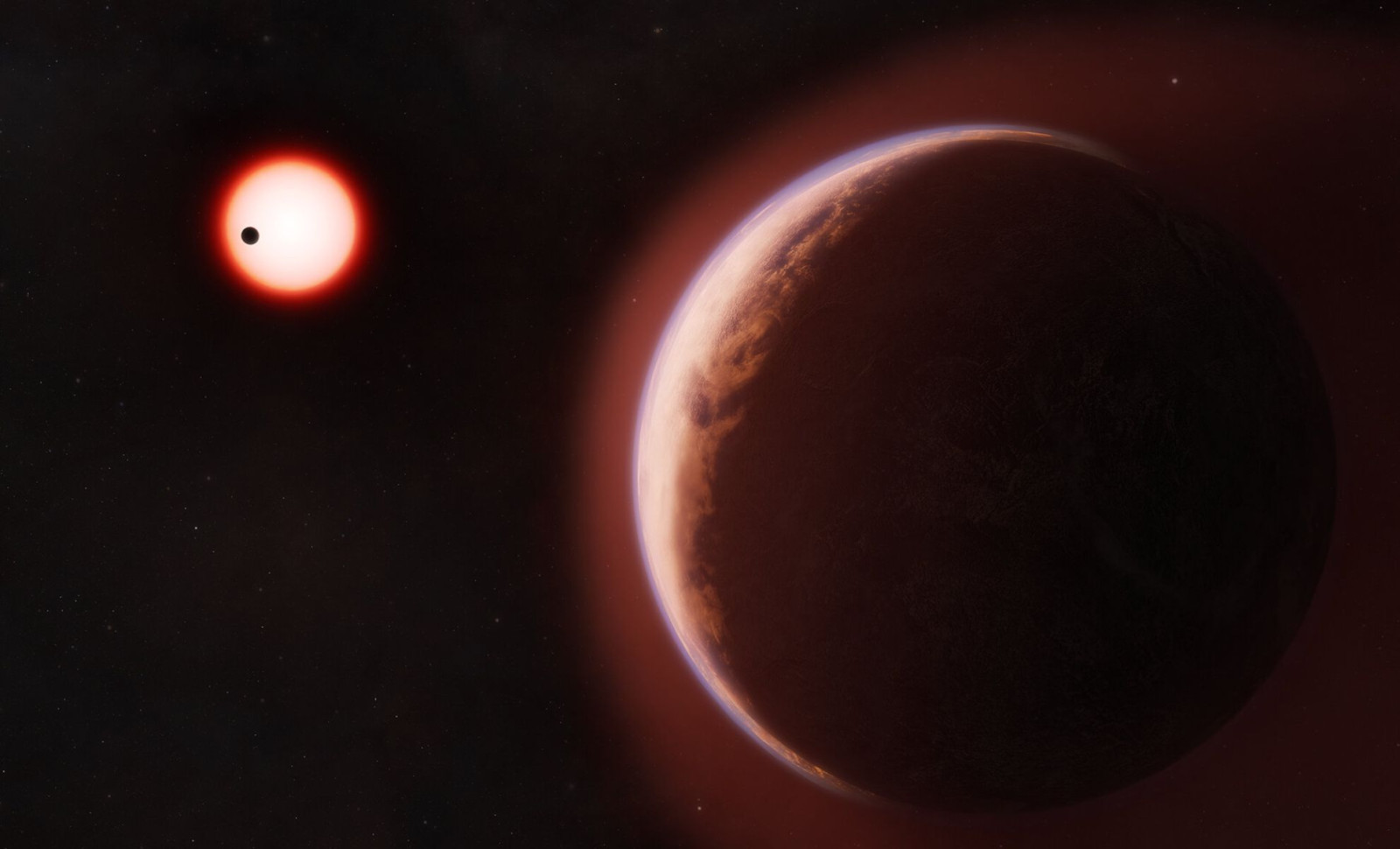
Scientists have identified an atmosphere enveloping LHS 1140 b, a rocky exoplanet approximately 48 light-years from our planet. This breakthrough marks a pivotal development in exploring worlds that could support life outside our solar system. The findings, detailed in Science, represent the first definitive proof of a rocky planet within another star's habitable zone maintaining an atmosphere over billions of years.
Significant Progress in Finding Earth Analogues
The detection of LHS 1140 b provides strong evidence that exoplanets with solid surfaces beyond our solar neighborhood can hold onto atmospheric layers essential for sustaining planetary processes over geological timescales. This planet orbits a dim red dwarf star within the habitable zone, where temperatures could allow water to remain liquid on its surface.
While thousands of exoplanets have been discovered, including rocky ones in habitable zones, confirming the presence of their atmospheres has remained challenging. Atmospheres are vital since they regulate climate, shield the surface from stellar radiation, and create conditions that might foster life.

This recent study uncovers evidence that LHS 1140 b has sustained an atmosphere for billions of years. Researchers observed helium escaping from the planet’s upper atmospheric layers, suggesting the existence of a surrounding gaseous envelope.
Collin Cherubim, who recently completed his Ph.D. in Earth and Planetary Sciences from Harvard University, highlighted the critical role of detecting atmospheres in the examination of rocky exoplanets.
“An atmosphere is essential for a planet to support life as we know it,” said lead author Collin Cherubim, who recently earned his Ph.D. in Earth and Planetary Sciences from Harvard University.
“This is the first time anyone has found an atmosphere on a rocky planet in the habitable zone of another star.”
Helium Signals Atmospheric Retention
The breakthrough combined theoretical predictions with observational data. Prior to using telescopes, Cherubim and his team created a model suggesting that LHS 1140 b possesses an upper atmosphere enriched with helium that gradually leaks into space.
To validate their hypothesis, they employed the Warm Infrared Echelle (WINERED) Spectrograph at the Magellan Observatory in Chile. During a rare event when LHS 1140 b and another planet in the same system transited their host star simultaneously, researchers collected data for comparison.
While the companion planet lacked atmospheric signs, LHS 1140 b exhibited a helium signature, confirming gas escaping from its atmosphere.
Published in Science, these results prove that ground-based instruments can identify atmospheric components in rocky exoplanets, paving a new path for studying planets with Earth-like features.
Although helium detection alone doesn't unravel the entire atmospheric makeup, it confirms that LHS 1140 b has preserved gaseous layers over extensive periods. Future research aims to determine the full atmospheric composition and whether the planet has conditions favorable to habitability.
Theoretical Model Validated by Observations
The confirmation of LHS 1140 b's atmosphere exemplifies the successful testing of a pre-observation prediction. David Charbonneau, chair of the Harvard Astronomy Department and an astronomer at the Center for Astrophysics | Harvard & Smithsonian, initially doubted whether the theoretical forecast could be empirically confirmed.
The model was developed by reviewing known exoplanets and identifying the one most likely to retain an atmosphere. Subsequent telescope data moved this from theory to a firmly supported discovery.
“Collin scrutinized existing planet data and accurately anticipated a helium atmosphere on this world,” Charbonneau commented. “He secured observation time, gathered data, and delivered a statistically robust detection.”
This accomplishment illustrates how theory can steer targeted searches for habitable exoplanets. Instead of surveying every candidate indiscriminately, astronomers can prioritize those with the greatest prospects for atmosphere retention.
With an atmosphere surviving more than three billion years, LHS 1140 b offers an exceptional case for investigating planetary evolution and the maintenance of potentially life-supporting environments.
Opening New Frontiers in Exoplanet Research
Though it doesn't prove life exists on LHS 1140 b, the confirmed atmosphere reshapes the approach to studying rocky exoplanets. This milestone provides a critical benchmark for probing atmospheric properties linked to habitability.
Upcoming studies will aim to uncover the planet’s complete atmospheric profile and analyze whether its surface conditions could sustain environments akin to Earth's.
The discovery positions LHS 1140 b as a prime candidate for future nearby exoplanet investigations. Scientists anticipate applying similar methods to find more rocky planets with stable atmospheres around other stars.
Robin Wordsworth, Gordon McKay Professor of Environmental Science and Engineering and Professor of Earth and Planetary Sciences at Harvard University, reflected on the evolution of exoplanet science over the past twenty years.
“Two decades ago, we questioned whether terrestrial planets even existed,” said Wordsworth, an advisor to Cherubim. “Since then, we’ve discovered they’re widespread and some reside in habitable zones. The next step was determining if any could hold onto atmospheres – now we have an example.”
For the research team, this finding marks the beginning. Cherubim views it as a successful validation of a model designed to pinpoint promising atmospheric targets.
“This discovery confirms the model’s predictive power and hopefully inaugurates many more atmospheric observations,” he stated.
As efforts continue across nearby stellar systems, LHS 1140 b may serve as a vital reference for understanding how rocky planets keep their atmospheres and the frequency of potentially habitable worlds beyond Earth.
- Categories:
- Astronomy











0 comments
Sign in to Comment