
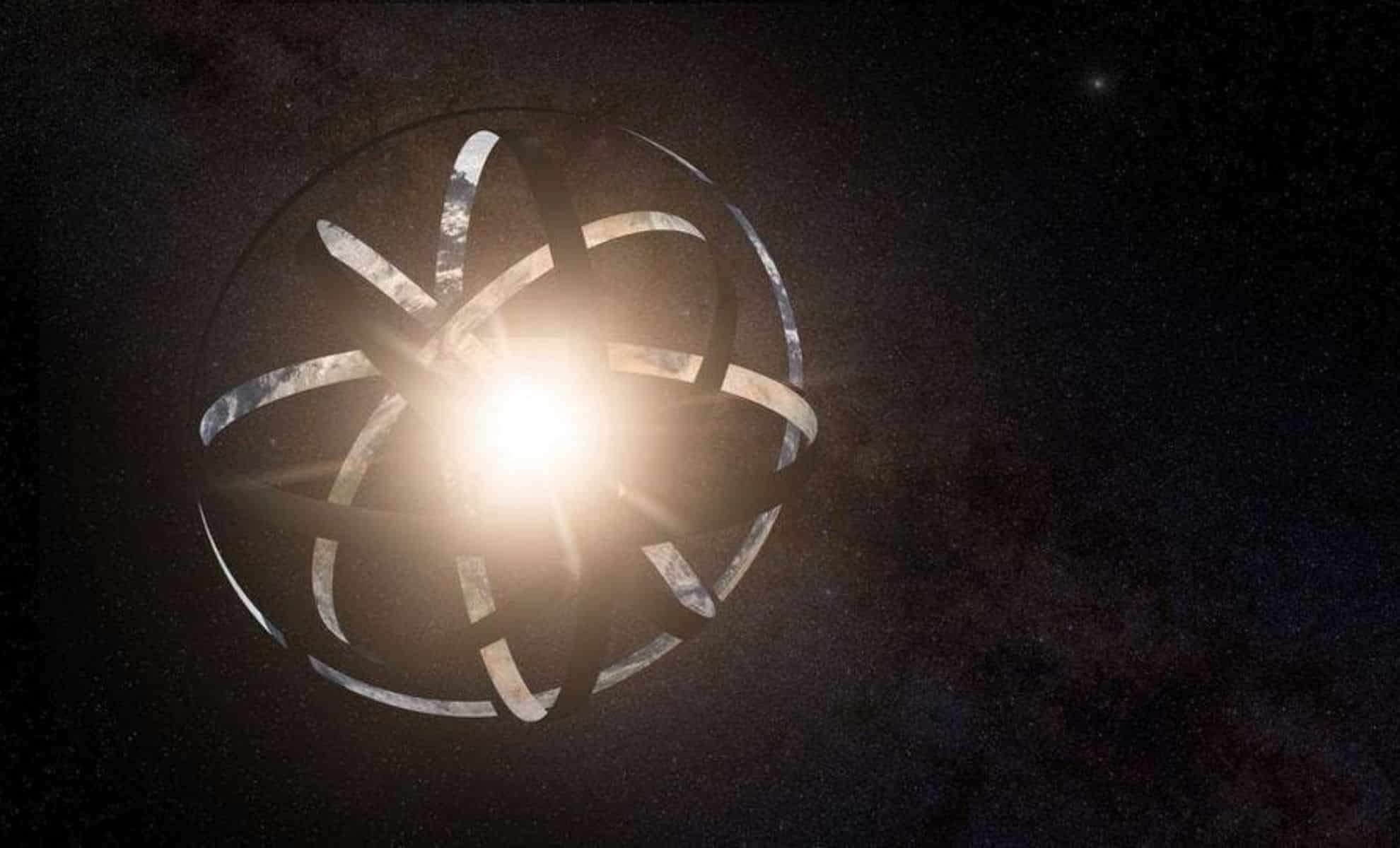
Emerging research has rekindled interest in Dyson spheres—gigantic hypothetical constructs designed to capture the full energy output of stars.
This captivating concept has led scientists to wonder if such structures might explain the elusive missing matter within the cosmos. Yet, despite the intrigue, many researchers remain doubtful about the actual existence of Dyson spheres and their significance in cosmological phenomena.
Understanding Dyson Spheres
The notion of Dyson spheres traces back to physicist Freeman Dyson in 1960, inspired by Olaf Stapledon’s science fiction classic “Star Maker.” Dyson envisioned that advanced alien civilizations could build immense structures enveloping their stars to harness stellar energy.

Though such megastructures would block visible light, they would emit infrared radiation, offering a potential method for astronomers to detect them. “It could just be normal old astrophysics at play,” commented astrophysicist and author Dr. Ethan Siegel, underscoring the necessity for extraordinary proof before confirming their presence.
Interest surged following the enigmatic brightness fluctuations of star KIC 8462852 (Boyajian’s star), which some hypothesized might be caused by an incomplete Dyson sphere, though this idea remains speculative.
The Universe’s Missing Mass Puzzle
Astronomers continue to grapple with the missing mass conundrum. This involves two distinct components: dark matter, required to explain the gravitational dynamics of galaxies, and ordinary matter, consisting mostly of hydrogen and helium, which appears less abundant than expected from observations.
While dark matter is theorized to be made of exotic particles, the whereabouts of the missing normal matter is still unresolved. Some hypotheses suggest vast intergalactic gas filaments might hold this hidden mass.
Evaluating Dyson Spheres as a Source of Missing Matter
Though Dyson spheres ignite the imagination, they are unlikely candidates for explaining the universe’s missing mass. Construction of a fully encompassing Dyson sphere is considered impractical given the staggering material demands and probable gravitational destabilization.
Should such structures exist, they would probably be very thin and vulnerable to collapse, reducing their feasibility. More realistic alternatives include Dyson swarms or rings, which are assemblies of solar energy collectors in orbit around a star. These would intercept only a small portion of starlight, are easier to build, and thus less likely to contribute significantly to missing mass. Furthermore, their infrared emissions should be observable by instruments like the James Webb Space Telescope (JWST), yet no conclusive detections have been made.
Observational Studies and Ongoing Doubts
A recent publication in the Monthly Notices of the Royal Astronomical Society identified seven stars displaying unusual infrared signatures that could hint at Dyson sphere-like structures. These stars lie within 1,000 light years from our solar system, exhibiting heat signatures that remain unexplained.
Nonetheless, the scientific community approaches these findings with caution. Dr. Janna Levin, a theoretical cosmologist at Barnard College, suggested these signals could originate from natural astrophysical processes such as collisions between planets or youthful stars surrounded by dust. “Heat signatures are so generic in nature that it’s far from a smoking gun and there are many possible natural explanations,” Levin explained to Salon.
Co-author Dr. Erik Zackrisson echoed reservations, emphasizing that despite these stars being top Dyson sphere candidates, alternate explanations like cosmic dust or background sources are feasible. “They are the best Dyson sphere candidates we’ve come across so far, but this does not mean that they are Dyson spheres, or even that Dyson spheres represent the most likely explanation for the phenomenon we’re seeing,” Zackrisson remarked.
The Importance of Pursuing the Search
Despite skepticism, the investigation into Dyson spheres remains scientifically valuable. It inspires novel approaches and fosters collaboration across disciplines such as astrophysics and history. Uncovering extraterrestrial megastructures, if real, would revolutionize our understanding of space and the potential for advanced alien life.
“What could be more exciting and existentially terrifying than the discovery of alien life?” Levin reflected, stressing the need to balance open-mindedness with scientific discipline. Dr. Siegel added, “It’s important to keep an open mind, and it’s easy to understand why the most wild possibilities excite us. But without stronger evidence, this is just another example of people getting hyped up over what’s almost certainly going to be a big nothing-burger.”
In summary, while Dyson spheres continue to intrigue as a theoretical concept, their role as an explanation for the universe’s missing mass remains improbable. Nevertheless, the quest to detect these colossal structures advances scientific curiosity and deepens our cosmic comprehension.
- Categories:
- Astronomy ,
- News ,
- Space ,
- Extraterrestrial life










0 comments
Sign in to Comment