
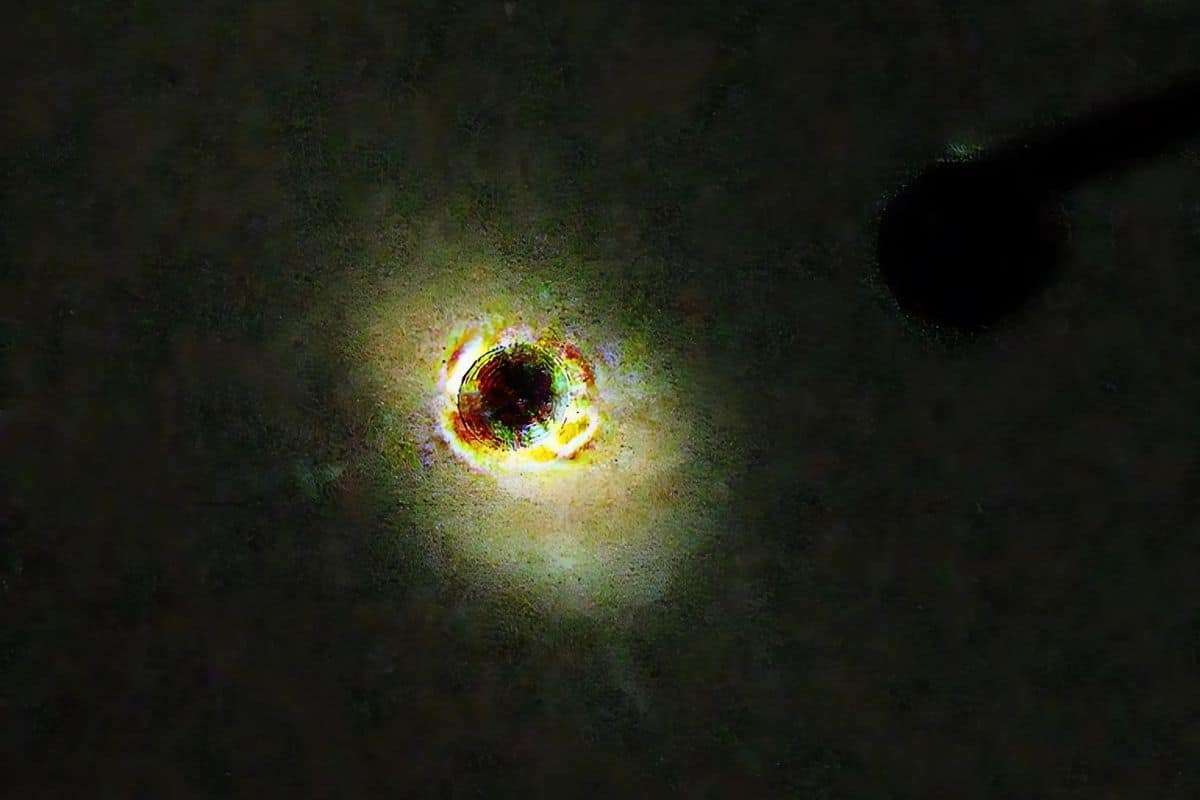
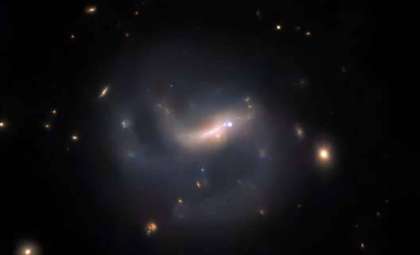
The Hubble Space Telescope from NASA has delivered an unprecedented detailed image of the famous and powerful cosmic object known as the quasar 3C 273. Situated more than 2.5 billion light-years away, this stunning observation offers fresh insights into the chaotic surroundings of a supermassive black hole and advances our knowledge of how galaxies develop and change over time.
An In-Depth View Inside a Cosmic Powerhouse
At the heart of 3C 273 resides a supermassive black hole that draws in nearby matter, producing the intense brightness characteristic of a quasar. Since its 1963 discovery, 3C 273 has been central to studies beyond our galaxy.
Yet, the quasar’s overwhelming glow has historically hindered detailed examination of its structure. Using the Space Telescope Imaging Spectrograph (STIS) as a coronagraph, Hubble successfully suppressed the quasar's bright core, allowing scientists to uncover intricate and surprising formations nearby.

Unveiling Unexpected Cosmic Shapes
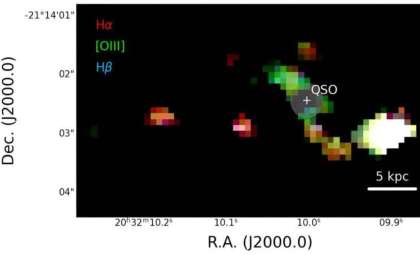
The recently captured Hubble images reveal multiple blobs of varying dimensions and an unusual L-shaped filament within a region spanning 16,000 light-years around the black hole. Bin Ren of the Côte d’Azur Observatory suggests these may be satellite galaxies spiraling inward — “Several blobs of different sizes and a strange L-shaped filamentary structure have been detected.”
This leads to the idea that galactic cannibalism might significantly contribute to quasar activity, offering new perspectives on how galaxies interact and evolve.
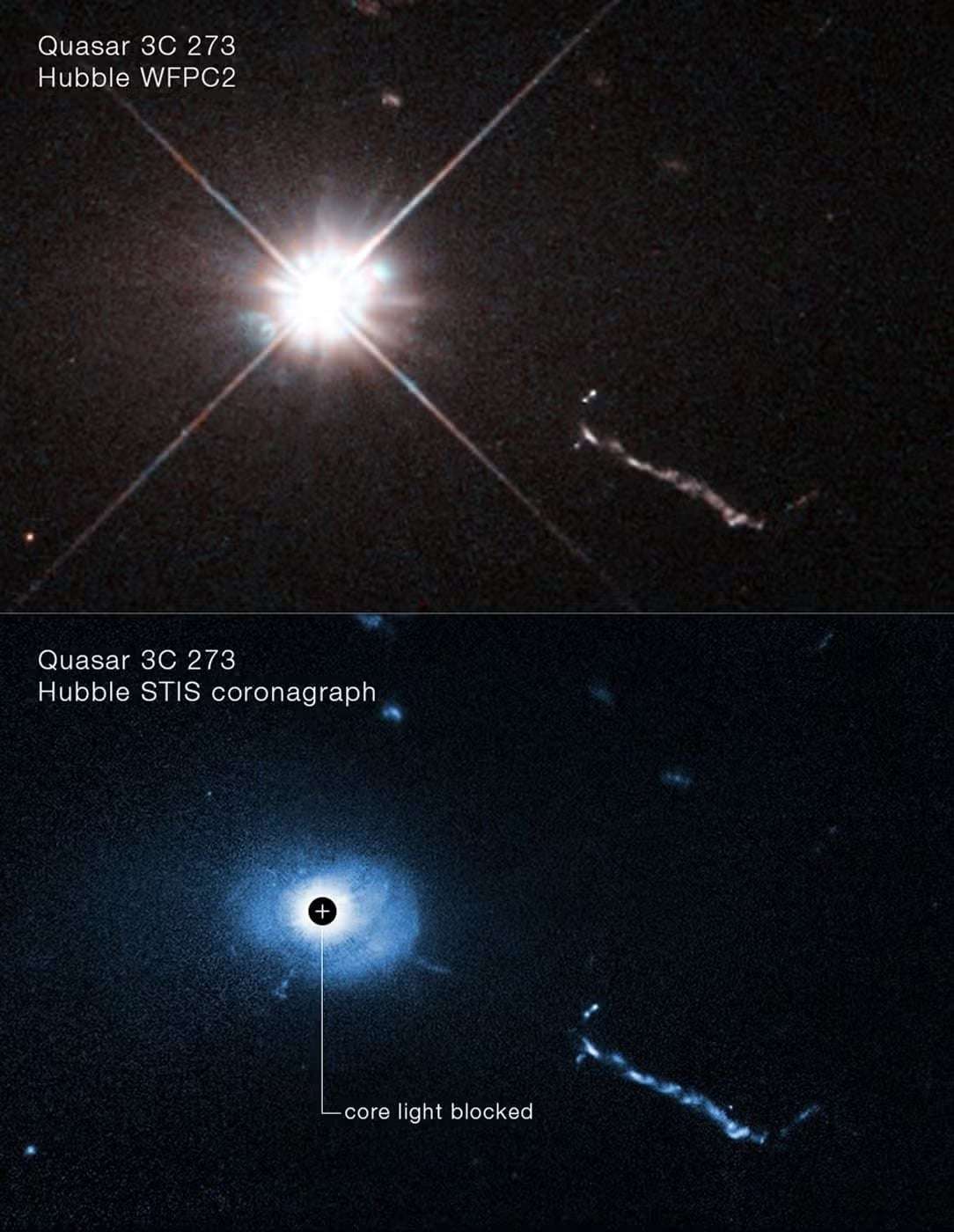
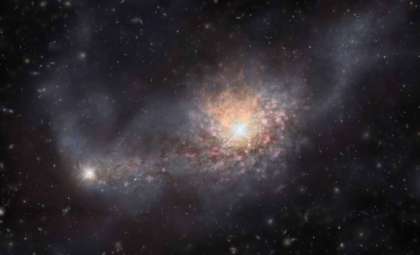
A coronagraph on Hubble blocks out the glare coming from the supermassive black hole at the heart of the quasar.
Jets Extending Across Cosmic Distances
One striking feature is the immense jet of material launched from 3C 273, extending more than 300,000 light-years — surpassing the Milky Way’s width. Moving at nearly light speed, this jet emits energy across the electromagnetic spectrum. Fascinatingly, by comparing with Hubble images taken 22 years earlier, astronomers observed the jet’s apparent acceleration as it flows outward, hinting at complex interactions with the surrounding intergalactic medium or unexplored forces.
A New Perspective on Quasar Phenomena
Earlier views considered quasars as solitary luminous sources, but Hubble’s sharp imaging has changed that understanding. The recent examination of 3C 273 confirms quasars are integrated within galaxies experiencing dynamic changes involving mergers, collapses, and gravitational disturbances.
The bright core now appears as part of a larger narrative about galaxy evolution and the powerful interactions between supermassive black holes and their galactic surroundings.
Looking Ahead with the James Webb Space Telescope
Researchers are now focusing on the James Webb Space Telescope to delve deeper into quasar environments. Its infrared abilities may penetrate dust-shrouded zones around the black hole, revealing star formation sites and how galaxies channel material inward. These future observations, combined with Hubble's extensive data, promise to enhance our understanding of quasar architecture and their significant impact on the early universe.
With over a million known quasars serving as cosmic lighthouses throughout space and time, objects like 3C 273 provide crucial insights into our cosmic history. “Thanks to Hubble’s powerful instruments, we’re unlocking unprecedented details about quasars, exciting researchers who have never observed this level of clarity before.”
- Categories:
- News




0 comments
Sign in to Comment