
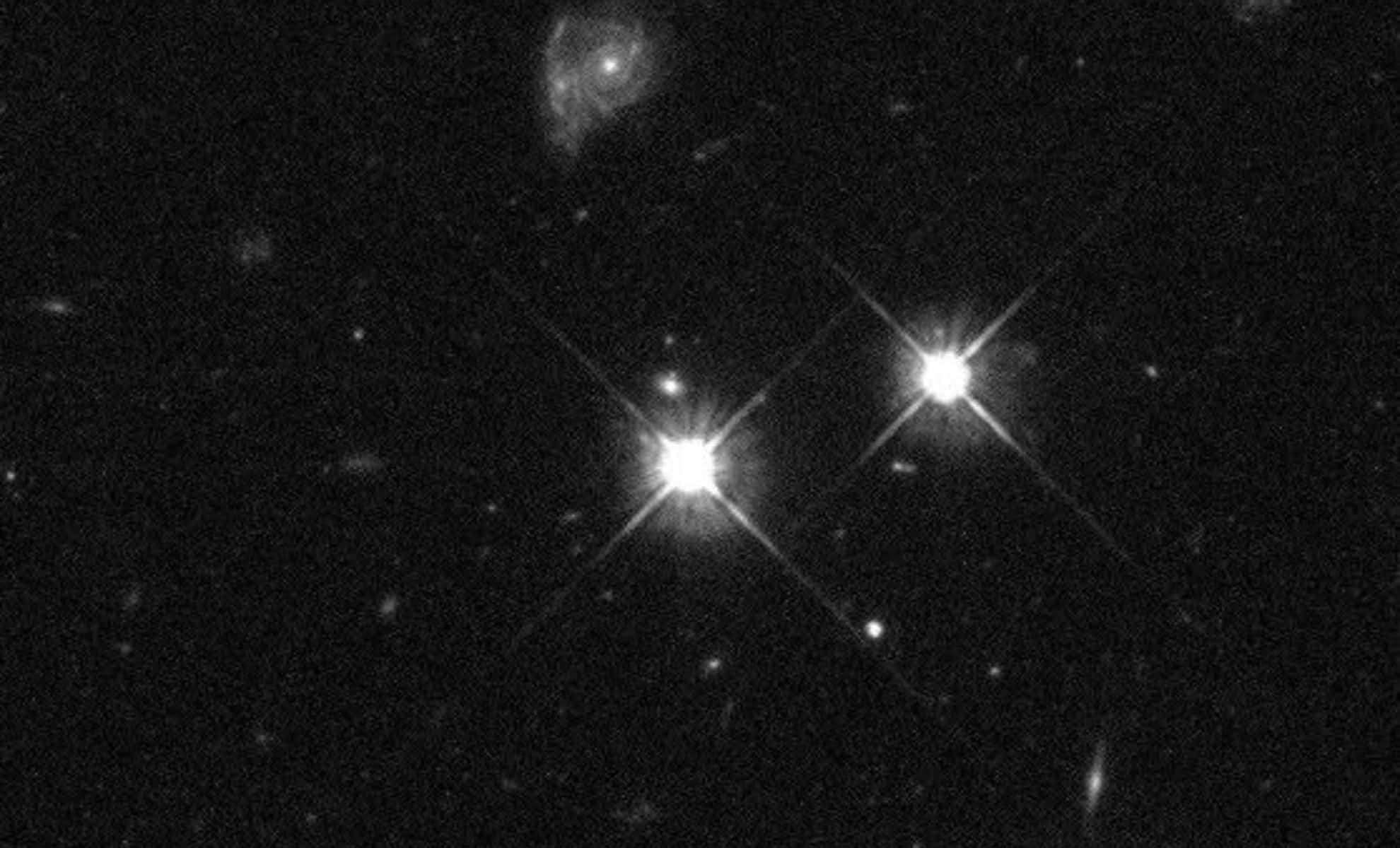
On June 22, 2025, NASA's Hubble Space Telescope marked an extraordinary achievement by capturing its 100,000th photograph—a stunning image featuring a quasar situated 9 billion light-years from our planet. Taken using Hubble’s Wide Field and Planetary Camera 2, this exposure presents a dazzling quasar at its center, accompanied by a surprising elliptical galaxy lying in the foreground at about 7 billion light-years away.
As detailed in NASA’s official statement, this remarkable discovery showcases Hubble’s extraordinary capacity to explore the cosmos and sheds light on the interactions between distant galaxies and the intense emissions from quasars.
A Quasar and a Concealed Galaxy Aligned in Space
Although the quasar shines as the most luminous feature in the frame, astronomers were particularly intrigued by the elliptical galaxy directly ahead of it. These two celestial bodies seem close in the image, but in reality, they are separated by roughly 2 billion light-years.

Astronomer Charles Steidel from the California Institute of Technology detected the hidden galaxy by studying the quasar’s light spectrum. Certain absorption patterns in the quasar’s light revealed the chemical fingerprints of the foreground galaxy.
“Steidel also was somewhat surprised to discover that the galaxy is an elliptical, rather than a spiral,” NASA reports. Usually, elliptical galaxies contain minimal gas, yet this particular one possesses a gaseous halo devoid of visible stars, making it a compelling subject for further research.
Quasars: Bright Beacons from the Distant Past
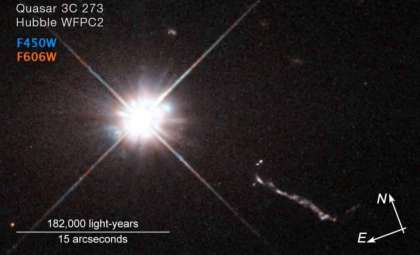
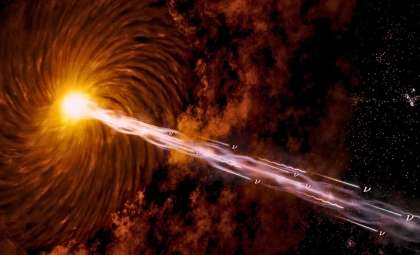
Quasars rank among the universe’s brightest phenomena, energized by supermassive black holes at the centers of remote galaxies. Despite their immense distances, their intense light helps astronomers investigate the makeup of galaxies along the line of sight, as their light journeys across vast cosmic structures to Earth.
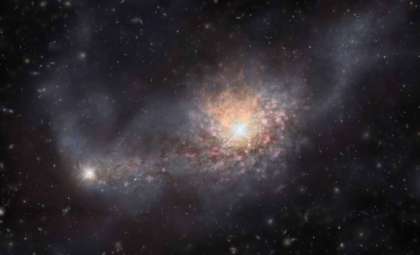
In addition to the quasar and elliptical galaxy, Hubble’s image captures a disturbed double spiral galaxy positioned above them, adding greater depth and detail to this cosmic tableau.
The Significance of Hubble’s 100,000th Capture
This landmark image highlights Hubble’s ongoing impact on astronomy, demonstrating its impressive ability to image faint and remote objects with clarity unmatched by many other observatories. Over decades of operation, Hubble has illuminated key topics such as:
- The development of the universe’s earliest galaxies and quasars
- The elemental makeup of faraway cosmic bodies
- The role of massive black holes in shaping their environments
As NASA anticipates the launch of the James Webb Space Telescope and other next-generation space observatories, Hubble remains a vital tool, continuously delivering groundbreaking discoveries that deepen humanity’s grasp of the cosmos.
- Categories:
- News





0 comments
Sign in to Comment