
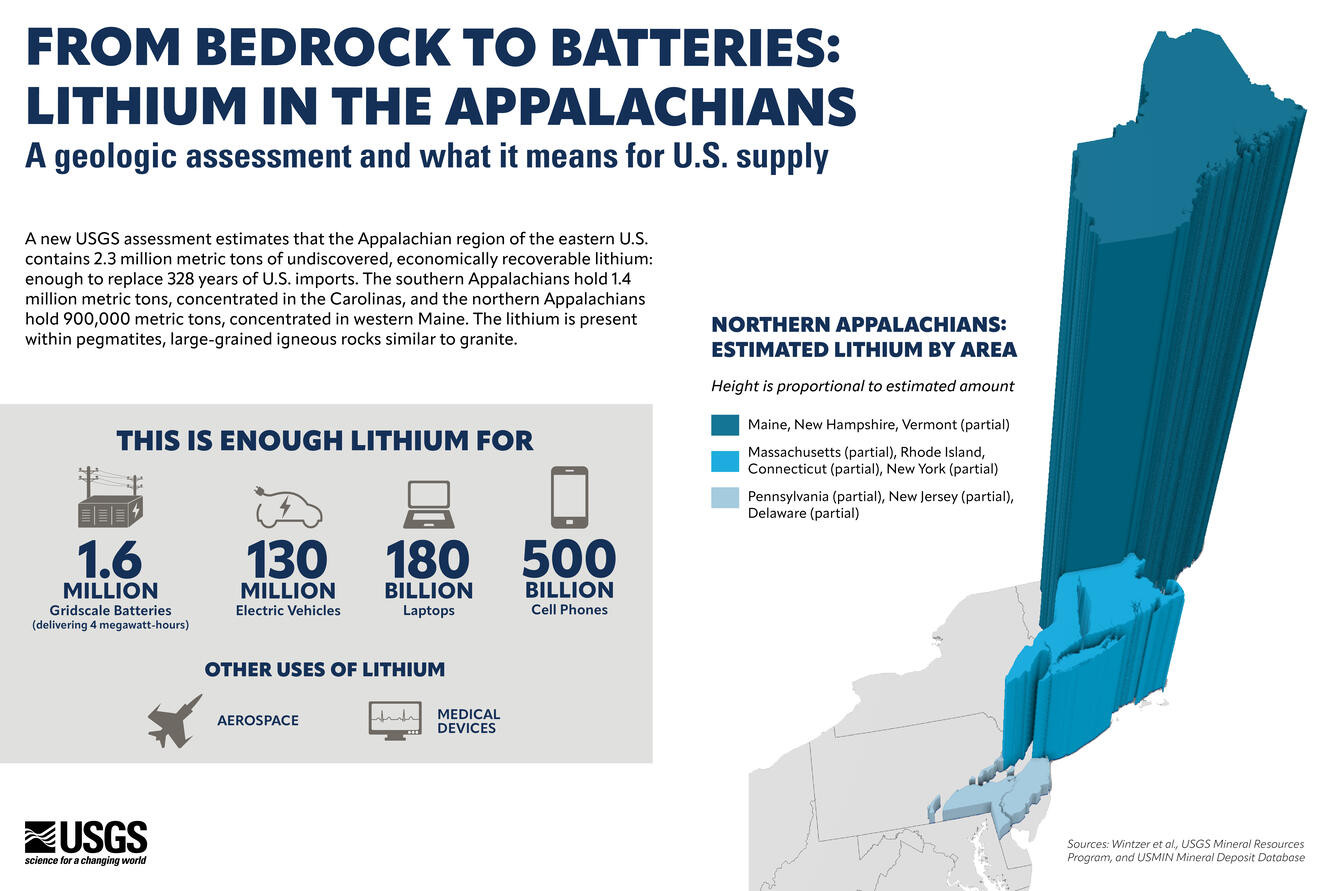
Once famed for its coal, the Appalachian Mountains have now gained attention for harboring one of the largest lithium deposits ever identified in the United States. According to research released in April 2026 by the U.S. Geological Survey in the journal Natural Resources Research, an estimated 2.3 million metric tons of lithium oxide could potentially be extracted economically here—enough supply to meet U.S. demand for over three centuries based on recent import levels.
To put this in perspective, the USGS notes that this lithium deposit could power batteries for 130 million electric cars, 500 billion smartphones, or 1.6 million large-scale energy storage systems designed to support power grids. Currently, the U.S. accounts for less than one percent of global lithium production, which makes this discovery particularly significant.
Designated as a critical mineral in 2025, lithium's global production is expected to double by 2029 due to soaring demand from consumer electronics, defense applications, and AI infrastructure. The Appalachian lithium discovery arrives just as the nation faces urgent questions about securing future lithium supplies.

Two Lithium-Rich Regions Shaped by Ancient Forces
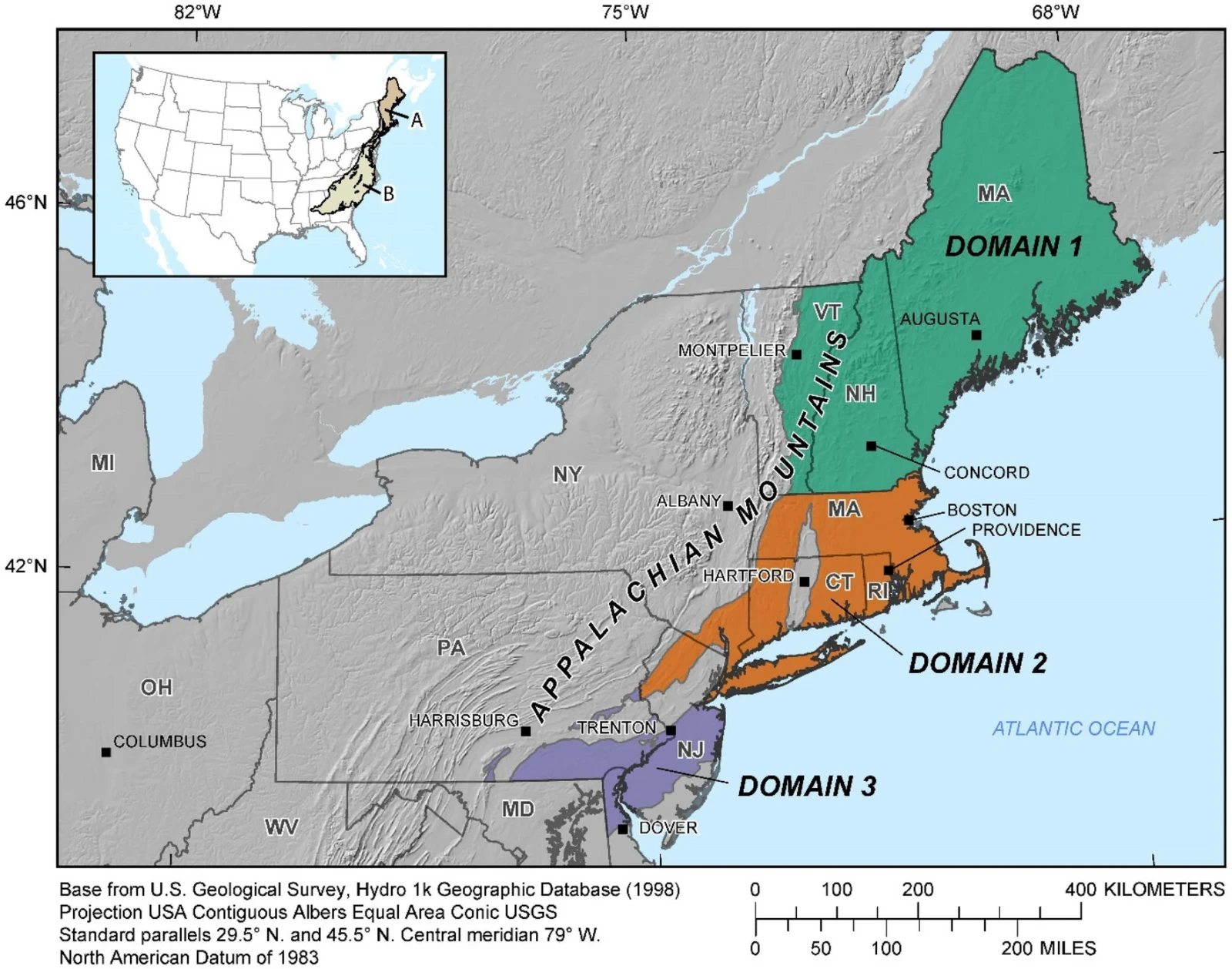
The total estimated lithium resource spans two separate areas. The southern Appalachian region, particularly in the Carolinas, holds approximately 1.43 million metric tons, while the northern zone, covering parts of western Maine and New Hampshire, accounts for around 900,000 metric tons.
Both are found within pegmatites—coarse-grained rocks resembling granite—formed when magma slowly cooled deep underground under intense pressure. Over 250 million years ago, the collision of continental plates that merged Africa, Europe, and North America into Pangea triggered the melting of crustal rocks beneath today’s Appalachians. Some of these magmas contained lithium, which subsequently crystallized into the pegmatite formations now identified.
These pegmatite deposits mirror similar geological structures in Ireland and Portugal, places that once shared ancient coastlines with the eastern U.S. along this prehistoric boundary.
The Kings Mountain region of North Carolina was historically the site of the United States’ first large-scale lithium mining operation. This new evaluation builds on that foundational knowledge by integrating geochemical analyses, geophysical data, tectonic models, and a comprehensive global lithium pegmatite database to estimate untapped resources.
Understanding the Ranges of Confidence
USGS scientists have been transparent about uncertainties. The headline 2.3 million metric tons estimate corresponds to a 50 percent confidence level, meaning it’s just as probable the true amount could be higher or lower. There is a 90 percent likelihood that the northern Appalachian region contains at least 90,000 metric tons of lithium, while a 10 percent chance exists that it could hold as much as 7.4 million metric tons.
“Our findings demonstrate that the Appalachian Mountains harbor ample lithium to satisfy America’s expanding demand, significantly enhancing the nation’s mineral security amid surging global needs,” USGS Director Ned Mamula stated.
Another USGS report from 2024 estimated between 5 and 19 million metric tons of lithium stored in brines beneath Arkansas’ Smackover Formation, though that study did not evaluate economic extraction viability.
Current U.S. Lithium Production Remains Limited
An estimate does not equate to immediate mining. Presently, the United States operates a single lithium mine, the Silver Peak facility in Nevada. Domestic lithium output in 2024 reached only 610 metric tons—roughly 0.3 percent of global production that year, according to the Energy Institute’s Statistical Review of World Energy.
Most lithium carbonate, the refined compound essential for battery manufacturing, is imported from Chile and Argentina. China dominates lithium processing and refinement, producing the majority of finished lithium-ion batteries globally. Over the past year, the U.S. imported nearly $85 million worth of lithium-ion batteries from China alone, a reliance that recent administrations have attempted to curb via trade policies.
While federal funding for domestic lithium projects is increasing gradually—the Department of Energy recently approved a $225 million grant for an Arkansas project targeting 22,500 metric tons of yearly battery-grade lithium—developing the Appalachian deposits will be challenging. Those reserves lie beneath heavily forested, rural land with no current mining infrastructure, and obtaining necessary permits could take several years.
- Categories:
- News








0 comments
Sign in to Comment