

Deep beneath the murky waters of the North Sea, researchers have identified evidence of an ancient Ice Age glacier that once dominated the region about one million years ago. Leveraging sophisticated acoustic imaging technology, the team mapped an array of landforms buried beneath nearly a kilometer of sediment. These structures offer new perspectives on the extent and movement of this immense ice sheet, illuminating pivotal moments in Earth's glacial history and climate evolution. Their findings, featured in Science Advances, provide essential clues about a notable shift in glacial cycles during the planet’s past.
Significance of a Singular Massive Ice Sheet
Previous theories suggested that the North Sea was influenced by several smaller ice sheets repeatedly advancing and retreating. Contrasting this, the new research uncovers seabed patterns pointing to one dominant, gigantic ice sheet that sculpted the landscape in a singular glaciation event. Christine Batchelor, a senior lecturer in physical geography at Newcastle University, commented, “Our evidence supports the presence of one significant ice advance during that period rather than multiple smaller events.”
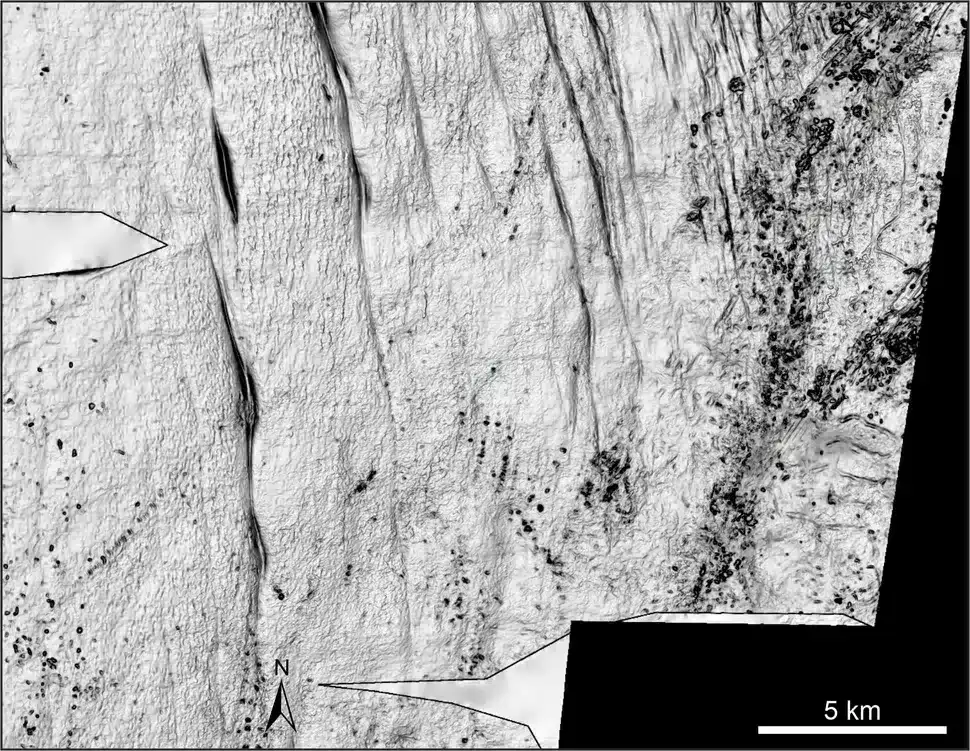
The imaging techniques revealed both streamlined, elongated landforms that trace the path of ice movement and transverse features indicative of ice retreat boundaries. Batchelor elaborated, “Advancing ice carves out streamlined shapes aligned with ice flow, while retreating ice leaves features perpendicular to that flow due to the staged withdrawal of grounded ice.” These unique formations grant researchers a detailed view of ancient glacier dynamics beneath the North Sea.

Insights Into a Major Climate Transition
This glacier thrived during the Mid-Pleistocene Transition (MPT), occurring roughly between 1.3 million and 700,000 years ago, when Earth’s glacial rhythm shifted from shorter 40,000-year periods to longer, more intense 100,000-year cycles. Determining the scale and behavior of the North Sea ice sheet during this time is key to unraveling the factors driving this climate shift.
Batchelor explained, “The period around one million years ago marks a transformative phase when glacial periods became both longer and more severe. Much research focuses on understanding why this change occurred.” The newly identified seabed features provide critical information to reconstruct the environmental conditions that sparked this climate evolution.
How Glacial Forces Sculpted the Seabed
The glacier’s advance and retreat sculpted the seabed beneath the North Sea, leaving distinctive landforms that narrate the ice sheet’s movement. One notable feature is the presence of crevasse-squeeze ridges, created when the ice sheet presses sediment into fissures as it sits atop soft ground prior to melting back. These ridges form a lasting imprint following the ice’s withdrawal.
“Determining precisely where ice sheets were positioned enables us to understand glacial feedback mechanisms, which, although altered, continue today,” Batchelor noted. These sediment structures improve models of glacier behavior and their climatic interactions, shedding light on both ancient glaciers and those currently found in Greenland and Antarctica.
Lessons for Modern Climate Change
Beyond shedding light on historic ice ages, these discoveries also bear relevance for forecasting future climate dynamics. The response of glaciers during the Mid-Pleistocene Transition to environmental shifts can inform predictions about how present-day ice sheets might react to ongoing global warming. Batchelor emphasized that examining these ancient patterns helps clarify feedback processes still occurring under today’s climate conditions, despite differences in scale and context.
As polar ice masses in Greenland and Antarctica melt more rapidly due to rising temperatures, insights garnered from the North Sea’s concealed glacial landscape could be crucial for projecting associated sea-level rise and other climate impacts.
An Uncovered Archive of Earth’s Past
The detailed landforms beneath the North Sea have lain untouched for over a million years, preserved beneath thick sediment layers. Their revelation offers a rare portal into Earth’s glaciation history, tracing the reach of a grand ice sheet and its role during a period of significant climate transformation.
Through state-of-the-art soundwave imaging, scientists have unveiled these buried features, detailing the dynamic processes of massive ice sheets as they advanced, carved, and retreated across the seabed. Each ridge and groove in the data contributes vital knowledge about the glacier’s behavior and environmental responses.
Besides their scientific value, these findings underscore the importance of investigating and preserving such hidden landscapes, which represent enduring records of Earth’s geological past. As research progresses, scientists hope to better understand these formations’ origins and apply this knowledge to contemporary challenges like rising sea levels and accelerated polar ice melt.
- Categories:
- News










0 comments
Sign in to Comment