
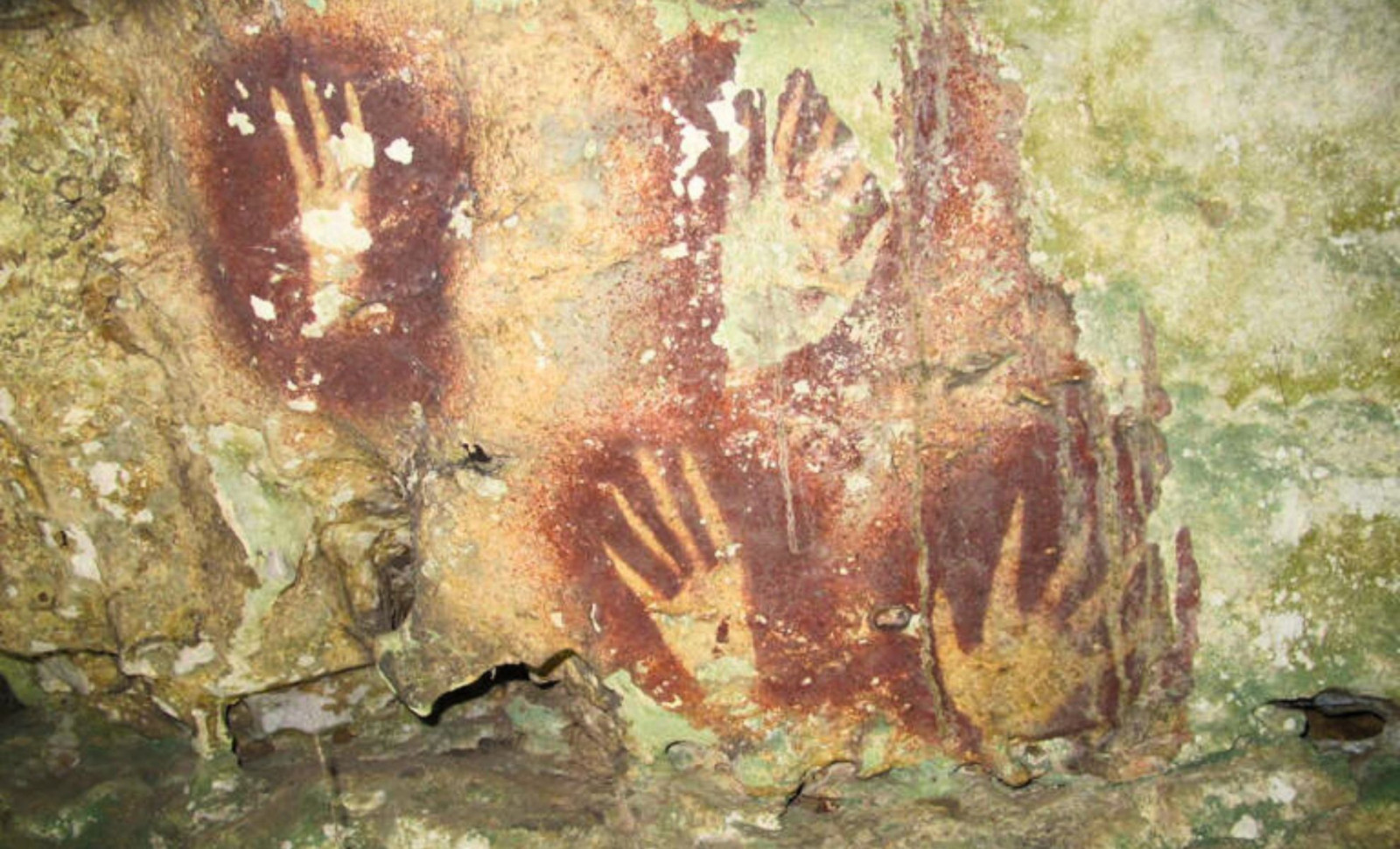
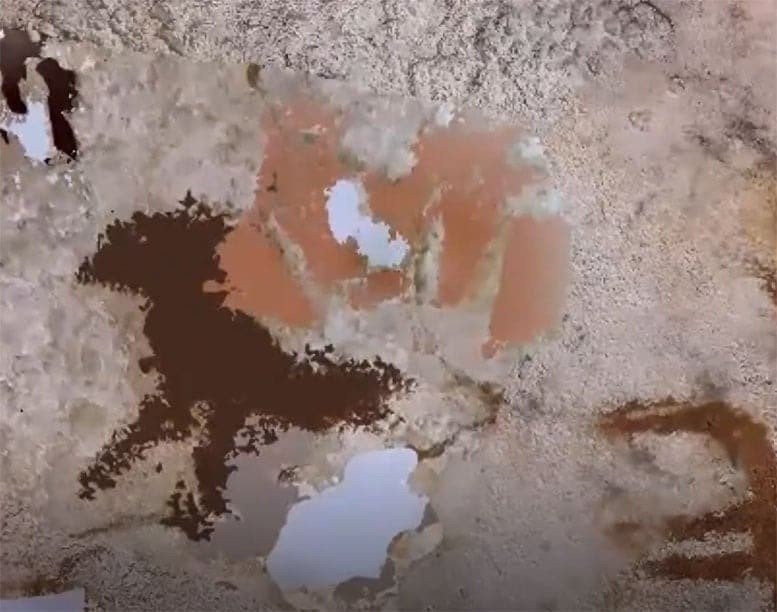
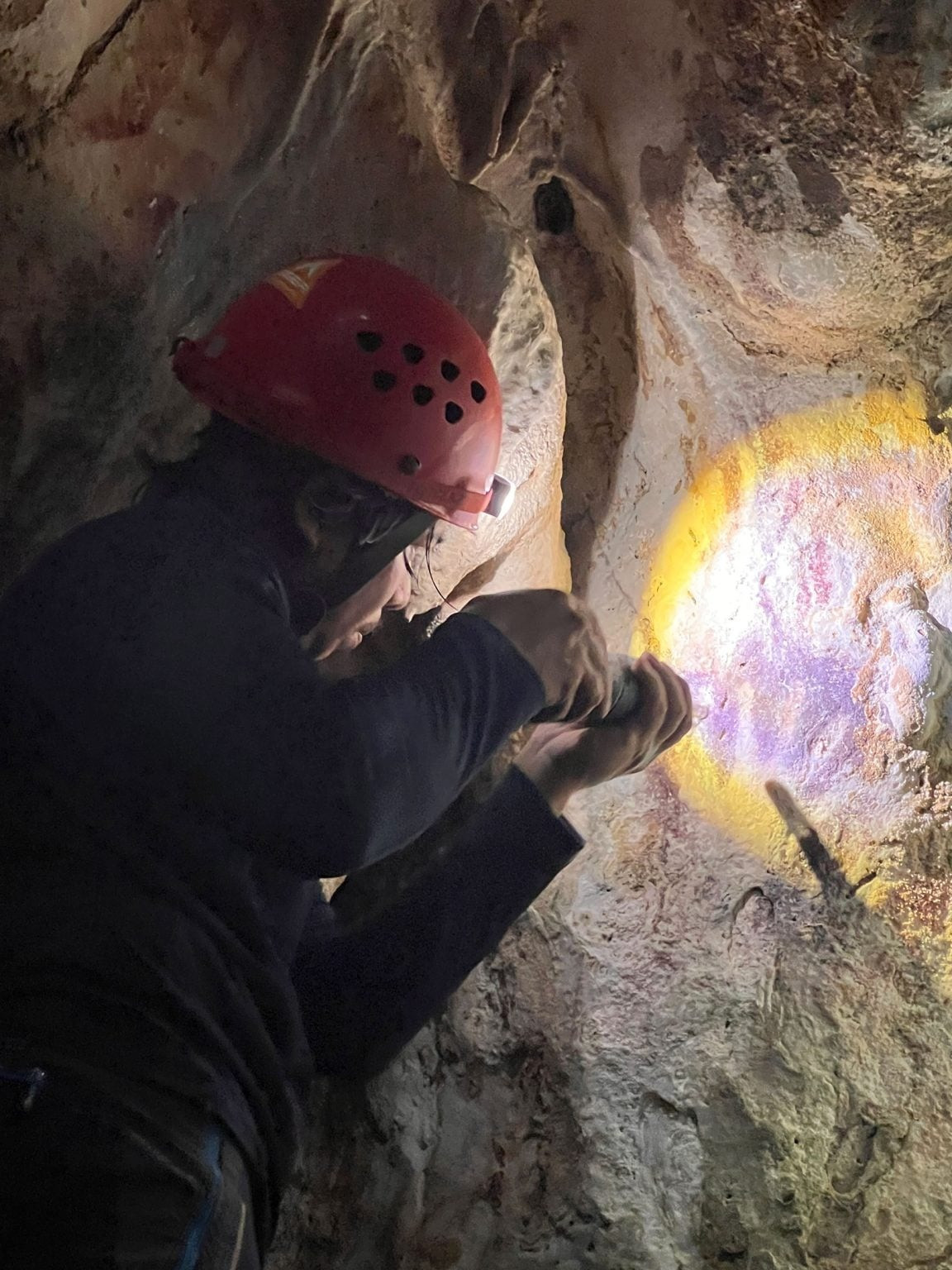
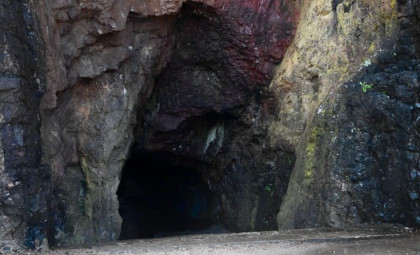
Hidden within the limestone caves of Sulawesi, a remarkable discovery has emerged. On Muna Island, a faint reddish mark on a cave wall was recently identified as a human handprint, created tens of thousands of years ago by pressing a hand covered in pigment onto the stone surface.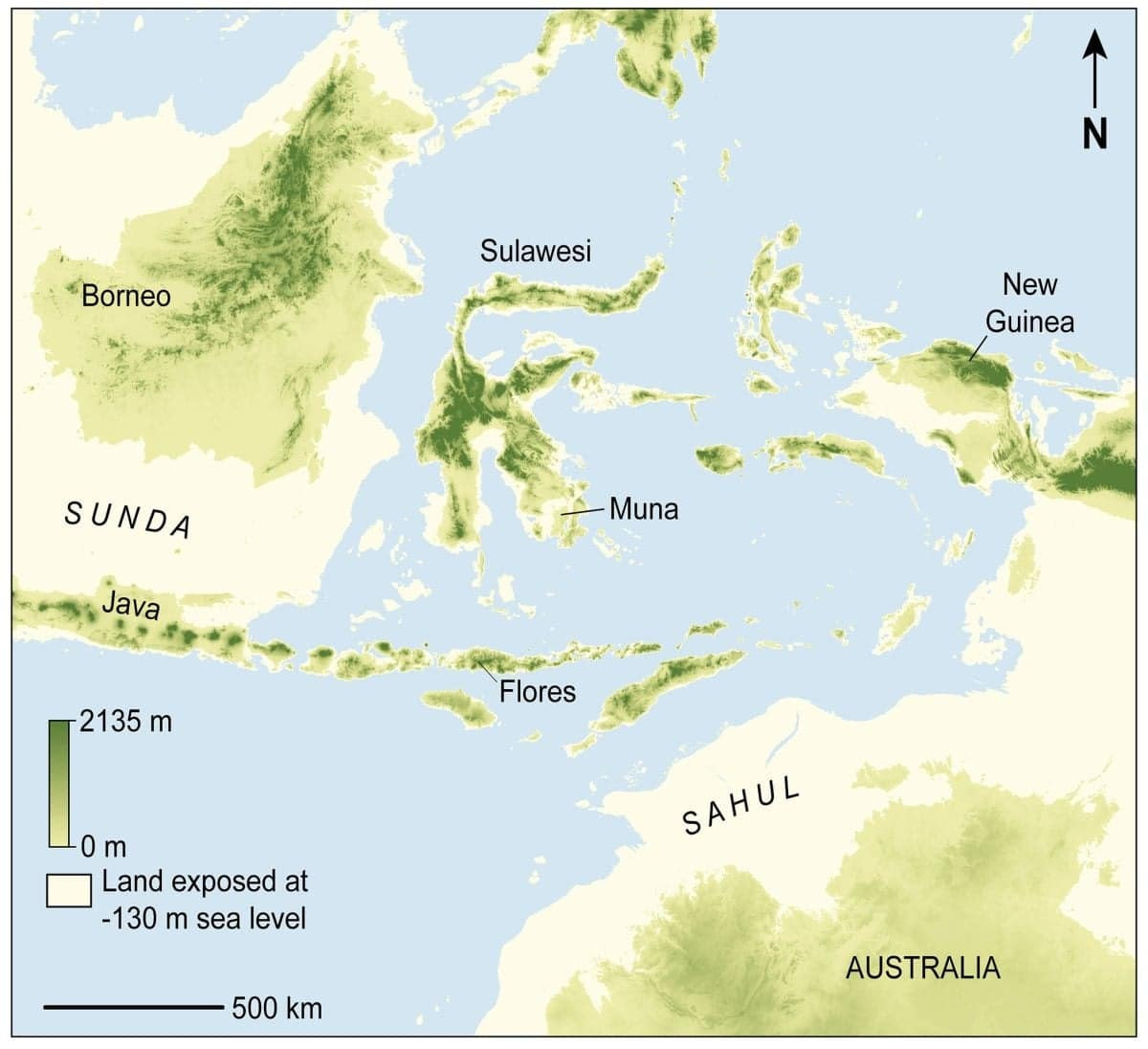
The stained area spans just 14 by 10 centimeters, revealing parts of fingers and palm segments. One finger tip appears intentionally modified to look more claw-like, either by hand movement during painting or added pigment, a distinctive form not seen in ancient cave art elsewhere.
Although Europe was long thought to possess the oldest rock art, new findings have decisively shifted this distinction to Southeast Asia.

Uranium Series Dating Establishes a Minimum Age of 67,800 Years
A collaborative international effort involving Griffith University, Indonesia’s BRIN, and Southern Cross University used uranium series dating on mineral deposits that formed on top of the pigment. Published in the peer-reviewed journal Nature, the study analyzed the radioactive decay within calcite layers overlaying the artwork.
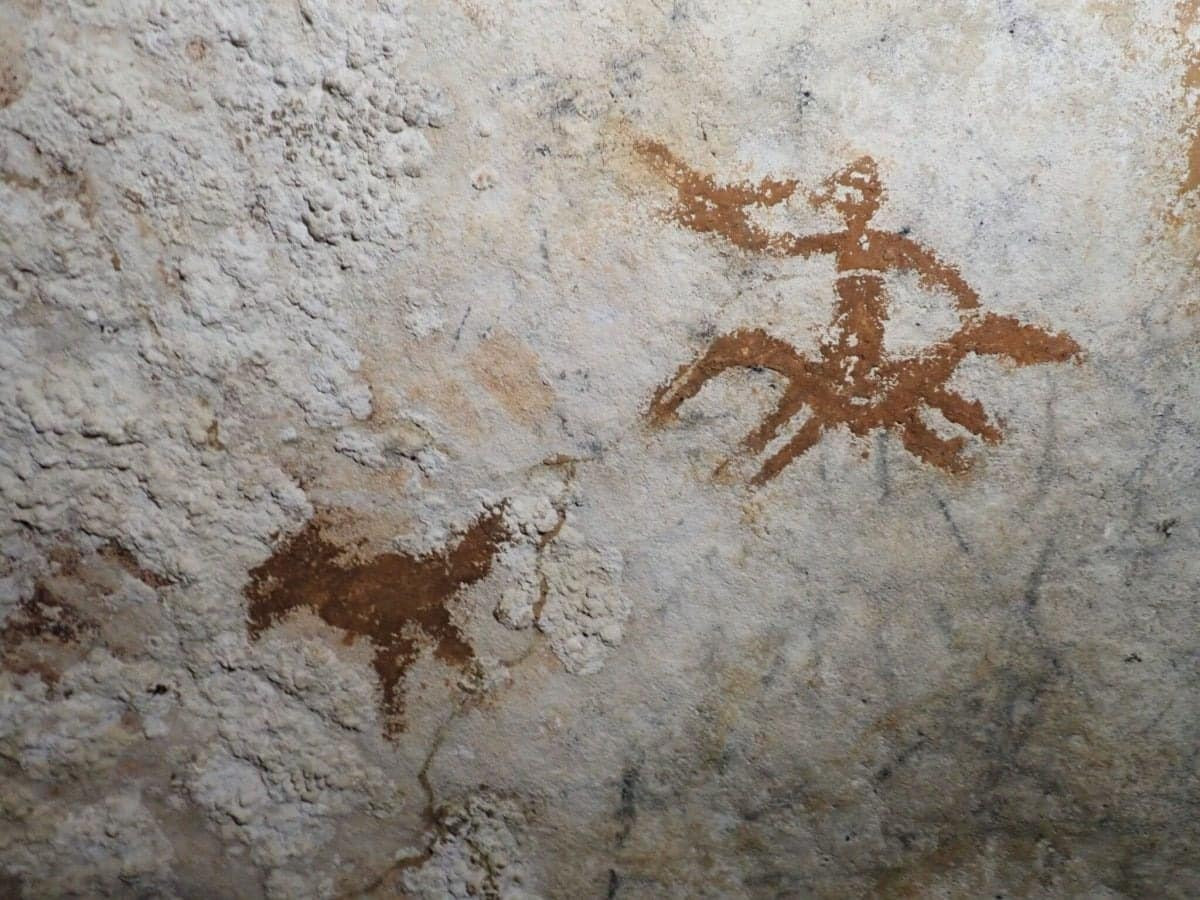
Findings date the calcite layer to about 71,600 years ago, with a margin of ±3,800 years, placing the hand stencil beneath at a minimum age of 67,800 years. This pushes the record older by more than 16,000 years compared to previous Sulawesi art and beats the contested 66,700-year-old Neanderthal hand stencils found in Spain.
Professor Maxime Aubert from Griffith’s Centre for Social and Cultural Research highlighted the implications, stating that Sulawesi’s artistic traditions are far older and richer than previously known, dating back to the earliest human inhabitants at least 67,800 years ago.
This particular rock panel shows traces of recurrent visits. Another handprint 11 centimeters away dates to at least 60,900 years, while a separate layer above it originates around 21,500 years ago. This gap of over 35,000 years suggests multiple generations repeatedly returned to create cave art at the same site.
Insights into Ancient Symbolism From the Cave Paintings
The claw-like finger design distinguishes this stencil from thousands globally. Professor Adam Brumm of Griffith’s Australian Research Centre for Human Evolution proposes it might reflect symbolic ideas about the bond between humans and animals.
“These images could represent beliefs about human-animal connections,” Brumm explains. “Similar depictions in early Sulawesi paintings mix human and animal traits, indicating an intertwined worldview.”
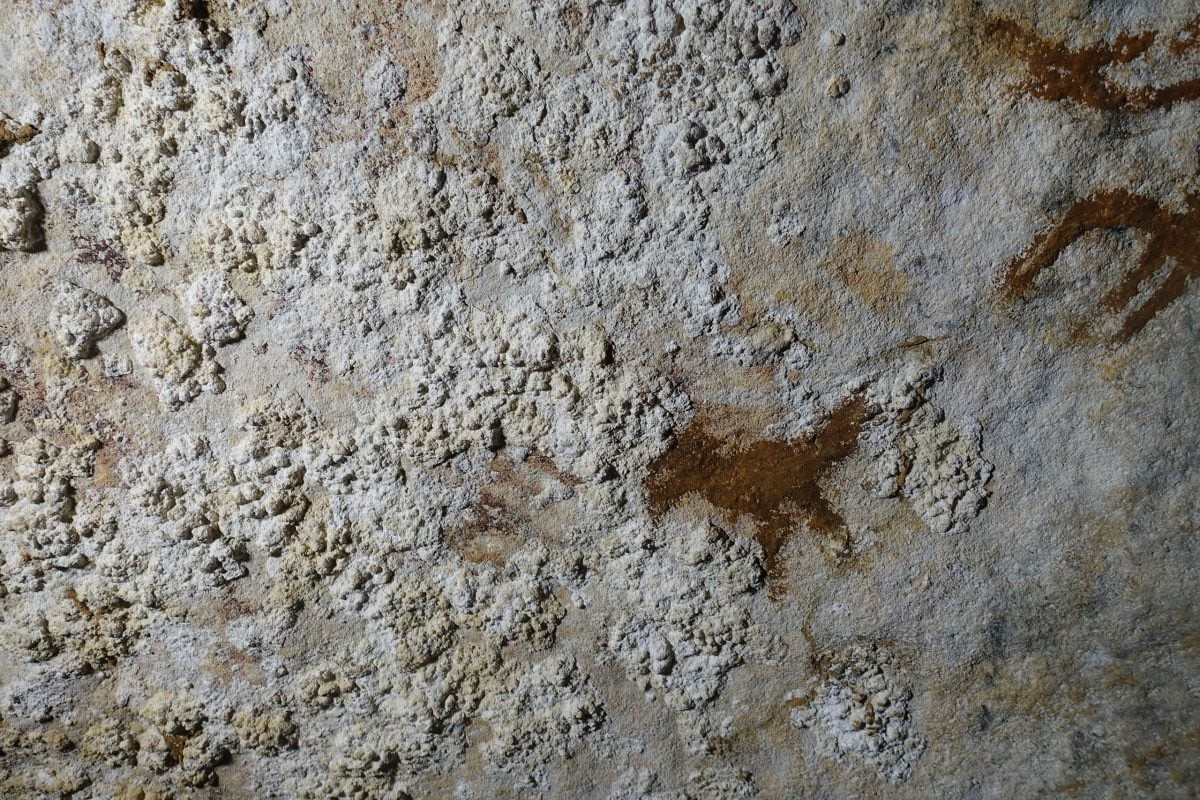
The research surveyed 44 sites across Southeast Sulawesi, including 14 newly identified caves. Eleven distinct motifs from eight caves were dated, most from the Late Pleistocene. For example, Gua Mbokita produced hand stencils at least 44,700 and 25,900 years old, while Gua Anawai features stencils from roughly 20,100 to 20,400 years ago, during the peak of the last ice age.
Implications for Understanding Human Migration to Australia
The cave’s location is crucial for studies of human migration into Australia. During the Pleistocene epoch, a landmass called Sahul connected Australia, Tasmania, and New Guinea due to lower sea levels. Accessing Sahul required multiple sea crossings through the Wallacea islands between Asia and Sahul.
Two migration routes are debated: a northern path through Sulawesi and Maluku to western New Guinea, and a southern path through Timor and the Lesser Sundas to northwestern Australia. Archaeological evidence has been sparse along both lines—until now.
Dr. Adhi Agus Oktaviana, a rock art expert affiliated with BRIN and Griffith University, notes this Sulawesi artwork as the oldest direct evidence of modern humans using the northern route. In an article from SciTechDaily, Oktaviana linked these findings to Australia’s ancient heritage.
“It’s probable that the artists on Sulawesi belonged to the wider population that eventually migrated through the region to Australia,” Oktaviana said. “This evidence strengthens the case that the ancestors of Indigenous Australians were present in Sahul by 65,000 years ago.”
The dates align with findings from Madjedbebe in northern Australia, where artifacts suggest human settlement between 68,700 and 59,300 years ago. Professor Renaud Joannes Boyau of Southern Cross University, who led the dating, describes this discovery as filling a key gap in our knowledge about initial human arrival in Australia. “By dating this ancient Sulawesi art, we now have the oldest direct proof of modern humans moving along the northern Sahul migration route,” Joannes Boyau explained.
Reference: “Rock art from at least 67,800 years ago in Sulawesi” by Adhi Agus Oktaviana, Renaud Joannes-Boyau, Budianto Hakim, Basran Burhan, Ratno Sardi, Shinatria Adhityatama, Andrea Jalandoni, Hamrullah, Iwan Sumantri, M. Tang, Rustan Lebe, Iswadi, Imran Ilyas, Abdullah Abbas, Andi Jusdi, Dewangga Eka Mahardian, Fadhlan S. Intan, Sofwan Noerwidi, Marlon N. R. Ririmasse, Irfan Mahmud, Akin Duli, Laode M. Aksa, M. Nur, Nasrullah Aziz, Sri Wigati, Iksam, Faiz, M. Sabri, Fardi Ali Syahdar, Eriani, N. A. Hidayatullah, Suryatman, Laode Darma, Nurmin, Laode Zulman, S. H. Sindara, Andi Muhammad Saiful, Pindi Setiawan, Adam Brumm and Maxime Aubert, 21 January 2026, Nature. DOI: 10.1038/s41586-025-09968-y
- Categories:
- News







0 comments
Sign in to Comment