

Excavations in Indonesia have uncovered fossils that deepen our understanding of Homo floresiensis, the small-bodied human species nicknamed 'hobbits' due to their compact size.
Published in Nature Communications, the research reveals that the predecessors of these diminutive hominins were even smaller than earlier estimates suggested, offering valuable perspectives on evolutionary developments.
Discovery of Early Hobbit Relics
Two decades ago, scientists found ancient remains on Flores Island, Indonesia, belonging to a hominin species averaging roughly 3 and a half feet in height. These fossils, dated between 60,000 and 100,000 years ago, earned the informal moniker “hobbits” in reference to their stature.

The current analysis, led by Yousuke Kaifu at the University of Tokyo and Adam Brumm of Griffith University’s Australian Research Centre for Human Evolution, examines fossils retrieved from Mata Menge—a site located about 45 miles from the original find.
In 2016, a jawbone and teeth from Mata Menge indicated that earlier ancestors of Homo floresiensis were smaller than their later descendants.
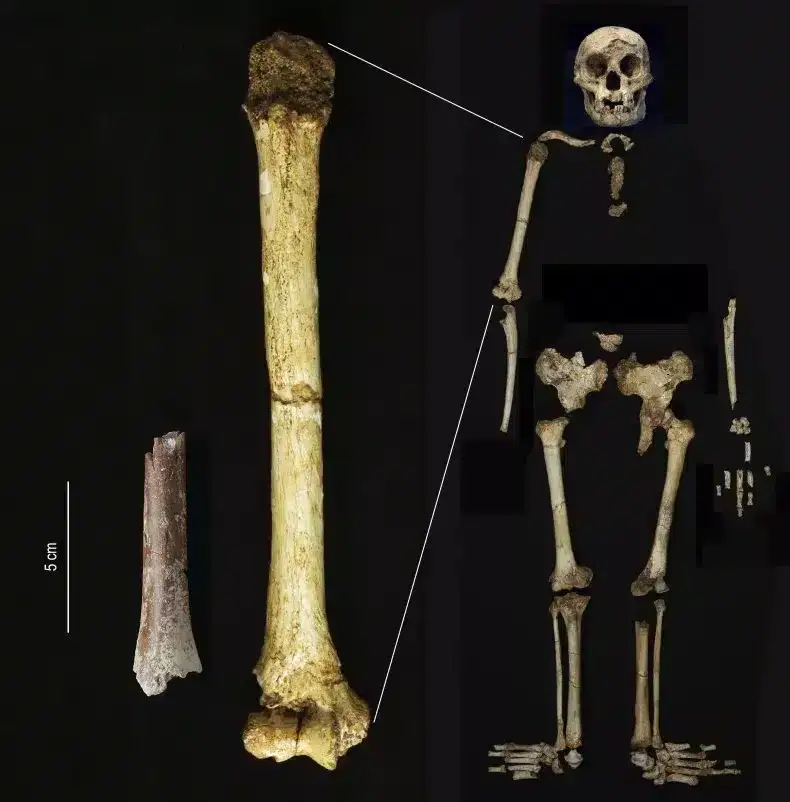
Subsequent examination of an upper arm bone fragment and additional dental remains confirmed these forebears lived around 700,000 years ago and were approximately 2.4 inches shorter than their ‘hobbit’ successors. This evidence reshapes previous perspectives on their biological evolution.
Revisiting Human Evolutionary History
Among the Mata Menge fossils is a remarkably small adult upper arm bone—the tiniest of its kind ever documented in the hominin record globally. "This exceptional specimen validates our theory that the forebears of Homo floresiensis had exceptionally small body sizes," stated Brumm.
These discoveries support the notion that the Flores hominins underwent significant body size reduction during their evolutionary timeline.
Debate continues surrounding how these hobbits attained their diminutive dimensions and their precise placement within the human lineage. One hypothesis suggests that Homo floresiensis descended from the larger Homo erectus populations that once inhabited the region. Alternatively, some propose ancestry from an even earlier hominin species predating Homo erectus. Ongoing research and further fossil discoveries are essential to resolve these questions.
Contemporary Theories and Ongoing Discussions
The unearthing of these tiny fossils has renewed scientific interest in unraveling the origins and evolutionary trajectory of Homo floresiensis. Researchers offer varied, often contrasting explanations for their small stature. A commonly accepted view is that the hobbits represent a dwarfed offshoot of Homo erectus, a species widespread across Asia around one million years ago.
This perspective holds that island dwarfism—a process where species evolve smaller sizes due to restricted resources and isolation—explains their reduced build on Flores Island.
By contrast, another school of thought argues Homo floresiensis evolved from a more ancient hominin branch that migrated out of Africa well before Homo erectus. This lineage might have retained smaller body size as an adaptive trait during their dispersal. The scientific community remains divided, pending additional evidence to clarify these evolutionary pathways.
Directions for Upcoming Research
The fresh insights have set the stage for further exploration. Excavations at Mata Menge and neighboring sites on Flores and adjacent islands are poised to uncover more fossil material that will illuminate the evolutionary story of Homo floresiensis. Cutting-edge techniques such as high-definition imaging and DNA analysis will facilitate deeper study of these ancient remains.
Scientists are also prioritizing the ecological and environmental reconstruction of ancient Flores. By examining the island’s prehistoric plant and animal life, researchers aim to understand the habitat and climatic conditions that shaped these hominins’ adaptation and survival strategies. This broad investigative approach promises a richer comprehension of their evolutionary context.
Scientific Impact of the Research
The importance of this study reaches beyond just the case of Homo floresiensis. It underscores the intricate nature of human evolution and the varied routes that different hominin species undertook to adjust to their environments. The emergence of such extremely small-bodied hominins on Flores challenges assumptions that larger body dimensions were inherently advantageous in early human development.
"This extraordinarily rare limb bone supports our hypothesis that the ancestors of Homo floresiensis were incredibly small; indeed, this specimen’s minute size reveals that these early predecessors of the ‘Hobbit’ were even tinier than formerly considered," remarked Brumm. These findings stress the value of examining diverse fossil samples to grasp the full diversity of human evolutionary history.
Expanding Perspectives on Human Evolution
Research into Homo floresiensis and their diminutive ancestors offers new insight into the broader narrative of human evolution. It points to a complex process marked not by a steady increase in size and sophistication, but by multiple adaptations shaped by varying environmental challenges. This refined viewpoint helps scientists interpret evolutionary developments among other fossil hominins.
By studying the evolutionary background of Homo floresiensis, experts uncover vital clues about the mechanisms driving human evolution and adaptation. Such understanding is crucial for piecing together how modern humans emerged and survived across diverse ecosystems, highlighting the lasting importance of fossil research.












0 comments
Sign in to Comment