

Scientists in Japan are exploring a novel way to supply oxygen by delivering it directly into the human intestine. This groundbreaking approach, currently being studied in animals and progressing to early human safety evaluations, is designed as an emergency alternative when lung function deteriorates or ventilators are unavailable.
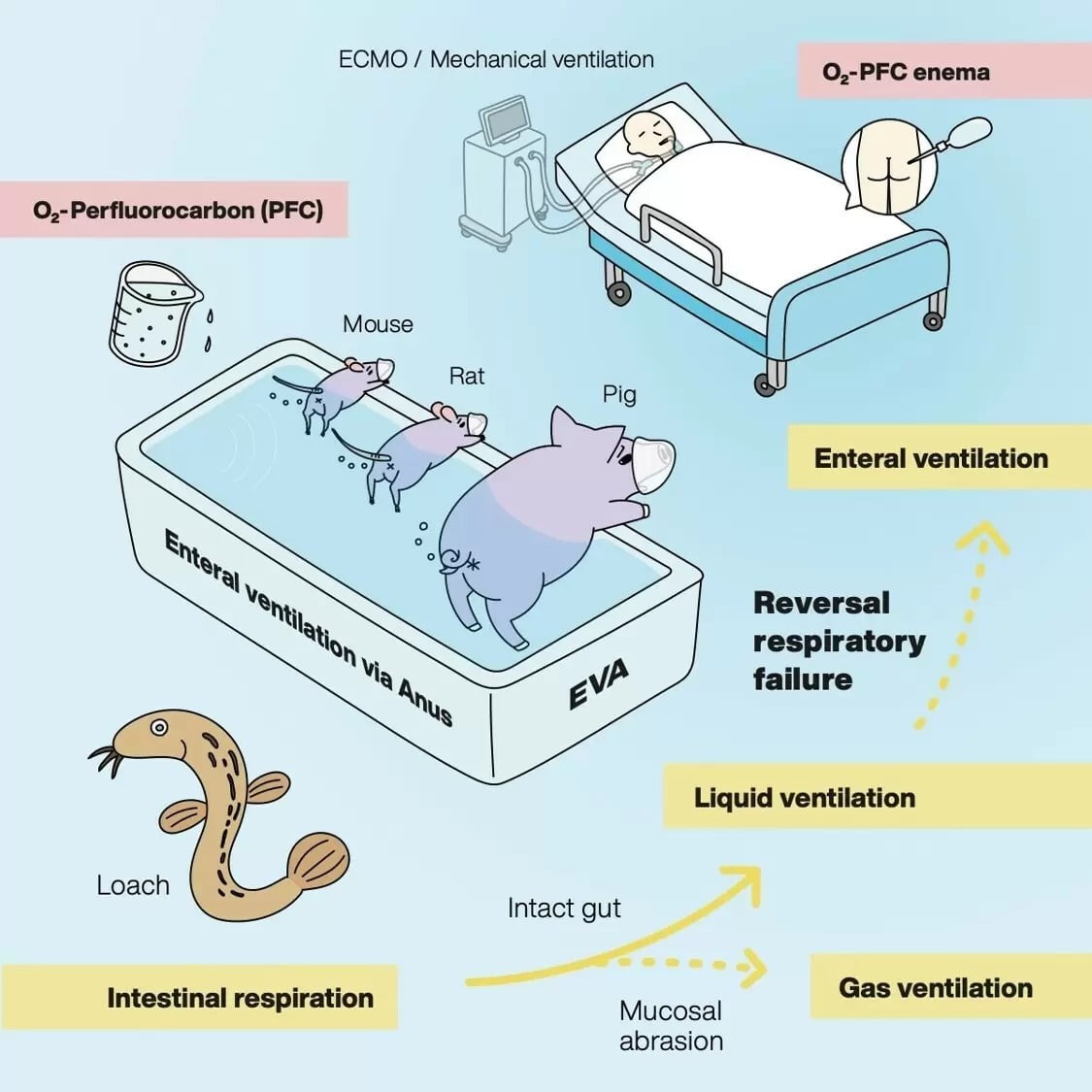
This technique involves administering an oxygen-rich liquid via the rectum, drawing inspiration from certain species of fish and amphibians that absorb oxygen through their digestive tracts in oxygen-poor conditions. Far from a mere biological curiosity, this method has the potential to transform emergency respiratory care, especially in pre-hospital environments, during patient transport, or where medical resources are scarce.
Leading this effort is Dr. Takanori Takebe, a physician-scientist affiliated with Cincinnati Children’s Hospital and the University of Osaka. His interest in the concept was sparked after witnessing his father’s pneumonia-related ventilator treatment, which he described as highly invasive when speaking to Science News. This experience motivated his pursuit of a less invasive oxygen delivery technique that could temporarily support or replace breathing.

Mechanism Behind Rectal Oxygenation in Mammals
The key component in this experimental procedure is perfluorodecalin, a medical imaging liquid known for its remarkable oxygen-carrying capacity. Delivered through a device similar to an enema, it deposits oxygenated fluid into the lower intestine where oxygen absorption occurs via the intestinal walls directly into the circulatory system.
Research published in Med (Cell Press) demonstrated that oxygen-infused perfluorodecalin helped mice and pigs endure oxygen deprivation. Notably, pigs receiving a 400-milliliter dose showed elevated blood oxygen levels lasting approximately 19 minutes. Subsequent studies reported in Med in December 2023 optimized dosing to sustain oxygen delivery for up to 30 minutes.
“Seeing the blood transition from dull brown to bright red was my breakthrough moment,” Takebe shared in the Science News feature, highlighting the visual proof of successful oxygen uptake into the bloodstream.
Although this approach cannot rival the efficiency of pulmonary respiration, it holds promise as a temporary, non-invasive oxygen delivery system when mechanical ventilation is delayed, risky, or inaccessible.
Initial Human Studies Highlight Safety and Tolerability
To bridge the gap from animals to people, Takebe’s team conducted trials evaluating the tolerance of perfluorodecalin enemas in 27 healthy men in Japan. These trials used non-oxygenated fluid solely to assess safety rather than therapeutic efficacy.
The volume administered ranged from 25 milliliters up to 1.5 liters, matching the maximum allowed for contrast use in gastrointestinal imaging. Results showed most subjects withstood up to 1 liter with only minor discomforts such as bloating and abdominal unease. However, four participants in the 1.5-liter group experienced stomach pain that led them to stop the study early.

This investigation is backed by EVA Therapeutics, a company co-founded by Takebe that focuses on developing oxygen-enriched rectal oxygen delivery devices. While the current data does not yet confirm clinical effectiveness, these safety trials are an essential foundation for further research into intestinal oxygen therapy’s potential in emergency healthcare.
Medical Experts Offer Mixed Reviews
The response from respiratory medicine specialists is varied. Some praise the innovation, while others raise concerns about the method’s limited efficiency compared with lung ventilation.
As noted in Science News, Dr. John Laffey, a critical care expert at the University of Galway, remains skeptical. “Lungs, even when impaired, outperform all other organs in gas exchange since that’s their primary role,” he said. Laffey emphasized the volume challenge: “One liter of perfluorodecalin carries around 500 milliliters of oxygen, whereas patients require roughly 250 milliliters per minute.”
In practical terms, this means maintaining oxygenation would necessitate repeated enemas, a procedure that’s difficult to implement widely in emergency scenarios.
Nevertheless, not all specialists are doubtful. Dr. Kevin Gibbs, a lung care physician from Wake Forest University School of Medicine, sees potential in brief, targeted applications. “If this treatment proves effective, it could offer critical oxygen support during the crucial minutes needed to secure life support,” he commented to Science News.
New Horizons in Emergency Oxygen Treatment Amid Global Crises
Though unlikely to supplant traditional ventilators, rectal oxygen delivery could serve as a vital temporary solution in emergencies—such as natural disasters, mass casualty situations, or military medicine.
This approach resonates with growing interest in non-invasive hypoxia treatments, especially reflecting lessons from ventilator shortages during the COVID-19 crisis. Even brief extensions of survival time can profoundly impact patient outcomes.
Takebe envisions this as a complementary tool rather than a substitute for conventional respiratory care. “We hope to deploy this in emergency contexts like patient transfers or ambulance care,” he shared with Science News.
- Categories:
- Science













0 comments
Sign in to Comment