
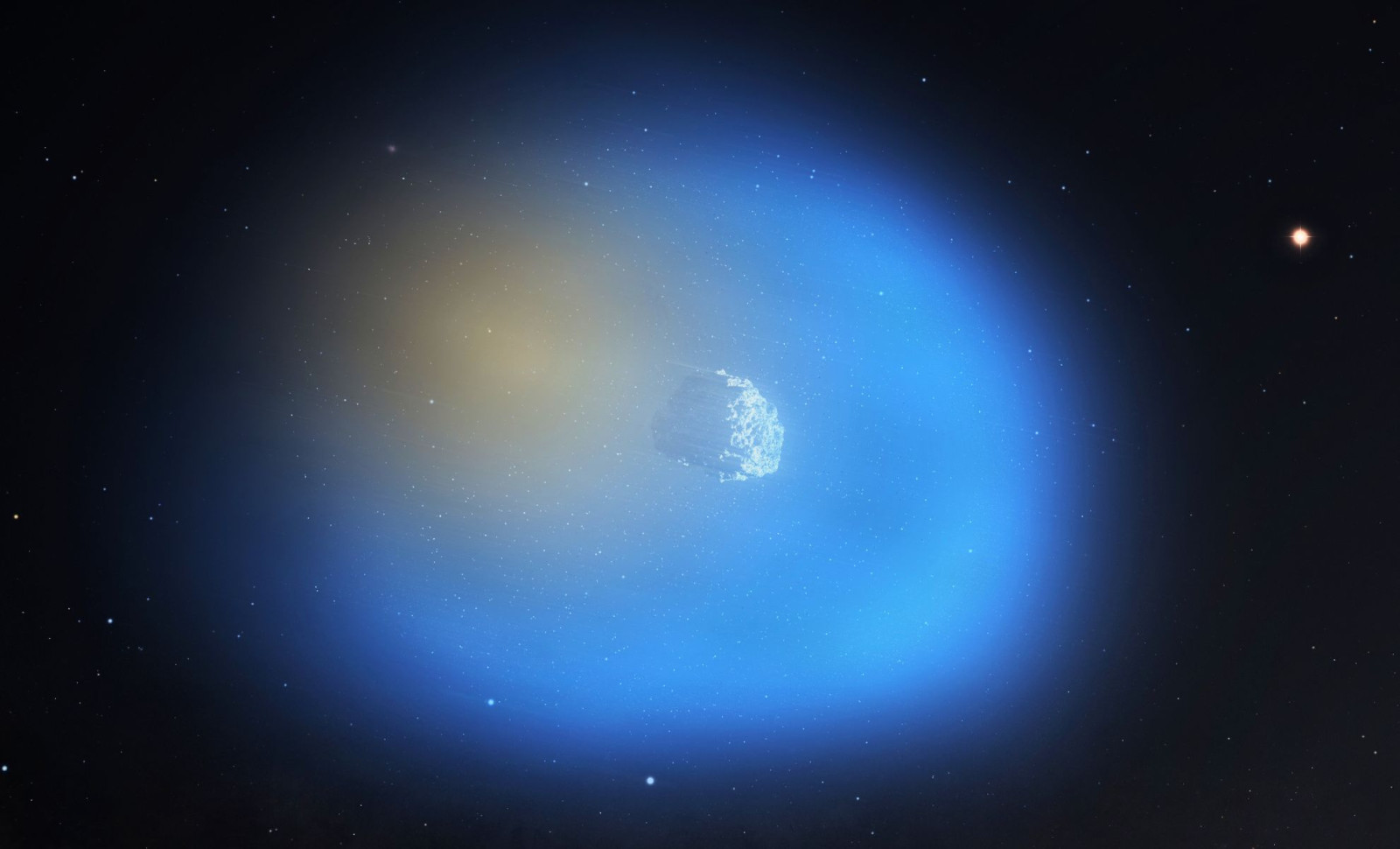
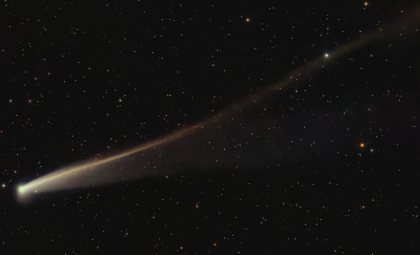
Throughout history, only a handful of celestial bodies originating outside our solar system have been detected passing through. The first, known as 1I/’Oumuamua, stunned astronomers in 2017 with its unorthodox shape and mysterious behavior. The second, 2I/Borisov, resembled typical comets native to our cosmic neighborhood in chemical makeup. However, the third visitor, 3I/ATLAS, is proving to be distinctly exceptional.
New insights gleaned from the Atacama Large Millimeter/submillimeter Array (ALMA) have uncovered that 3I/ATLAS contains an extraordinary abundance of methanol compared to other molecules. The detected ratios place this comet among the most methanol-heavy objects ever examined, surpassing even comets originating from our own Sun. This suggests the star system that created 3I/ATLAS had unique conditions that imparted a different chemical profile to its ices.
“Examining 3I/ATLAS is akin to collecting a chemical fingerprint from a distant solar system,” explained Nathan Roth, the study’s lead author and professor at American University, in the published work in The Astrophysical Journal Letters. “Its composition is flooded with methanol in a manner uncommon among the comets in our own neighborhood.”

ALMA Observed the Comet as Solar Radiation Triggered Sublimation
Roth’s team leveraged ALMA’s Atacama Compact Array—a set of smaller antennas within the main Chilean observatory—to track 3I/ATLAS over several sessions in late 2025. As the comet edged closer to the Sun, rising temperatures caused its surface ices to vaporize, forming a luminous shroud called a coma around its core.
The researchers focused their measurements on this coma. By analyzing the weak submillimeter radiation it released, they identified signatures of two organic compounds: methanol (CH₃OH) and hydrogen cyanide (HCN), a nitrogen-containing molecule typical in comets within our solar system.
The findings from two observation periods were remarkable. Methanol-to-HCN production rate ratios hovered around 70 and 120—far exceeding the values recorded in comets formed in our solar system. This pronounced methanol enrichment categorizes 3I/ATLAS as chemically distinct from any comet studied locally.
Methanol and Hydrogen Cyanide Escape the Comet Differently
ALMA’s data also uncovered differing emission pathways for the two molecules. HCN mainly originated directly from the solid comet nucleus, consistent with patterns seen in solar system comets.
In contrast, methanol was released both from the nucleus and from icy dust grains suspended in the coma. These dust particles act as secondary sources; when warmed by sunlight, the methanol ice on their surfaces sublimates, directly increasing the comet’s surrounding gas envelope.
This mechanism, known as extended outgassing, has been observed previously in some solar system comets. However, ALMA’s report marks the first time such spatially resolved outgassing has been documented on an interstellar object, confirming the exact origin of the methanol detected.
Previous Observations Hinted at Unusual Chemistry
3I/ATLAS’s extraordinary methanol levels add to its growing list of peculiar traits. Data from the James Webb Space Telescope revealed that, while still far from the Sun, the comet’s coma was dominated by carbon dioxide instead of water vapor—a stark contrast to solar system comets caught at similar distances.
Adding methanol to that unusual mix paints a chemical portrait unlike typical comets. Results from two distinct instruments examining the same comet under different conditions both highlight compositions outside the norms found locally.
Methanol forms on the cold surfaces of interstellar dust grains via hydrogenation of carbon monoxide at frigid temperatures. How effectively this reaction proceeds depends on factors such as temperature, radiation exposure, and elemental abundance in the environment where those dust grains originally condensed. An elevated methanol concentration compared to molecules like HCN may indicate this comet’s material spent considerable time in a particularly cold or chemically unique region of its protoplanetary disk, though pinpointing a precise origin remains elusive.
What the Third Known Interstellar Comet Reveals
Given there are only three verified interstellar bodies observed to date, each brings substantial scientific significance. ’Oumuamua offered no detectable coma and exhibited acceleration unexplained by water ice sublimation alone. Borisov’s composition resembled solar system comets, suggesting universal planet-forming chemistry.
3I/ATLAS adds complexity to the picture by exhibiting a chemical makeup far removed from anything observed in our local cosmic environment, demonstrating that interstellar comets can harbor compositions influenced by truly distinct formation circumstances.
- Categories:
- Science




0 comments
Sign in to Comment