

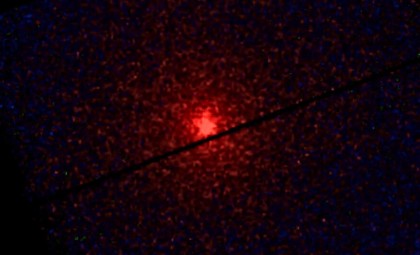
The NASA SPHEREx mission has detected a remarkable increase in sublimation activity on the interstellar comet 3I/Atlas following its close approach to the Sun, as detailed in a new study released on arXiv. The research reveals significant alterations in the comet’s composition and emissions after perihelion, indicating newly exposed volatile substances beneath its outer layers.
SPHEREx Observations Post-Perihelion
The SPHEREx telescope, which conducts a comprehensive near-infrared survey of the sky, observed fresh emissions from 3I/Atlas that highlight a dramatic shift in the comet’s volatile makeup. According to the arXiv publication, emissions of carbon dioxide, carbon monoxide, and water vapor surged to unprecedented levels as the comet traveled inside the solar system’s ice line—the zone where solar radiation heats and causes icy substances to vaporize.
“The CO₂ emitted flux is only about 33% larger than in August, which verifies that this species was fully active in August pre-perihelion. The CO emitted flux has increased ~20x, meaning that the CO/CO₂ abundance ratio has also increased ~15-fold. Along with the greatly enhanced H₂O flux and new C-H species emission, this implies that a new ice reservoir is now active along with the one supporting the CO₂-coma,” the study authors explain.
Add Cosmo Herald as a Preferred Source

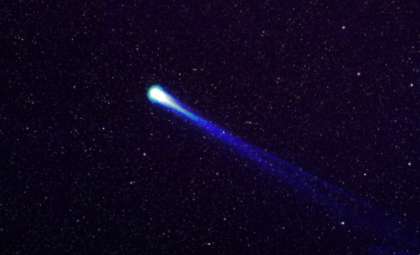
This significant transformation suggests that as 3I/Atlas neared the Sun, previously concealed icy layers beneath its surface became active, triggering the observed escalation of gas and dust emissions.
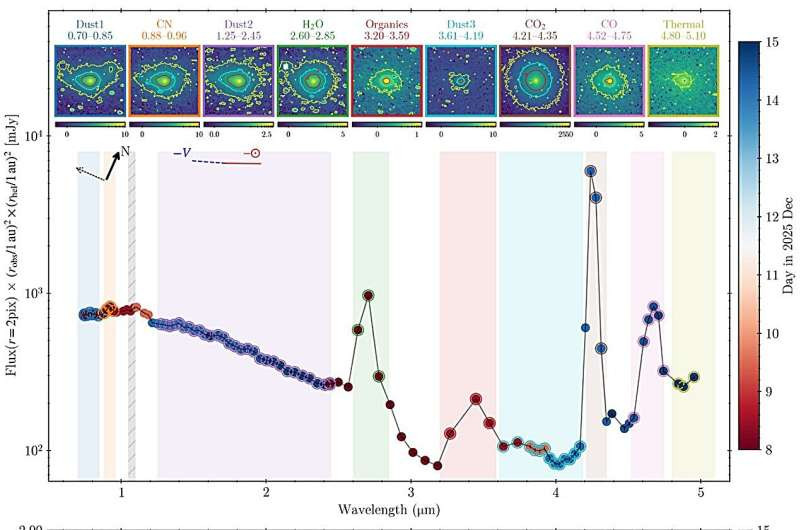
The Evolution of 3I/Atlas Inside the Ice Line
Researchers highlight that the comet’s pre-perihelion behavior markedly differed from later SPHEREx observations. Early in 2025, 3I/Atlas’s activity was driven mostly by large icy dust grains, which emitted carbon dioxide while keeping other volatile ices frozen due to low temperatures. However, conditions shifted significantly once it moved inside the solar system’s ice line.
“This change from pre-perihelion observations makes sense because, in August 2025, 3I’s behavior was dominated by large icy dust grain emission, with the icy grains too cold to sublimate anything more volatile than CO₂ fully. By December-2025, though, the ISO had spent ~3.5 months inside the solar system’s ice line, and all of the cometary constituents, not just the highly volatile CO₂ and CO ice portions, were active. I.e., bulk matrix comet material was evaporating, releasing everything the comet contains,” the study authors write.
These findings offer the first solid proof that interstellar objects (ISOs) experience multi-phase sublimation influenced by their distance from the Sun. The researchers suggest this insight will help compare comets formed in other star systems to those originating in our own.
Insights Into the Core of an Alien Comet
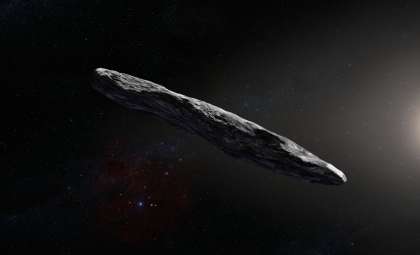
3I/Atlas, only the second verified interstellar comet after 2I/Borisov, serves as a rare opportunity to analyze the makeup of planetary material beyond our solar system. Data from SPHEREx imply that beneath its surface lies a mixture of complex ices and organic compounds resembling those present during the early stages of our solar system. This supports the hypothesis that planet-building components and precursors to life are widespread across the galaxy.
The authors of the study, whose work is publicly accessible on arXiv, stress that ongoing observations via SPHEREx and future instruments like JWST are poised to deepen our understanding of these interstellar visitors and their significance in cosmic evolution.
- Categories:
- Space







0 comments
Sign in to Comment