
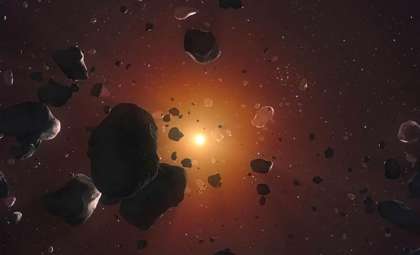
Scientists have identified a pivotal zone in the nascent Solar System where planet-building blocks, known as planetesimals, gradually took shape over millions of years. Their findings, detailed in The Astrophysical Journal, highlight a ring-shaped region just beyond Jupiter’s orbit that functioned as a remarkably effective and diverse nursery for these primordial objects. Utilizing state-of-the-art computer simulations, the team traced the creation and development of several planetesimal generations, enhancing our understanding of the Solar System’s origin.
The Dust Accumulation Zone That Influenced Planet Creation
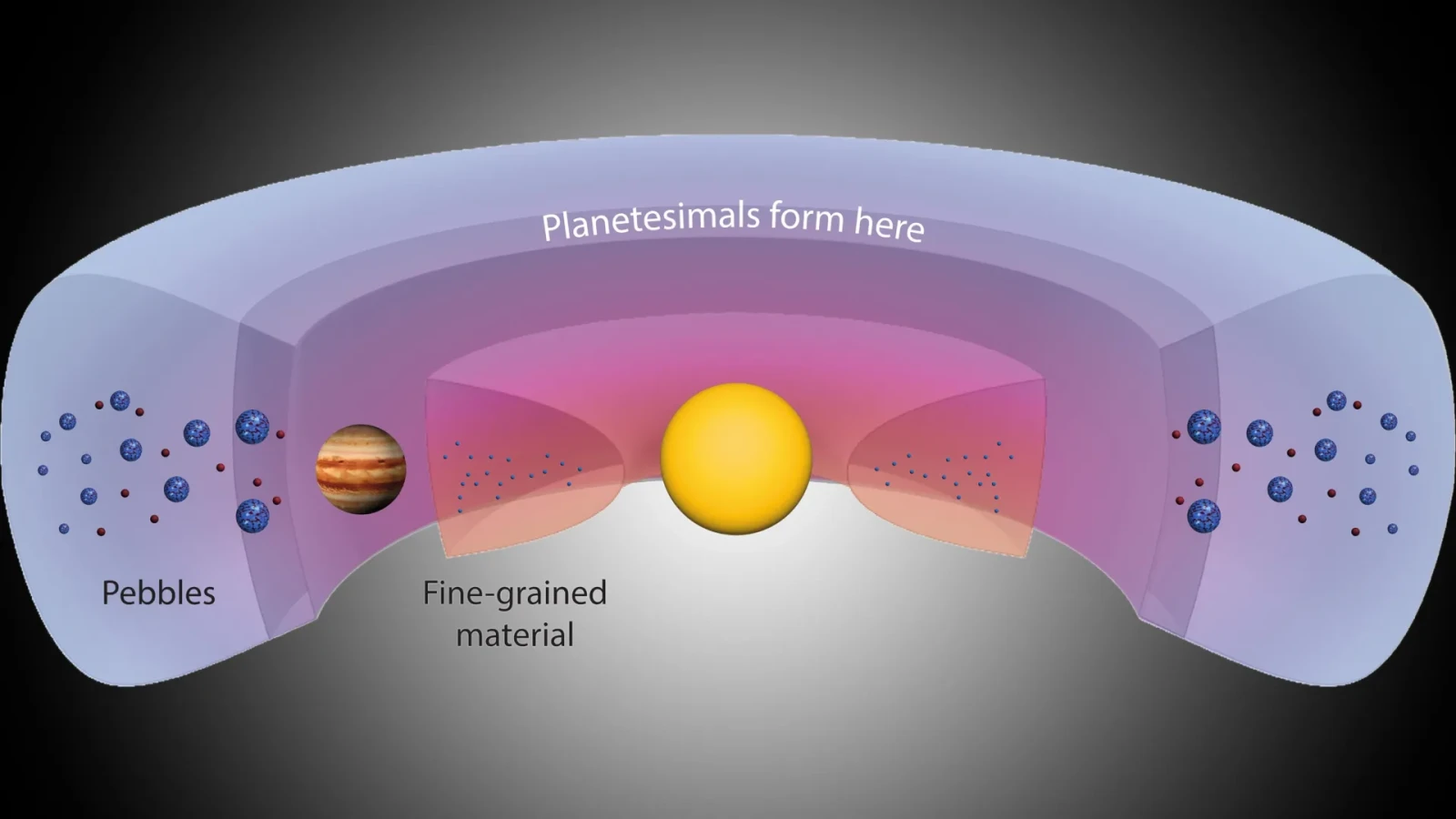
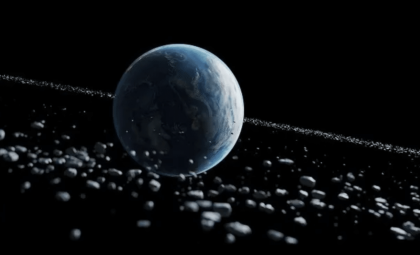
Between two and four million years after the Solar System began forming, Jupiter cleared much of the material near its orbit, carving out a gap within the surrounding gas and dust disk. This action generated a high-pressure gas ring just beyond Jupiter, which trapped significant quantities of dust and pebbles. These “dust traps” served as prime environments where tiny particles could collide and cohere, eventually growing into larger planetesimals over extended timeframes.
“Planetesimals of various types likely emerged in this same region of the early dust and gas disk, though at different intervals. The space just outside Jupiter provided ideal conditions for such formation,” explained Joanna Drążkowska, leader of the Lise Meitner Group focused on planet formation. The simulations indicate that this single ring-like band could harbor a wide array of planetesimal types, contributing diverse components that would form future planets and asteroids.

Linking Simulated Data With Meteorite Compositions
Meteorites reaching Earth contain clues that reflect processes from early planetary formation. The research particularly examined carbonaceous chondrites, carbon-rich meteorites believed to have originated beyond Jupiter. Laboratory analyses divide these meteorites into distinct categories based on their composition and ages; some are composed of delicate, fine-grained matter, while others incorporate tougher inclusions within the dust.
“Our simulations needed to accurately represent how both fragile and rigid materials behave and interact at multiple scales,” said Nerea Gurrutxaga, a doctoral student at the Max Planck Institute for Solar System Research (MPS) and lead author. By simulating particle collisions, drift patterns, and accumulation inside the dust trap, the team successfully recreated conditions that correspond with observed meteorite varieties, bridging lab data with planetary-scale phenomena.
Successive Waves of Planetesimals Took Shape
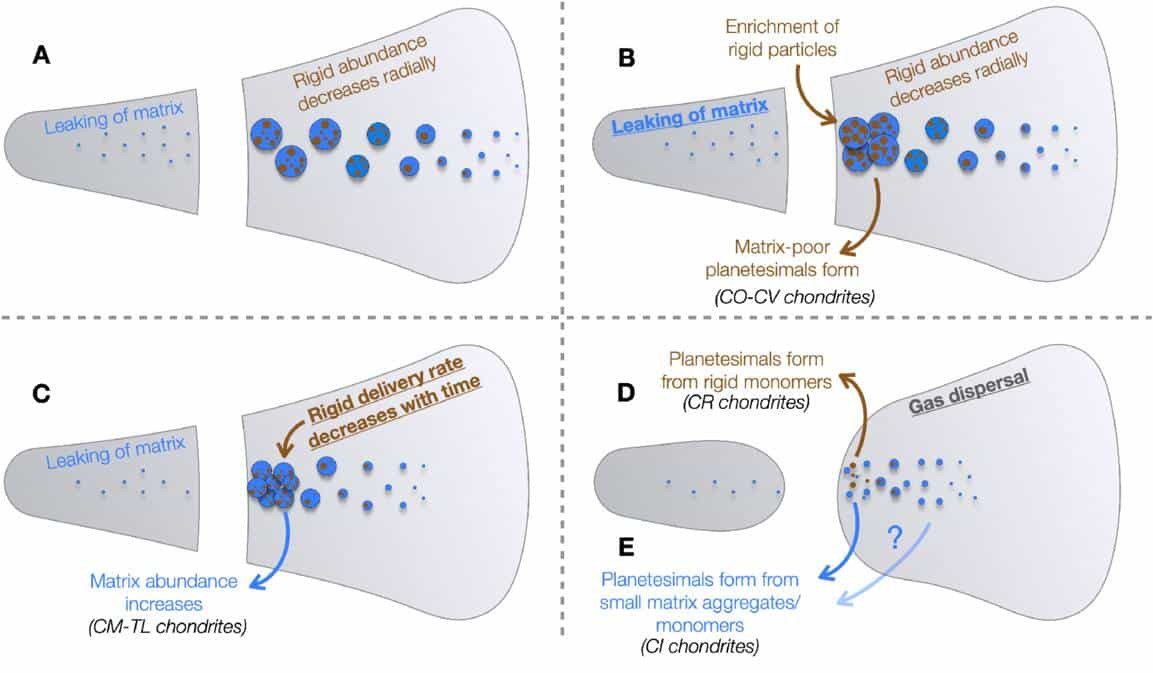
The simulations exposed a dynamically complex environment influenced by Jupiter acting as a filter. Larger, sturdier particles experienced greater resistance, whereas smaller grains moved more freely. Over millions of years, this filtering generated distinct waves of planetesimal formation—some emerging from fragile materials, others from denser clumps.
“This is the first time that laboratory meteorite findings have been precisely replicated through computer modeling of early Solar System dynamics. Meteorites effectively serve as benchmarks for our planetary formation theories,” noted Thorsten Kleine, MPS director and cosmochemist. The results, published in The Astrophysical Journal, elucidate the varied nature of planetesimals and identify dust traps as enduring creators of planetary material.
Broader Insights Into Solar System Development
This breakthrough underscores the significant influence of dust traps in defining the early Solar System’s structure. By concentrating matter within specific zones, these traps enabled efficient and compositional diversity in planetesimal formation. According to Drążkowska, “Compelling evidence points to dust traps being the prime locations where planetesimals originated in our Solar System.”
The findings pave the way for deeper exploration of the timeframe and mechanisms behind planetary formation. Additionally, linking simulation outcomes with specific meteorite types offers a rare chance to validate theoretical models with actual physical samples. Importantly, the study reveals that planet formation was spatially and temporally varied, occurring in distinct zones with evolving conditions over millions of years.
- Categories:
- Astronomy




0 comments
Sign in to Comment