

Originally designed to study Jupiter, NASA’s Juno spacecraft has unveiled remarkable details about the fiery volcanic landscapes on Io, one of Jupiter’s moons.
Equipped with the Jovian Infrared Auroral Mapper (JIRAM), Juno has captured infrared imagery that highlights Io’s dynamic volcanic plumes and molten lava lakes, offering unprecedented insights into the solar system’s most volcanically active world.
Key Discoveries from Juno’s Io Flybys
During close passes over Io in December 2023 and February 2024, Juno observed vast lava lakes across the moon’s surface. Infrared data revealed bright white rings marking these lakes, with temperatures ranging from 450 to 1,350°F (232 to 732°C), while their centers were measured much cooler at approximately -45°F (-43°C).

Alessandro Mura, a Juno co-investigator at the National Institute for Astrophysics in Rome, noted, “We have identified the dominant volcanic style on Io as massive lava lakes featuring magma that periodically rises and sinks.” These findings indicate that Io’s lava lakes behave similarly to Hawaiian lava ponds, where magma motion causes the crust at the surface to crack along the lake’s edges.
One standout feature, Chors Patera, shows an intense heat signature around its perimeter in infrared images, produced by the continual fracturing of the lava crust that reveals fresh magma beneath.
The Mechanics Behind Io’s Volcanoes
Io’s explosive volcanism is fueled by tidal heating generated from Jupiter’s powerful gravitational forces, which create internal friction and heat in the moon’s interior. This process leads to frequent volcanic eruptions that spew sulfur and sulfur dioxide plumes as high as 300 miles into the atmosphere. The abundance of sulfur compounds also gives Io its vivid surface colors, including yellows, reds, greens, blacks, and whites.
Scott Bolton, Juno’s principal investigator at the Southwest Research Institute, emphasized the importance of these discoveries: "By merging these observations with Juno’s ongoing efforts to study Io’s poles, JIRAM is proving essential in unraveling how this volcanically turbulent world operates."
Although JIRAM was designed to map Jupiter’s auroras, its infrared capabilities have enabled it to produce detailed thermal maps of Io during Juno’s close approaches, illuminating temperature variations across the moon’s surface.
Alessandro Mura added, “Thanks to JIRAM’s fine spatial resolution and favorable flyby positions, we now know that lava lakes fill many caldera-like depressions on Io. From our most complete observations, roughly 3% of the surveyed terrain is covered by these molten lakes.”
The JIRAM data shows these lava lakes are surrounded by narrow rings of exposed lava without any visible flows extending beyond the rims, suggesting a steady-state balance where magma circulates between eruption and subterranean return. This observation sheds light on the ongoing volcanic mechanisms at work.

Theories and Continued Investigations
To explain the behavior of Io’s lava lakes, scientists are considering two main models. The central upwelling model proposes that heat rises centrally within the patera, spreading lava outwards before it cools and sinks at the margins, accounting for the heat distribution but raising questions about how the lava crust thickness remains so consistent.
The piston motion model suggests that the lava lake’s surface moves vertically like a piston, breaking the crust against the crater walls and exposing fresh magma, although it has difficulty fully explaining the uniform brightness around the lake edges.
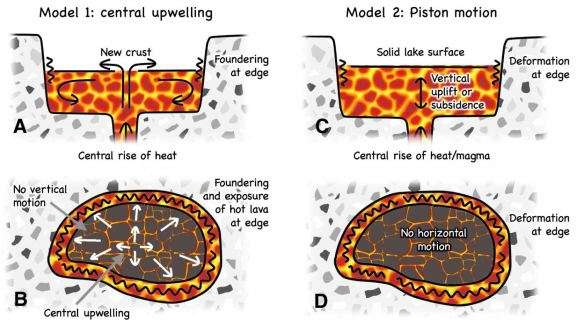
NASA’s ongoing Juno mission continues to refine these volcanic models by tracking both active and dormant paterae, aiming to deepen our understanding of Io’s fiery interior and its volcanic dynamics.
- Categories:
- Astronomy ,
- News ,
- Space ,
- Nasa






0 comments
Sign in to Comment