
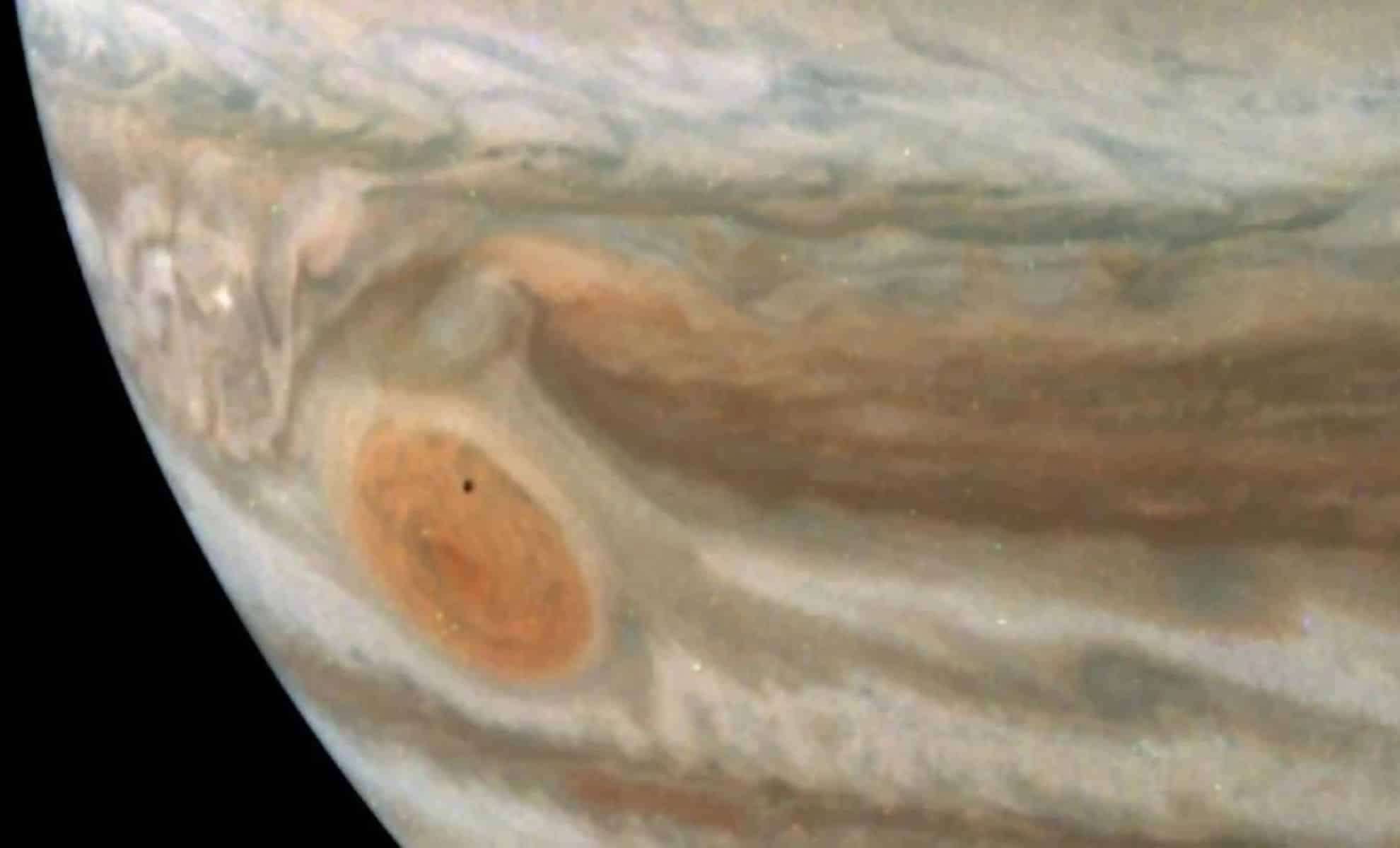
NASA’s Juno spacecraft, orbiting Jupiter since 2016, has recently documented a rare event: the small moon Amalthea traversing the planet’s famous Great Red Spot.
This unique observation provides fresh data on Amalthea, one of Jupiter’s less prominent moons, while offering new perspectives on the enormous storm dominating the planet’s atmosphere. By acquiring high-resolution images from its close orbit, Juno enables scientists on Earth to study Jupiter and its moons with exceptional detail.
Discovering Amalthea: An Uncommon Jovian Satellite
Amalthea, first identified by astronomer Edward Emerson Barnard in 1892, stands apart from Jupiter’s larger Galilean moons such as Io and Europa.

Unlike the spherical giants, Amalthea has an irregular, elongated shape resembling a potato and spans roughly 250 kilometers across its longest axis.

The moon’s surface is tinted with an unusually deep red hue, perhaps the reddest in the solar system. Scientists theorize this color results from sulfur deposits originating from Io’s active volcanoes.
Amalthea’s distinctive size, form, and coloration make it a fascinating subject for studies looking to unravel the composition and environmental conditions of Jovian satellites.
Expanding Knowledge Through the Juno Mission
Juno’s key objective is to investigate Jupiter’s formation, internal structure, atmosphere, and magnetic environment. By mapping the planet’s gravitational and magnetic fields over multiple passes, the mission reveals details hidden beneath Jupiter’s thick cloud layers.
Each close encounter adds important information, letting scientists piece together the dynamics shaping Jupiter’s iconic weather, including its renowned Great Red Spot.
Spanning a size larger than Earth and persisting for centuries, this giant storm provides clues into atmospheric phenomena on gas giants that can be extrapolated to other worlds.
Improved understanding of these powerful weather systems aids in interpreting planetary processes both in our solar system and among distant exoplanets.
Why the Great Red Spot Matters
Jupiter’s Great Red Spot draws attention due to its massive expanse and remarkable longevity.
Watching Amalthea transit this massive storm is crucial, as it helps astronomers analyze how the moon’s path and characteristics respond to Jupiter’s turbulent atmospheric conditions.
These observations also shed light on the storm’s effects on the surrounding space environment, including interactions with the planet’s electromagnetic field influencing nearby celestial orbits.
Data gathered by Juno during these crossings contribute to a richer understanding of the interplay between Jupiter’s magnetic forces and its moons.
Investigating Amalthea’s Color and Heat Anomalies
Amalthea remains scientifically intriguing due to its striking red surface and the unexpected heat it emits. While Io’s volcanic sulfur is believed to tint the moon, the source of its surplus heat remains uncertain.
Potential causes include electric currents induced by Jupiter’s magnetic field or tidal forces from Jupiter’s gravity creating internal heating within Amalthea.
Exploring these theories could deepen knowledge of thermal and geological activity on moons orbiting gas giants, expanding our understanding of their development and evolution across the cosmos.
Looking Ahead: Juno’s Continuing Exploration
As Juno advances in its mission, it steadily enriches our comprehension of Jupiter and its intricate system of moons and rings. The insights gained not only illuminate Jupiter itself but also serve as vital information for studying planetary systems beyond our own.
With every orbit, Juno delivers invaluable data that advances planetary science and highlights the significance of robotic spacecraft in uncovering the universe’s secrets.
This ongoing probe into Jupiter and its satellites exemplifies the forefront of space technology and humanity’s enduring pursuit of cosmic understanding.
- Categories:
- Astronomy ,
- News ,
- Science ,
- Space ,
- Nasa









0 comments
Sign in to Comment