

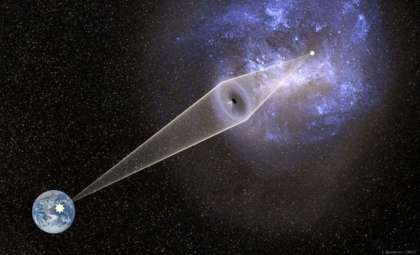
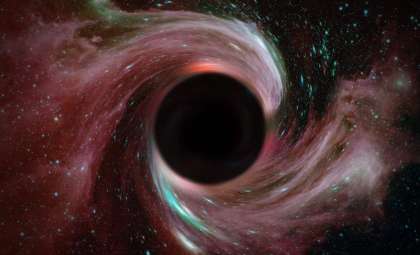
Scientists are exploring one of space’s most profound puzzles: the process through which supermassive black holes—gigantic cosmic objects millions to billions of times heavier than the Sun—merge into even larger entities. The key to this cosmic mystery might lie in the properties of dark matter.
Innovative new research points to a special form of dark matter, called self-interacting dark matter, as a crucial factor in enabling black holes to collide. This invisible substance could be facilitating the monumental mergers of these massive objects, shedding light on phenomena that have long baffled astronomers.
Unraveling a Long-Standing Cosmic Puzzle
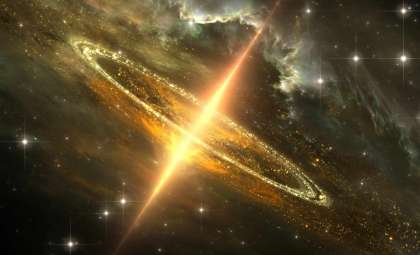
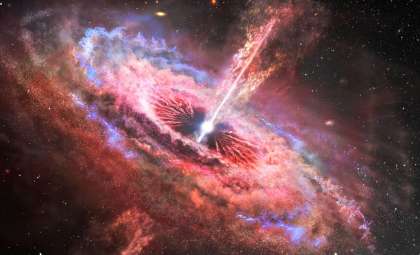
Supermassive black holes inhabit the centers of most galaxies, growing over billions of years by consuming matter and merging with other black holes. Yet a central enigma has persisted: what allows these colossal black holes, when separated by about three light-years, to lose enough energy to finally merge?

The challenge, known as the “final parsec problem,” describes the difficulty in explaining how black holes close that final gap and ultimately collide—an issue that has perplexed experts for decades.

Dark Matter’s Role in Black Hole Mergers
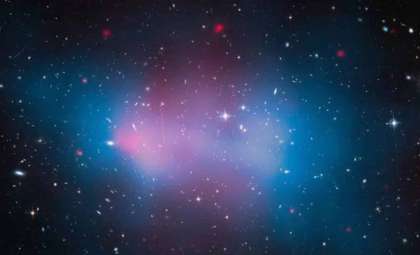
A recent paper featured in Physical Review Letters proposes that self-interacting dark matter might resolve the final parsec dilemma. Contrary to its reputation as an inert cosmic component, dark matter—which doesn’t emit or absorb light but constitutes most of the universe’s mass—may actively influence black hole dynamics.
By incorporating self-interactions in dark matter models, scientists demonstrated that the energy barrier preventing black holes from merging dissipates. In the milieu of colliding galaxies, this type of dark matter could absorb orbital energy, acting like a cosmic damper that enables the black holes to converge.
Clues from the Universe’s Gravitational Signals
This approach also offers an explanation for the strange, persistent "background noise" of gravitational waves—minute ripples in space-time—detected recently through a pulsar timing array. The study suggests dark matter’s influence could subtly modify these gravitational waves, providing new insights into its elusive nature.
Researchers now speculate that dark matter may not be a mere passive participant but a dynamic force crucial to how supermassive black holes perform their cosmic dances. Ongoing observations with pulsar timing arrays promise to test this idea in the near future.
Looking ahead, upcoming data analyses could confirm whether self-interacting dark matter holds the key to solving one of astronomy's greatest mysteries. The cosmos continues to surprise and inspire with its complex secrets.
- Categories:
- Astronomy ,
- Space





0 comments
Sign in to Comment