
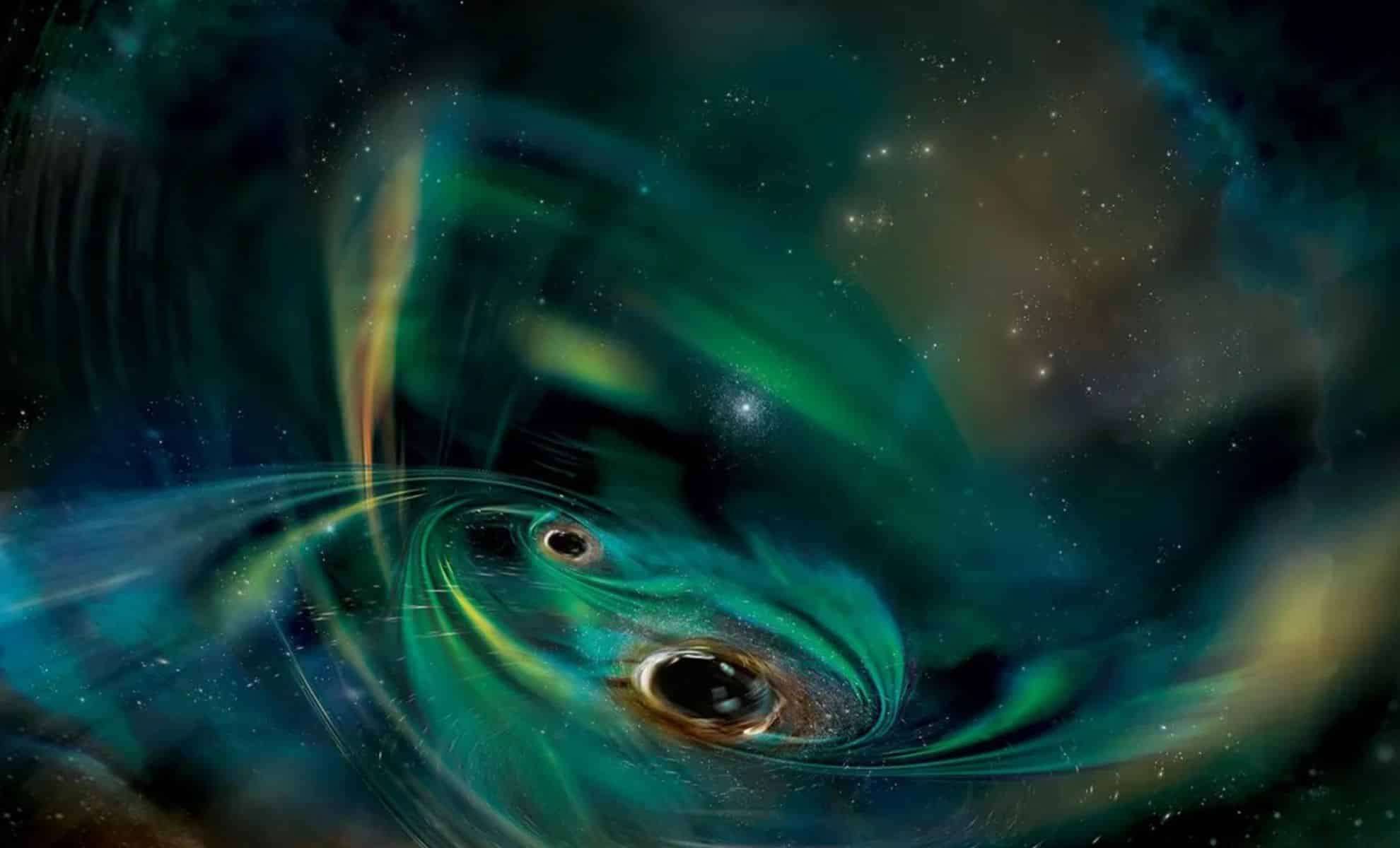
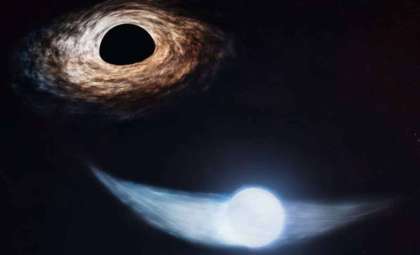
Scientists have observed an extraordinary cosmic occurrence nearly a billion light-years away: a pair of supermassive black holes locked in orbit around each other, jointly consuming a single cloud of gas. This groundbreaking observation, conducted with NASA’s Swift Observatory and the Zwicky Transient Facility (ZTF), illuminates previously unexplored dynamics of black hole interactions and the gravitational effects that lead to their eventual merger. The discovery, documented in Astronomy and Astrophysics, represents a significant advancement in the study of binary black hole systems.
Stunning Fluctuations Expose a Rare Black Hole Binary
Located within the galaxy 2MASX J21240027+3409114, this system harbors two supermassive black holes whose combined mass equals about 40 million suns. Separated by roughly 16 billion miles, the black holes complete an orbit around each other every 130 days. Initially detected by ZTF in 2021 as an unusual brightness variation called AT 2021hdr, it was first mistaken for a supernova. Further ultraviolet and X-ray observations from NASA’s Swift Observatory revealed emissions in sync with visible light changes, confirming that the black holes are jointly interacting with the same gas cloud.
“AT 2021hdr is a peculiar event that repeats every few months,” explained Lorena Hernández-García, principal investigator at the Millennium Institute of Astrophysics and the University of Valparaíso in Chile. “We believe a gas cloud has engulfed the black holes, and as they orbit, their gravitational forces disturb and consume the gas, producing this distinctive oscillating light pattern.”

This interaction generates bursts of energy across several wavelengths, a phenomenon seldom captured with such clarity. The immense gravitational pull of the black holes tears the gas cloud into hot, dense strands, some of which are ejected during each orbit, offering a rare live view of the fierce energy exchanges happening in these powerful cosmic systems.
Cracking the Code Behind the Recurrent Flashes
The recurring bright flares of AT 2021hdr, appearing every 60 to 90 days, initially confounded researchers. Early data suggested a typical active galactic nucleus or a star being disrupted by a black hole. But as monitoring extended into 2022, alternative explanations surfaced. “While at first it seemed like a supernova, the repeated flares in 2022 led us to reassess,” said co-author Alejandra Muñoz-Arancibia from the Millennium Institute of Astrophysics and the Center for Mathematical Modeling at the University of Chile.
Ultimately, the team concluded that the source is a binary black hole system feeding on a large gas cloud. The gravitational forces between the black holes and the gas generate intense friction that heats the gas to extreme levels, creating the distinctive light fluctuations observed. This insight enhances models of how black holes accrete matter, paving the way for deeper studies of binary black hole behavior.
NASA’s Swift Observatory Sheds Light on Cosmic Phenomena
This discovery was possible thanks to the combined efforts of NASA’s Swift Observatory and the ZTF survey at Palomar Observatory. Swift’s capability to simultaneously monitor ultraviolet and X-ray emissions was key to detecting the unique periodic light pattern, verifying the presence of a binary black hole system.
“As Swift nears its 20th year, it continues to enable remarkable scientific breakthroughs,” stated S. Bradley Cenko, Swift’s principal investigator at NASA’s Goddard Space Flight Center. “There is still so much to learn about the constantly evolving universe through Swift’s observations.”
These findings demonstrate the critical value of long-term astronomical monitoring for uncovering rare and complex cosmic events. Swift’s versatile multi-wavelength tracking has been vital in decoding the complex behavior of this unusual black hole duo.
Impending Black Hole Merger Promises Insightful Finale
The two supermassive black holes are destined to collide within roughly 70,000 years. When they merge, they will unleash a colossal burst of gravitational waves, which will ripple across the fabric of spacetime. This dramatic ending will offer crucial data on the mechanics of black hole mergers and their influence on galaxy formation and evolution.
Their host galaxy, 2MASX J21240027+3409114, is itself merging with another galaxy, feeding fresh material to the black holes and adding layers of complexity to the system. This ongoing galactic collision highlights how such events drive supermassive black hole growth and affect the cosmic environment around them.
“This rare system allows us a window into the life cycle of binary black holes and their impact on their host galaxies,” noted Hernández-García. “It serves as a natural laboratory for exploring some of the universe’s most extreme phenomena in real time.”
- Categories:
- Astronomy ,
- News ,
- Nasa



0 comments
Sign in to Comment