
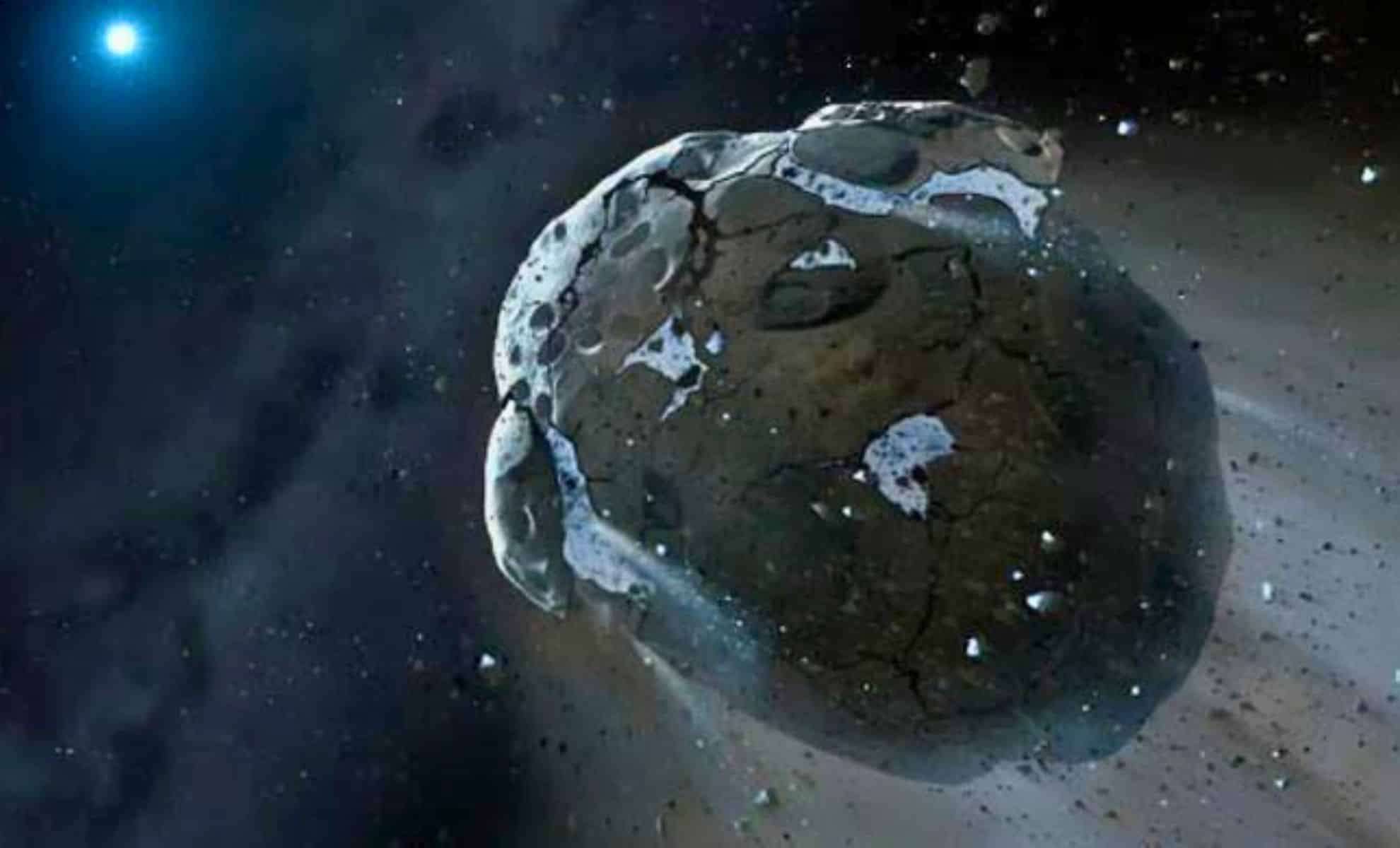
Asteroids are often seen as simple rocky remnants in space, yet recent observations reveal a more intricate reality. Some asteroids host moons with unusual forms, such as watermelon-like shapes, challenging conventional ideas about asteroid development.
For decades, scientists have been fascinated by the irregular shapes of certain small celestial bodies like Dimorphos and Selam. A recent investigation offers explanations for these peculiar geometries and suggests that such unconventional “moonlets” could be more widespread than once assumed.
Decoding Binary Asteroid Systems and Their Satellites
Within our solar system, there exist binary asteroid systems that mirror miniature versions of the Earth-moon pairing. A prime example is the Didymos-Dimorphos duo, which played a key role in NASA’s 2022 DART mission.

Research indicates these binary pairs form when a fast-rotating parent asteroid—consisting of loosely bound rock fragments—ejects material that accumulates into a smaller satellite, known as a moonlet.
Typically, such moonlets are shaped like elongated ellipsoids or blunt-ended footballs standing upright. Yet, some display distinct morphologies, like Dimorphos did before being struck by DART.
This moonlet exhibited an “oblate spheroid” profile—flattened at its poles but expanded around its equator, much like a watermelon. Interestingly, Selam consists of two connected rocky lobes and orbits asteroid Dinkinesh.
These unusual forms intrigued astronomers, including John Wimarsson, a graduate researcher at the University of Bern and the study’s lead author. “Current models don’t fully explain these asteroidal companions,” he explained.
To address this, Wimarsson and his team from Europe and the US developed two simulation models. One focused on how parent asteroids alter shape while shedding material.
The other modeled a doughnut-shaped debris disk orbiting around the parent’s fragments, tracking their movement and collisions. They also examined two asteroid types similar to Ryugu and Didymos.
The shape of a moonlet is largely determined by two factors: the gravitational pull from its host asteroid and the impacts occurring within the debris disk, as detailed in their paper published in Icarus.
Other variables influence which force prevails. For instance, fast-spinning, dense asteroids like Didymos form broader debris disks that push moonlets further outward. When a moonlet reaches the Roche limit—where tidal forces balance its internal strength—it typically assumes a stretched, prolate shape.
In contrast, moonlets forming beyond this limit tend to flatten into oblate forms, as gravitational influence weakens. Collisions within the debris promote more uniform shaping. Moonlets too near their parent may fragment, losing elongated shapes and becoming flattened spheroids through repeated collisions.
Additionally, the angle at which early moonlets collide affects their eventual form. Side collisions along shorter axes produce oblate shapes, while end-to-end impacts along longer axes result in bilobate structures resembling Selam.
What These Moon Shapes Reveal About Asteroid Evolution
The identification of these strange satellite shapes pushes scientists to rethink established models of asteroid formation. Previous theories couldn’t easily account for such diversity, prompting fresh investigations into binary asteroid dynamics.
This study indicates that oblate and bilobate moonlets might be far more prevalent than recognized. Due to technological constraints, these shapes might have gone unnoticed, skewing our understanding of their frequency throughout the solar system. As observing technology improves, such unique shapes could be found to be more typical than rare.
These insights open promising paths for forthcoming research. Grasping how these unusual moonlets form and evolve could shed light on conditions during our solar system’s infancy. As exploration continues, we can anticipate discovering even more complex satellite shapes, enriching our knowledge of cosmic history.
- Categories:
- Astronomy ,
- Space




0 comments
Sign in to Comment