
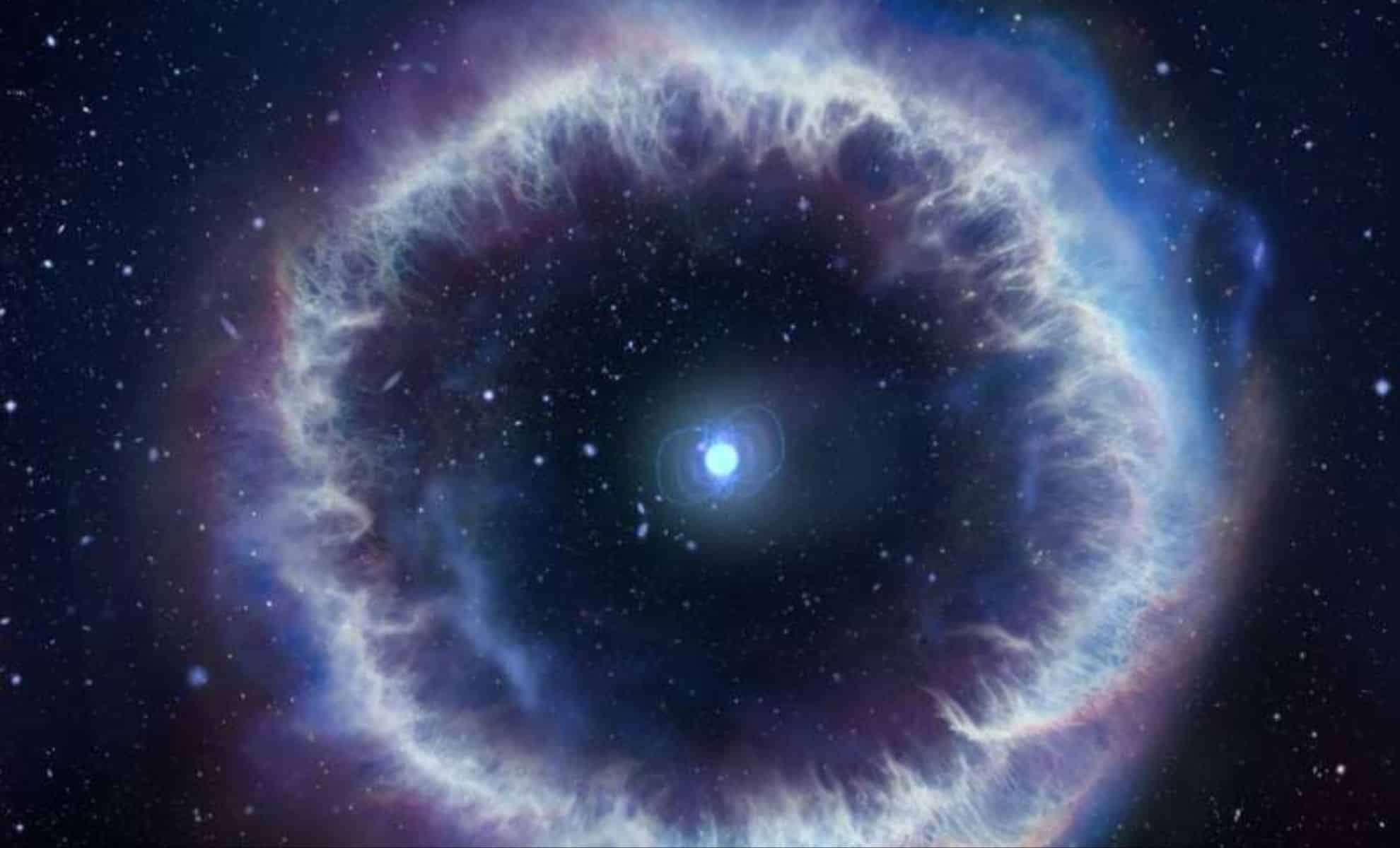
Groundbreaking research has shed light on the origins of fast radio bursts (FRBs), attributing these brief yet powerful cosmic signals to magnetars—neutron stars with extraordinarily strong magnetic fields.
This discovery marks a major advance in deciphering some of the universe’s most energetic occurrences.
Unraveling the Enigma of Fast Radio Bursts
Fast Radio Bursts (FRBs) are intense bursts of radio waves lasting mere milliseconds, yet they discharge immense energy—often exceeding what our Sun emits in several days. First detected in 2007, these fleeting signals originate far beyond our galaxy, spanning millions or even billions of light-years. Pinpointing their exact sources remains a complex challenge due to their ephemeral and unpredictable nature.

FRBs are primarily captured by radio telescopes worldwide, but their short lifespans and irregular timing complicate detailed investigation. Despite these hurdles, astronomers have made notable strides in uncovering the underlying physics causing these energetic outbursts. The tremendous energy released by FRBs offers a unique window into extreme astrophysical processes.
Magnetars: The Likely Producers of FRBs
For some time, scientists have proposed that magnetars—a subclass of neutron stars characterized by ultra-strong magnetic fields—could be the engines driving FRBs. Born from the dense remnants of supernova explosions, neutron stars condense solar mass into spheres roughly 12 miles wide. The interplay of their intense magnetic fields and rapid spin rates positions magnetars as prime candidates generating the bursts of radio energy observed.
Magnetars rank among the universe’s most extreme entities, with magnetic strengths trillions of times greater than Earth’s. They frequently unleash violent energy eruptions, lending credibility to the idea they power the detected FRBs. Supporting this, several FRBs coincide with detected X-ray and gamma-ray flares, emissions typically produced by magnetars.
Connecting Plasma Nebulae and Continuous Signals
New research connects the ongoing radio emissions linked to some FRBs to plasma bubbles enveloping the magnetars. Led by Gabriele Bruni from the Italian National Institute for Astrophysics (INAF), the study indicates these plasma nebulae form through magnetar winds or from high-accretion X-ray binaries—systems where neutron stars or black holes rapidly pull gas from companion stars.
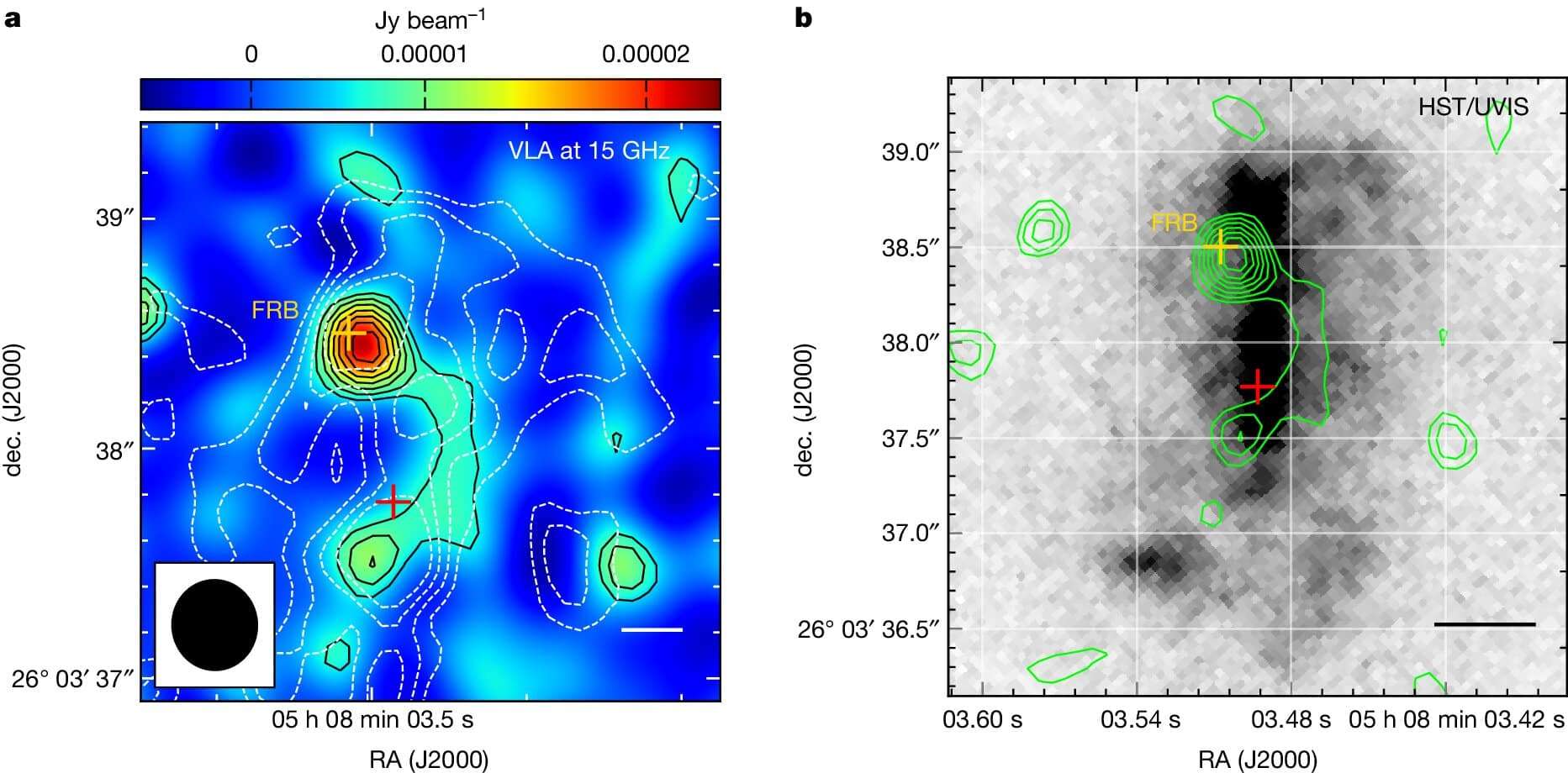
“Observations have confirmed that the continuous signals paired with certain FRBs align with the nebular emission model—essentially a bubble of ionized gas around the burst’s energy source,” Bruni stated. This breakthrough tightens our grasp on the mechanism fueling these enigmatic bursts and establishes a direct link between the plasma environment and the FRB engine.
The investigation focused on FRB 20201124A, a prolific repeating source situated roughly 1.3 billion light-years away. Employing the Very Large Telescope (VLT) in Chile’s Atacama Desert, the researchers identified the faintest known radio continuum connected to an FRB, validating theoretical predictions that such bursts are enveloped by a plasma bubble created by the outflow of charged particles from a magnetar.
Advanced Techniques and Data Collection
Data gathered using the world’s most sensitive radio instrument, the Very Large Array (VLA) in the USA, confirmed the presence of the plasma bubble fueling the persistent radio emissions linked to FRBs. These findings appeared in the journal Nature.
The team complemented their findings with observations from the NOEMA interferometer and the Gran Telescopio Canarias (GranTeCan), offering multi-wavelength data on the host galaxy. This allowed precise mapping of hydrogen emissions and assessments of dust quantities in star-forming zones, ensuring the emissions originated from the FRB rather than other astrophysical activity.
These comprehensive, high-resolution observations enabled reconstruction of the entire galactic environment and the detection of a compact radio source—the plasma bubble—embedded within the star-forming region. This mapping was essential for validating the nebular emission model and understanding the context in which these intense bursts occur.
Significance for Future FRB Investigations
Confirming this nebular bubble and its connection to magnetars provides an essential roadmap for upcoming studies of these potent cosmic signals. Tools like the VLA and NOEMA interferometer will be instrumental in probing the origins and environments of FRBs further.
By observing hydrogen emissions and measuring dust content within star formation areas, researchers can exclude alternative explanations for the persistent radio emissions detected.
“Our work narrows down the nature of the engine behind fast radio bursts,” Bruni noted. Understanding the characteristics of sustained emissions is key to piecing together the puzzle behind these cosmic enigmas.
These discoveries enhance our comprehension of the physical processes governing FRBs and highlight the pivotal role of detailed observations and global scientific partnership in solving one of astronomy’s most captivating mysteries.
- Categories:
- Astronomy ,
- News










0 comments
Sign in to Comment