
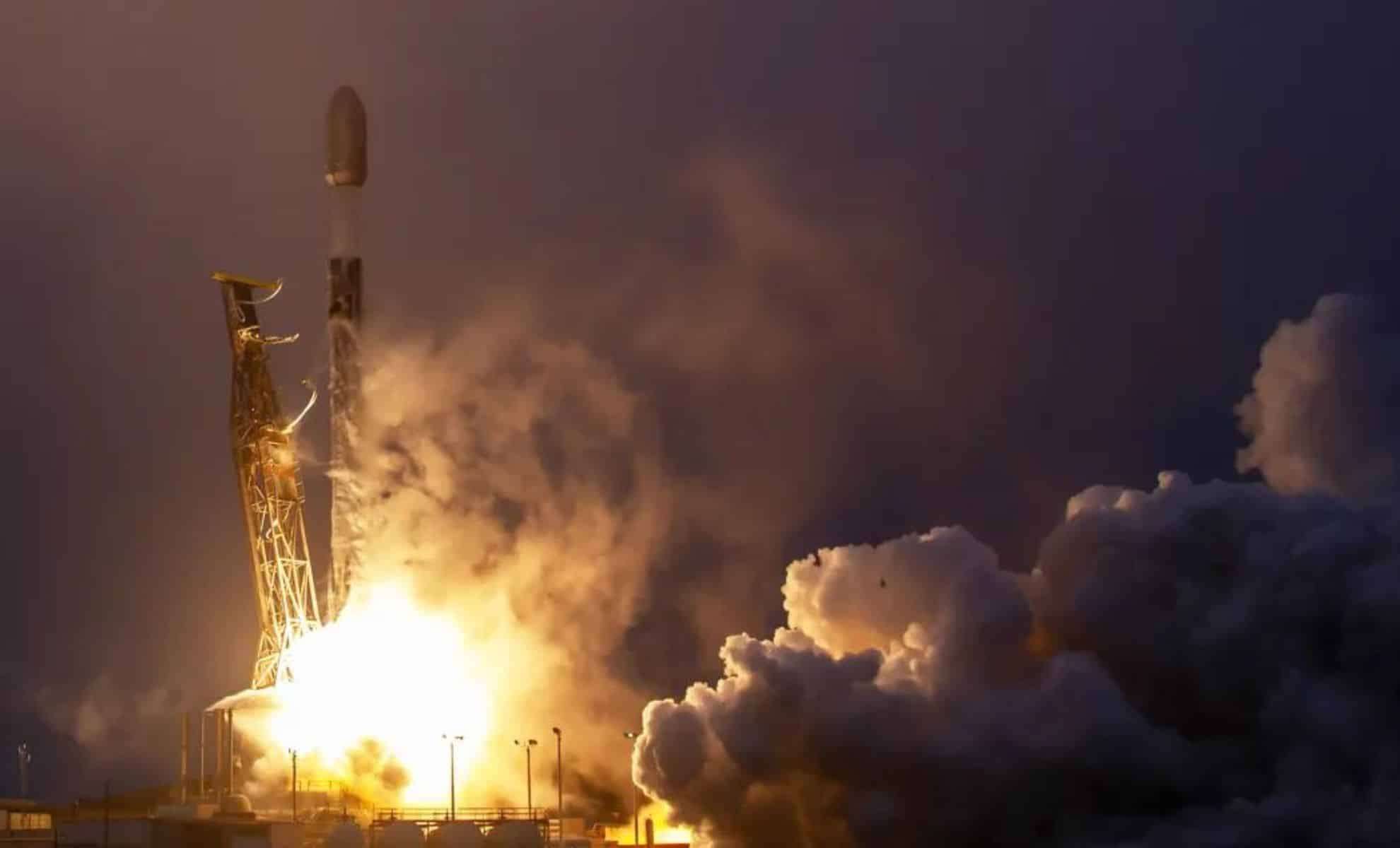
SpaceX achieved a successful Falcon 9 rocket launch Friday evening from Vandenberg Space Force Base, California, advancing its active schedule of missions.
This flight, known as NROL-186, involved deploying multiple payloads for the National Reconnaissance Office (NRO), the U.S. agency responsible for spy satellite design and deployment.
Launch Overview and Flight Profile
The Falcon 9 vehicle lifted off at 8:14 p.m. PT, carrying a payload vital for national defense. The NRO described this operation as part of its “proliferated architecture,” a strategic plan to improve space-based intelligence, surveillance, and reconnaissance (ISR) by using a network of many smaller satellites instead of fewer large ones.

After ascending vertically, the Falcon 9 performed a controlled maneuver to achieve its targeted orbit. Nearly eight minutes post-launch, the first stage booster landed safely on the drone ship “Of Course I Still Love You,” positioned in the Pacific Ocean.
This marked the booster’s eighth mission, having previously supported launches including Crew-7, CRS-29, and multiple Starlink flights. The successful recovery highlights SpaceX’s progress in rocket reusability, helping lower space access costs considerably.
Importance of the NRO Operation
This NRO flight, although cloaked in secrecy, plays a vital role in strengthening U.S. national security infrastructure. It is the second launch under the agency’s proliferated architecture program, following the NROL-146 mission earlier this year.
Details about the payload count and their orbits remain undisclosed for security, yet the mission emphasizes the growing reliance on space-based ISR to support defense operations.
In a communication with Spaceflight Now, the NRO reinforced the classified nature of their systems: “NRO systems are designed, built and operated by the NRO. As a matter of national security we do not discuss the companies associated with the building of our systems, our contractual relationships with them, their specific activities, or the locations where NRO systems are built.”
The satellites are thought to utilize the Starshield satellite bus developed by SpaceX alongside Northrop Grumman, marrying commercial spaceflight innovations with national security demands.
Commercial Spaceflight’s Expanding Role in Defense
This launch illustrates a growing trend where private aerospace firms like SpaceX take on crucial national security missions. The NRO’s decision to operate beyond the confines of the National Security Space Launch (NSSL) Phase 2 program showcases the agency’s push for quicker, adaptive launch solutions. Moving into Phase 3 of NSSL reflects a broader focus on agile and resilient space capabilities.
The successful deployment of the Falcon 9 rocket with NRO payloads underscores SpaceX’s dependability and the strategic value of their collaboration with U.S. security agencies. Alongside several recent flights, this mission highlights the indispensable role space operations now play in defense intelligence. As competition in space intensifies, rapid deployment and control of ISR assets will be key to maintaining American technological edge.
Continuous improvements in reusable rocket technology and strategic satellite architectures exemplify the rapid evolution of space activities. SpaceX’s pioneering work in commercial space, combined with partnerships like those with the NRO, reflects how private sector advances are becoming central to securing the nation’s future in space.
- Categories:
- Astronomy ,
- News ,
- Space ,
- Aircraft






0 comments
Sign in to Comment