
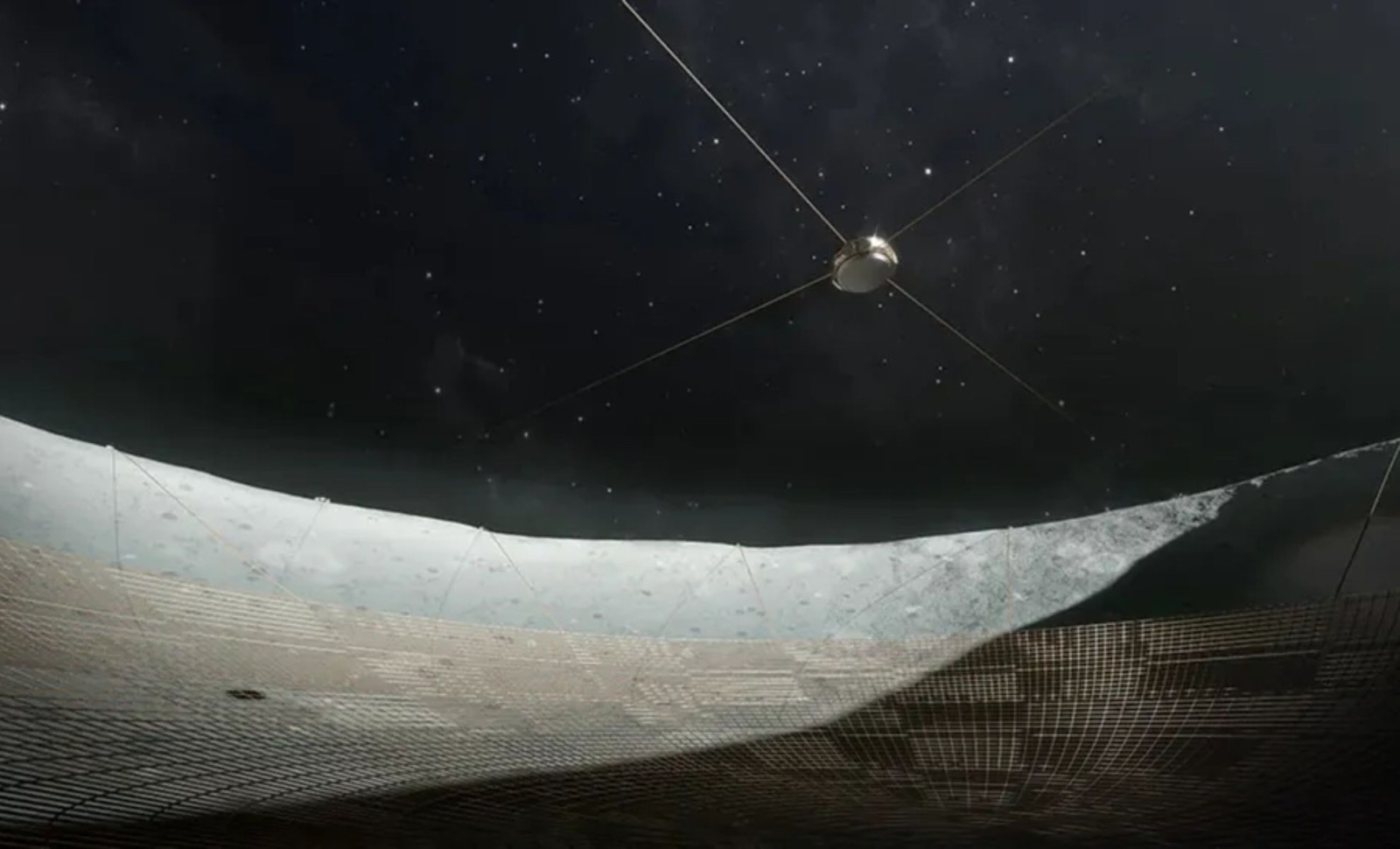
NASA is actively investigating the creation of an enormous radio telescope positioned on the Moon's far side. This location is chosen to avoid Earth's radio frequency interference, allowing clearer observations of the cosmos.
Named the Lunar Crater Radio Telescope (LCRT), the initiative has been progressing for several years and is nearing a significant development milestone. If approved, robotic systems would construct the telescope in the 2030s, with costs estimated above $2 billion.
Transforming a Moon Crater into a Giant Radio Dish
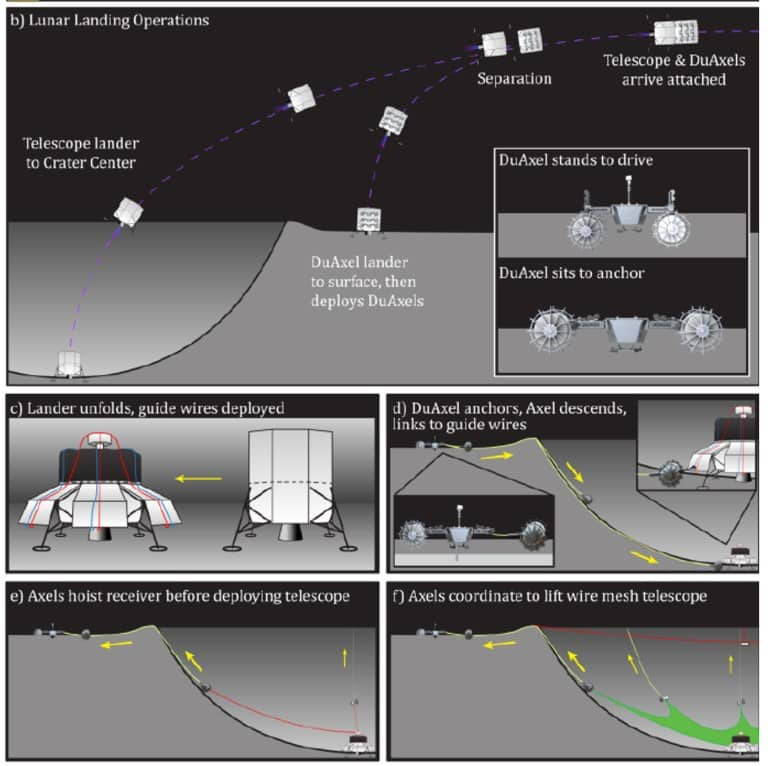
The concept involves converting a natural lunar crater on the Moon’s far side into a massive radio antenna. According to NASA’s explanation, a network of cables would suspend a wire mesh, establishing a structure roughly 350 meters in diameter. This would surpass the size of the historic Arecibo Observatory, though it remains smaller than China’s FAST telescope. NASA stated:

“This Lunar Crater Radio Telescope (LCRT), with 1km diameter, will be the largest filled-aperture radio telescope in the Solar System! LCRT could enable tremendous scientific discoveries in the field of cosmology by observing the early universe in the 10-50m wavelength band.”
Due to the complexities, robotics will handle the entire construction process rather than astronauts. Teams at NASA’s Jet Propulsion Laboratory (JPL) are currently developing a 1:200 scale model for testing in California, as reported by Live Science.
The project has already secured preliminary funding through NASA’s Institute for Advanced Concepts, receiving $125,000 in phase I and $500,000 in phase II. The forthcoming phase III could transition the idea into an operational mission.
Shielding Observations from Earthly and Satellite Noise
The Moon’s far side provides an exceptionally quiet environment for radio astronomy, naturally blocking interference from Earth-based sources, including satellites and certain solar emissions. This is increasingly critical as satellite networks such as SpaceX’s Starlink proliferate rapidly, emitting signals that degrade the quality of ground-based radio telescope data.
“It would mean that we are artificially closing ‘windows’ to observe our universe,” said Federico Di Vruno, from the Square Kilometer Array Observatory.
Nevertheless, a solitary lunar telescope would complement rather than replace Earth observatories, preserving access to specific frequency bands that might otherwise vanish.
Detecting Signals Inaccessible from Earth
One key advantage of the LCRT is its capability to observe extremely long wavelengths over 10 meters, which are mostly blocked by Earth's atmosphere, making them largely undetectable from terrestrial sites. On the Moon, such constraints vanish, enabling studies of the cosmic dark ages—the period before the emergence of the first stars. Researcher Gaurangi Gupta noted:
“During this phase, the universe primarily consisted of neutral hydrogen, photons and dark matter, thus it serves as an excellent laboratory for testing our understanding of cosmology.” Gupta added, “Observations of the dark ages have the potential to revolutionize physics and cosmology by improving our understanding of fundamental particle physics, dark matter, dark energy and cosmic inflation.”
Initial experiments have begun; in 2024, NASA deployed the ROLSES-1 instrument aboard the Odysseus lander. However, its Earth-facing orientation meant most signals originated on our planet, underscoring the importance of the lunar far side. Additional missions, including Firefly Aerospace’s Blue Ghost II, are planned to advance radio astronomy on the Moon.
- Categories:
- Nasa








0 comments
Sign in to Comment