

NASA has converted a retired Japan Airlines Boeing 777 into an expansive airborne laboratory, dramatically enhancing its ability to investigate atmospheric phenomena. Designed as a successor to the aging DC-8, this aircraft boasts extended flight durations, increased equipment capacity, and access to previously challenging study regions.
This upgrade arrives amid growing demand for continuous, high-altitude environmental data collection, particularly over remote areas. NASA integrates this initiative within a broader push to advance climate and atmospheric science.
The legacy DC-8 served for decades in harsh conditions—ranging from polar zones to volcanic environments. After its retirement, simply replacing it wouldn't suffice. The redesigned Boeing 777 introduces new possibilities for operational capability and onboard collaboration among scientists.

Extensive Modifications Enable Cutting-Edge Research
Converting a commercial aircraft into a research platform involved significant engineering changes. According to details from L3Harris Technologies, the airframe was altered to open larger observation windows and install substantial openings below the plane’s belly.
These enhancements permit deployment of instruments like lidar systems and infrared spectrometers with unobstructed views for precise Earth and atmospheric measurements. Additionally, the aircraft’s internal wiring was overhauled to support sophisticated laboratory equipment and high-power operations.
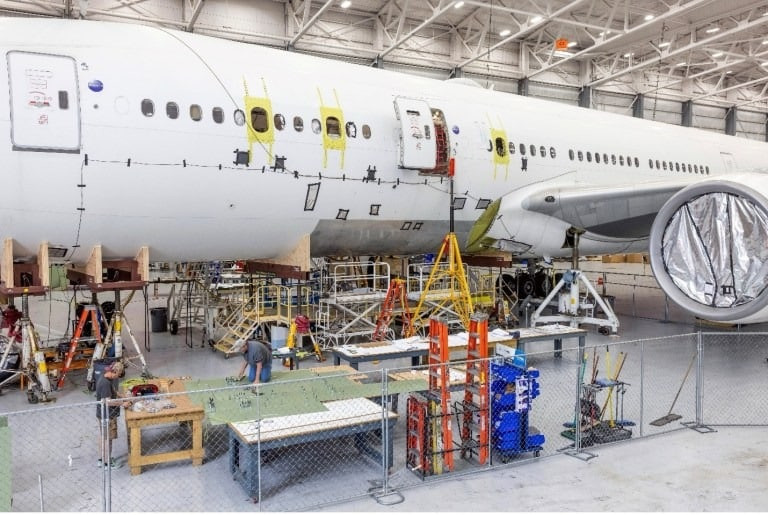
Such significant structural adaptations are rare for a jet of this scale. Engineers balanced maintaining airframe strength with creating spaces suited to sensitive research hardware. This results in a seamless integration of long-range aviation design and specialized scientific capabilities.
A New Standard for Airborne Scientific Exploration
The enhanced Boeing 777 can sustain flights lasting up to 18 hours, allowing for continuous data acquisition across extensive distances. NASA reports indicate this longevity surpasses that of earlier airborne platforms by a wide margin.
With a maximum load of approximately 34 metric tons and able to ascend to 43,000 feet, the aircraft accommodates diverse instruments reaching high altitudes. Its range near 9,000 nautical miles enables missions to isolated locations such as the Arctic and North Atlantic without mid-route refueling.
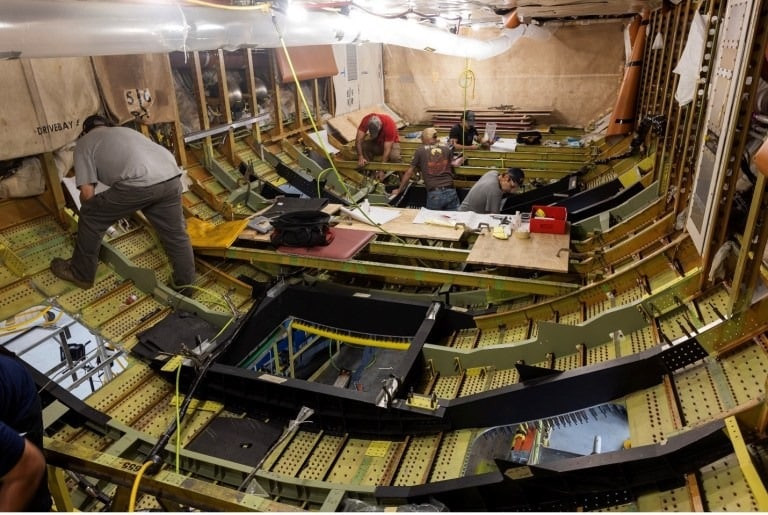
Inside, the cabin is redesigned to accommodate up to 100 researchers simultaneously. This setup transforms the aircraft into a dynamic research environment allowing scientists to evaluate data and modify experiments during flight, reducing reliance on post-mission analysis. As Derek Rutovic, NASA’s Airborne Science Program manager, explains:
“Airborne missions at NASA use cutting-edge instruments to explore and understand our home planet. The 777 will be the largest airborne research laboratory in our fleet, collecting data to improve life on our home planet and extend our knowledge of the Earth system as a whole.”
Upcoming Mission to Study Polar Vortex Behavior
The Boeing 777’s inaugural mission, NURTURE (North American Upstream Feature-Resolving and Tropopause Uncertainty Reconnaissance Experiment), is slated for January 2027 led by NASA’s Langley Research Center. This campaign will concentrate on tropopause polar vortices, atmospheric phenomena linked to intense winter ice storms.
NASA highlights that these vortices are capable of triggering substantial icing events that disrupt infrastructure and transportation. Monitoring their movement from North America to Greenland is expected to refine weather forecasting models significantly.
“We’ve been completing the engineering design and analysis to install the NURTURE payload into the aircraft in parallel with the portal modification. We’re excited to get the airplane back home to NASA and on the road to its first mission,” Rutovic explained.
- Categories:
- Nasa








0 comments
Sign in to Comment