
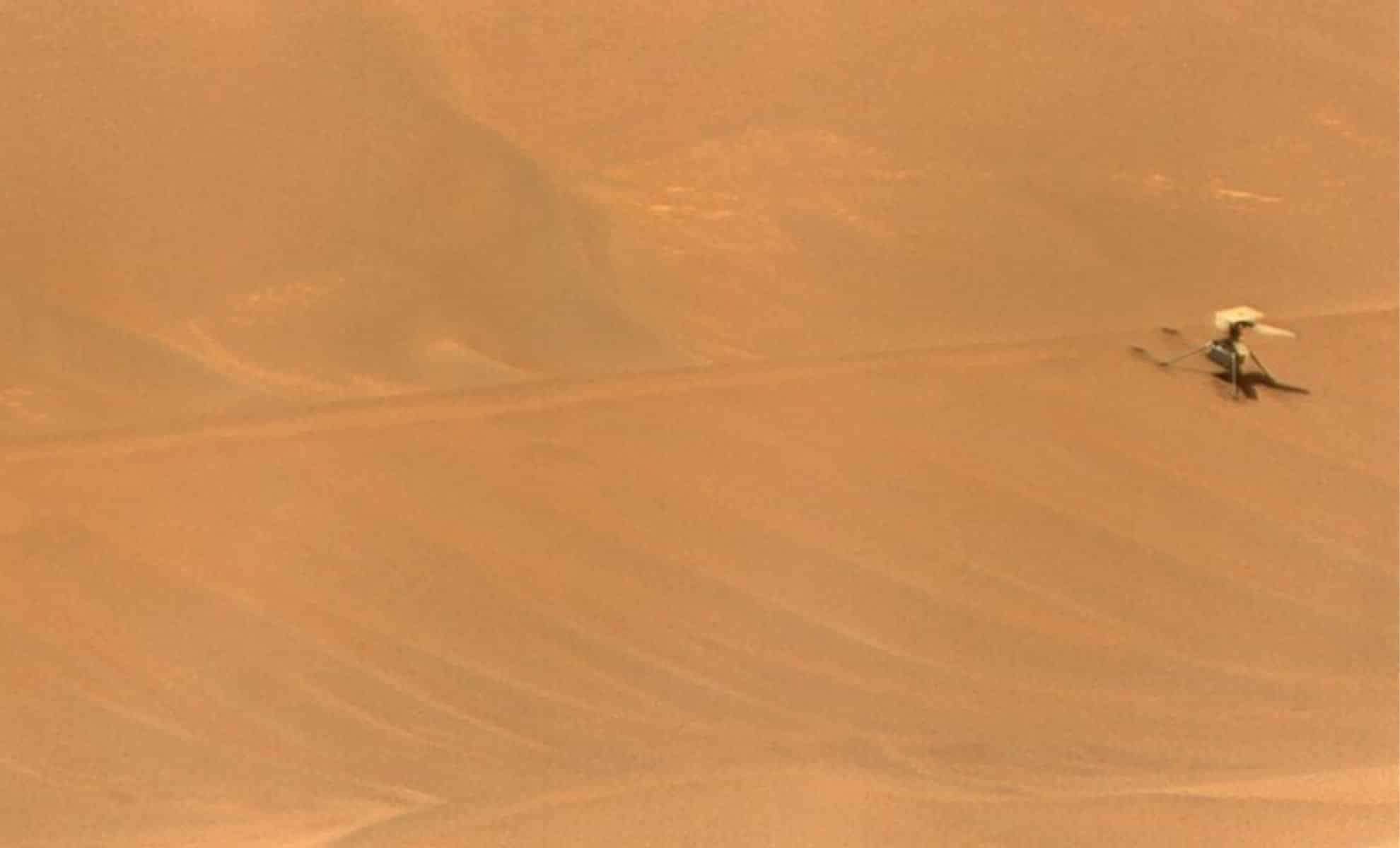
For the first time ever, NASA has carried out an investigation into an aircraft incident beyond Earth, analyzing the crash of the Ingenuity Mars Helicopter. On January 18, 2024, during its 72nd flight, the helicopter endured a severe landing. Originally intended for only five experimental flights, Ingenuity surpassed expectations by operating for nearly three years and completing 72 flights, unlocking new possibilities for exploring distant planets. This final flight exposed critical weaknesses, prompting NASA engineers to delve into the causes of the accident. Their pioneering assessment sheds light on Ingenuity’s difficulties and offers valuable takeaways for future Martian flight endeavors.
Investigating the Incident
The plan for Ingenuity’s 72nd flight was straightforward: ascend to 40 feet (12 meters), hover momentarily, then safely land. But during descent, contact with the helicopter was lost, and telemetry indicated a hard crash landing. Specialists at NASA’s Jet Propulsion Laboratory (JPL) carefully reviewed data to identify what went awry.
“Conducting an accident review from nearly 100 million miles without black boxes or eyewitnesses is quite a challenge,” said Håvard Grip, the helicopter's original pilot at JPL. The team depended on telemetry and images sent before communication ended. Grip noted the most plausible explanation: “A lack of contrasting surface features gave the navigation system insufficient visual information.”

The navigation system of Ingenuity relies on a downward-facing camera to detect ground patterns, calculating speed and position. The landing area at Jezero Crater featured smooth sandy ground, providing too few visual references for the system. Consequently, the helicopter lost precise orientation, causing a rough landing. This event underscores the need for navigation technologies that can adapt to varied terrains, a vital lesson for upcoming Mars missions.
A Trailblazing Mars Aircraft Design
Despite the crash, Ingenuity’s mission remains a major triumph. It was the first powered aircraft to fly on another planet and exemplified innovative, budget-conscious engineering. Teddy Tzanetos, JPL project manager for Ingenuity, highlighted the novel aspects of its design. “Ingenuity was crafted to be low-cost while delivering massive computing power. We became the first mission to deploy commercial off-the-shelf cellphone processors in deep space,” he explained.
This economical, lightweight design enabled NASA to explore a new paradigm for spacecraft construction. Unlike traditional spacecraft heavily fortified against radiation and built with custom parts, Ingenuity utilized readily available hardware adapted for Mars’ harsh conditions. Impressively, the helicopter operated almost continuously for four years, proving smaller, affordable systems can succeed in extreme environments.
“Approaching four years of nonstop operation shows that space hardware doesn’t always need to be large, heavy, and radiation-hardened to function on Mars,” Tzanetos remarked. This achievement paves the way for affordable spacecraft designs that could revolutionize Mars exploration.
Shaping the Future of Martian Aerial Exploration
Although Ingenuity’s final flight concluded its extraordinary journey, the helicopter’s influence endures in shaping space missions ahead. Over 72 flights, it validated the concept of aerial exploration on Mars, delivering precious data about how rotorcraft perform in the thin atmosphere. Insights from these flights, including the last, are guiding the development of next-generation Martian aircraft.
“Ingenuity has provided the confidence and data needed to envision future Mars flight,” Tzanetos stated. NASA is advancing concepts for larger helicopters capable of carrying scientific tools and autonomously surveying terrains unreachable by ground vehicles. These aerial drones could fundamentally alter Martian exploration by reaching cliffs, caves, and other challenging sites.
The helicopter also proved valuable for working alongside the Perseverance rover, acting as a scout by scouting routes and points of interest. This collaboration between aerial and surface vehicles is likely to be a cornerstone of future Mars missions.
- Categories:
- News











0 comments
Sign in to Comment