
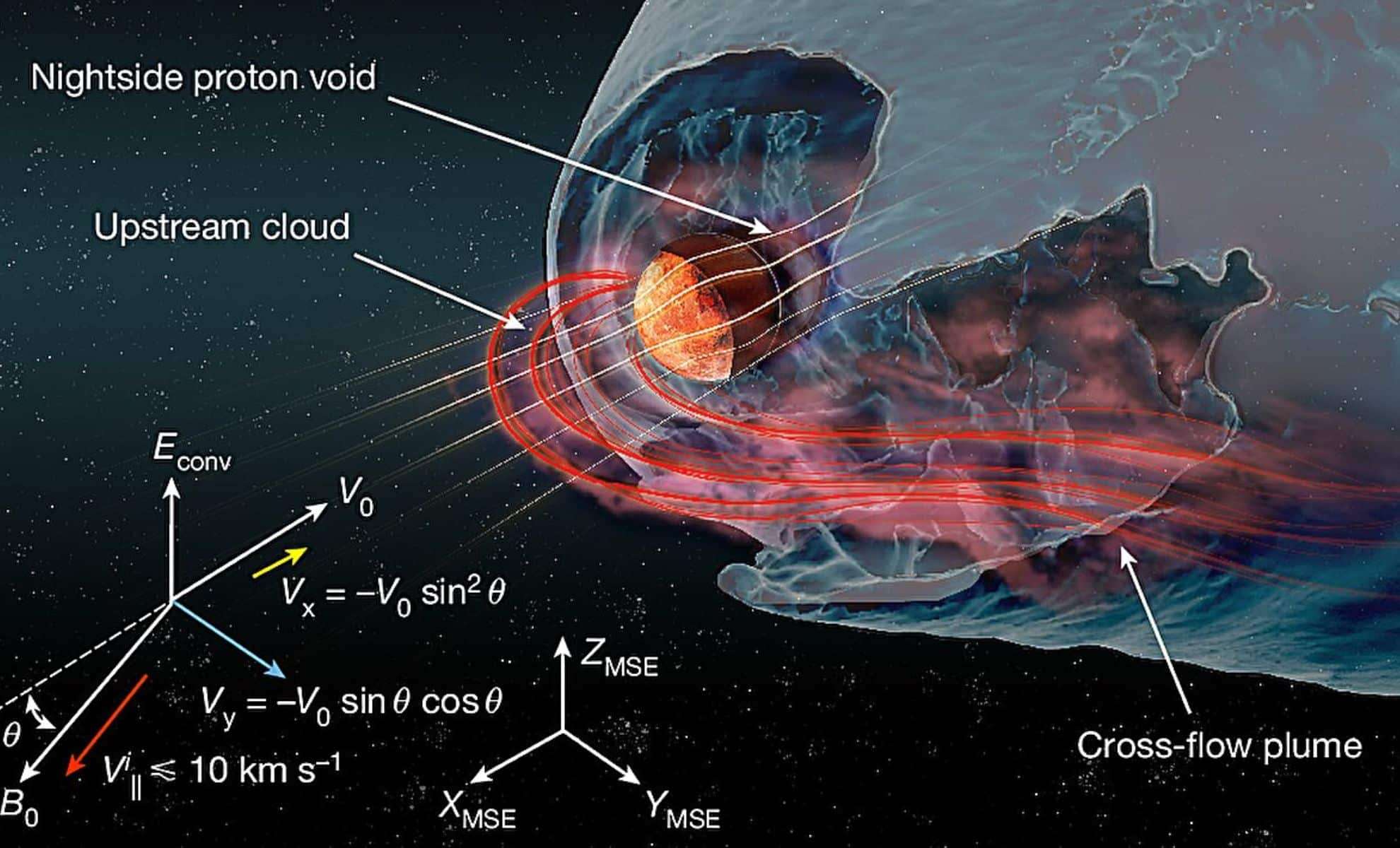
Scientists have uncovered unexpected details about how Mars’ induced magnetosphere interacts with the solar wind, revealing that certain factors can cause a marked weakening of Mars' magnetic shield. Researchers from the Swedish Institute of Space Physics (IRF) and Umeå University conducted this investigation, shedding light on how solar wind conditions impact the Red Planet’s atmosphere and magnetic environment, with important consequences for atmospheric erosion.
The Distinctive Nature of Mars’ Magnetosphere
In contrast to Earth’s strong internal magnetic field, Mars possesses an induced magnetosphere created by interactions between its atmosphere and the solar wind—a continuous flow of charged particles from the Sun. This interaction generates a transient magnetic shield that safeguards Mars from harmful solar radiation. However, when the solar wind protons align with the magnetic field carried by the solar wind, this protective bubble can deteriorate or even collapse.
Ph.D. candidate Qi Zhang from IRF and Umeå University highlights this dynamic: “Alignments between solar wind proton flows and the solar wind's magnetic field lead to the degeneration of Mars’ induced magnetosphere, which directly affects the planet’s atmospheric escape rate.” Such degradation accelerates the leakage of Mars’ tenuous atmosphere into space.

Insights from Mars Express and MAVEN Observations
The team analyzed over two decades of measurements from instruments aboard the Mars Express (ESA) and MAVEN (NASA) missions, both equipped with the ASPERA-3 instrument developed by IRF. This device has been essential in constantly tracking ions, electrons, and neutral atoms surrounding Mars, enabling breakthroughs in understanding the planet’s atmospheric and magnetic conditions.
Combining extensive computer modeling with observational data, researchers reconstructed how solar wind fluctuations trigger the breakdown of Mars’ magnetic shield. This advancement is vital for grasping how Mars’ atmosphere has evolved and its ability to retain oxygen and other gases over time.
Consequences for Atmospheric Loss on Mars
Over billions of years, Mars has experienced a gradual depletion of its atmosphere. This study offers new clarity on one process that hastens this loss: the magnetosphere’s collapse under specific solar wind alignments enables increased atmospheric particle stripping into space. Understanding this mechanism is key to explaining Mars’ transformation from a possibly habitable world with liquid water to the cold, arid planet we observe today.
Previous research has linked solar wind effects to atmospheric erosion, but this work details how proton-magnetic field alignment intensifies changes in Mars’ magnetospheric behavior. Extensive data from the ASPERA-3 instrument on ion outflows have been pivotal in revealing these processes, contributing valuable insights into atmospheric escape phenomena.
Looking Ahead: Mars’ Atmospheric Evolution
The findings spark new questions about how Mars’ magnetosphere varies with solar wind conditions and the implications for its atmospheric stability. Continued monitoring by MAVEN and Mars Express missions will expand understanding, and similar phenomena may be explored on other solar system planets.
Qi Zhang and colleagues will keep examining the long-term climate and habitability impacts of solar wind-driven magnetosphere changes. This research highlights the complex interaction between Mars and its space environment, offering crucial clues about planetary climate evolution and atmospheric endurance.
By deepening knowledge of these interactions, scientists will refine models of Mars’ climate history and assess its potential for life. The study, published in the prestigious journal Nature, represents a major advance in comprehending space weather effects on planetary atmospheres.
In summary, this research reveals the vulnerability of Mars’ induced magnetosphere under certain solar wind conditions and its role in the planet’s ongoing atmospheric depletion. Future exploration and studies will continue to investigate these phenomena, enhancing our understanding of Mars’ past, present, and prospects for exploration.
- Categories:
- Astronomy ,
- News ,
- Science ,
- Physics






0 comments
Sign in to Comment