
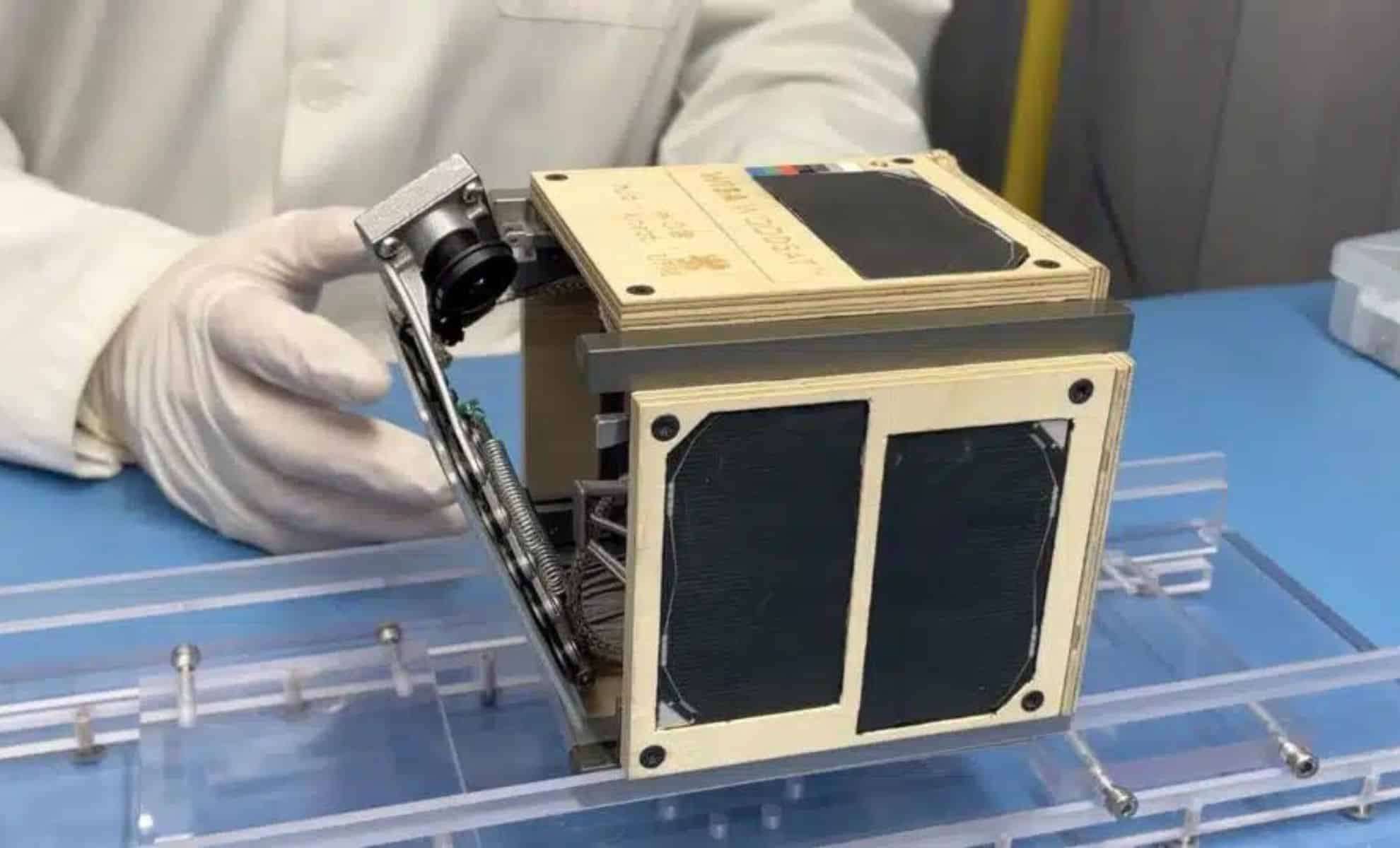
Japanese scientists have achieved a milestone by crafting the globe’s inaugural wooden satellite, named LignoSat. This creation merges age-old materials with cutting-edge aerospace technology, marking a novel approach to satellite engineering.
Produced through a partnership between Kyoto University and Sumitomo Forestry Co., LignoSat is the result of four years of dedicated work focused on improving sustainability and reducing costs in satellite manufacturing. This project aims to showcase that wood, a renewable natural resource, can play a valuable role in space exploration hardware.
This innovation reflects Japan’s dedication to advancing eco-friendly solutions in the realm of outer space technology.

Innovative Construction and Materials
LignoSat exemplifies a seamless blend of traditional craftmanship and contemporary design. The small satellite measures 10 centimeters on each side and is mainly composed of magnolia wood panels ranging from 4 to 5.5 millimeters thick. Its frame includes aluminum parts to strengthen its structure.
The satellite’s assembly rejects screws and adhesives, employing instead classic Japanese joinery techniques that emphasize sustainability and mechanical resilience. Solar panels cover several faces of LignoSat, and the entire unit tips the scales at around 1 kilogram.
Stringent durability assessments confirm that the wooden materials endure the extreme environment of space effectively. The satellite's development involved thorough thermal and vacuum trials to guarantee it withstands harsh outer space conditions.
Eco-Friendly Advantages and Innovation
A key driver for creating LignoSat is its environmental benefit compared to traditional metallic satellites. Conventional satellites produce alumina particles during atmospheric re-entry, potentially disrupting weather and communications, whereas wooden satellites disintegrate more cleanly, minimizing ecological impact.
This project spotlights wood’s potential as a sustainable resource for aerospace engineering. By pioneering this unconventional material, researchers aim to open new horizons for environmentally responsible space technologies. LignoSat’s success may encourage future green satellite designs, helping reduce space debris and boosting ecological stewardship.
Launch Plans and Mission Overview
LignoSat is set for launch via a SpaceX rocket from the U.S. in September. Prior to its launch, the satellite will be delivered to the Japan Aerospace Exploration Agency (JAXA) on June 4. Following launch, it will be transported to the International Space Station (ISS) and deployed into orbit about a month later.
The world’s first wooden satellite has been built by Japanese researchers.
The tiny cuboid craft is expected to be blasted off on a SpaceX rocket in Septemberhttps://t.co/C2ydPZaofw pic.twitter.com/iH6LAzfmVZ
— AFP News Agency (@AFP) May 29, 2024
The mission’s objective is to gather data transmitted by LignoSat, providing valuable insights into the viability of wood as a space-grade material. These findings could pave the way for new sustainable methods in satellite creation and space technology applications.
Japan’s Vision for Sustainable Space Exploration
Looking ahead, developers of LignoSat plan to push the boundaries by creating satellites where even electronic substrate components are crafted from wood. Such innovations could transform aerospace manufacturing, aligning it with global efforts toward environmental sustainability.
The creation and upcoming deployment of LignoSat emphasize both the resourcefulness of Japanese scientific research and a major stride towards reducing the ecological footprint of space missions. As space endeavors expand, projects like this highlight the exciting possibilities of blending natural resources with advanced technology.
The ongoing exploration may spark similar eco-conscious projects worldwide, demonstrating how traditional craft can meet and enhance modern scientific achievement in space exploration.
- Categories:
- Astronomy ,
- News ,
- Space ,
- Aircraft












0 comments
Sign in to Comment