
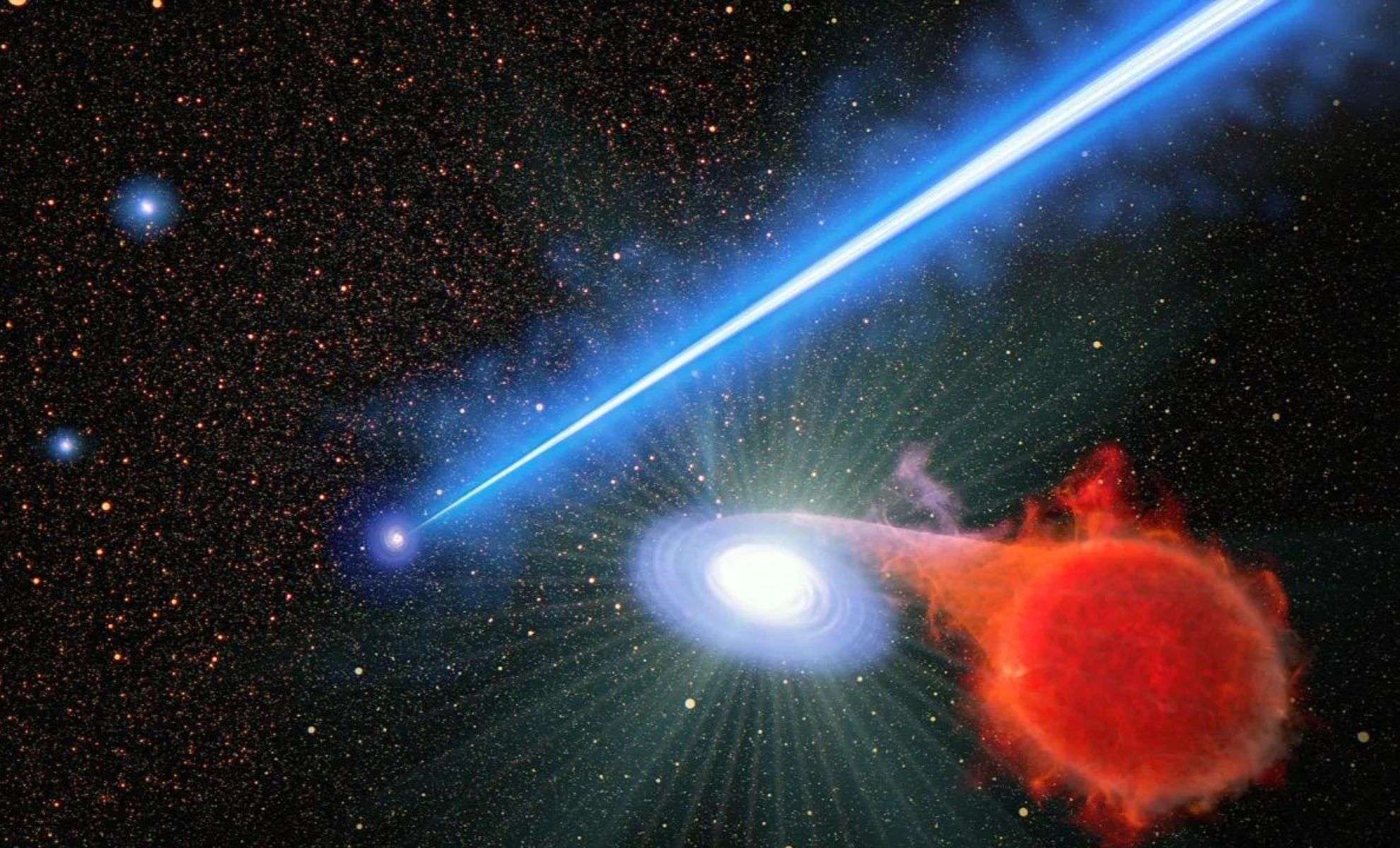
Astronomers utilizing the Hubble Space Telescope have uncovered that jets streaming from supermassive black holes can instigate explosive events in adjacent stars, a dynamic never documented before.
This investigation centers on the M87 galaxy, which harbors an enormously massive black hole weighing 6.5 billion times the Sun’s mass. The study illustrates that jets from this black hole are directly linked to triggering stellar outbursts called novae within binary star systems, revealing a surprising connection between intense black hole activity and the evolution of stars.
The Reach of Black Hole Jets Across Space
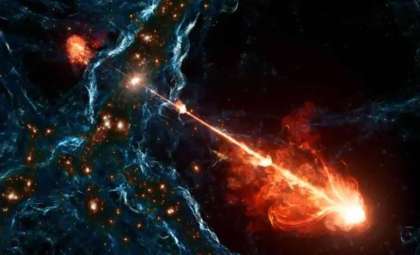
Situated roughly 54 million light-years away from Earth, the core of M87 houses one of the largest known black holes. Captured famously in a 2019 image by the Event Horizon Telescope, this black hole emits a powerful plasma jet extending over 3,000 light-years. Traveling close to the speed of light, this jet consists of extremely energetic particles and has been recognized as a prominent feature of the galaxy. New Hubble data, however, unveils that the jet’s influence extends further, significantly affecting stars in its surrounding areas.

Researchers observed that stars located near the path of the jet experience nova explosions at twice the rate compared to stars elsewhere in M87. These novae arise in binary systems where a white dwarf gradually draws hydrogen from its companion star. Once enough hydrogen accumulates on the white dwarf’s surface, it ignites a thermonuclear blast. While novae commonly occur in various galaxies, the heightened eruption frequency close to the jet in M87 is unusual, especially since these stars aren’t caught directly in the jet’s stream.
Alec Lessing of Stanford University, the leading author, reflected, “This unexpected phenomenon challenges our current understanding of how black hole jets interact with their environments. The stars being outside the jet’s direct path yet still affected is especially puzzling.” The observations suggest that the jet exerts a profound but indirect impact on these nearby stellar systems.
Exploring How Jets Might Trigger Novae
The precise process behind jet-induced nova eruptions remains uncertain, though several compelling ideas have emerged. One theory proposes the jet functions like a cosmic “snowplow,” pushing hydrogen gas towards the white dwarf and accelerating nova formation. Another possibility is that intense radiation pressure from the jet influences the rate at which hydrogen transfers from the companion star to the white dwarf.
Lessing hypothesized, “Perhaps the jet indirectly pushes hydrogen fuel onto the white dwarfs, triggering more frequent outbursts. However, this effect might not involve direct physical pushing but rather the influence of radiation pressure.” Although these scenarios are promising, definitive evidence is still lacking. Some scientists also suggest the jet’s energy might warm the companion star, prompting greater hydrogen transfer, but current models indicate this heating alone is unlikely to produce the observed increase.
The significance of this finding is underlined by robust statistics. Over a nine-month observational campaign, Hubble detected double the number of novae erupting near M87’s jet compared to other areas in the galaxy. “The discovery emerged simply by examining the images,” said Michael Shara from the American Museum of Natural History, a co-researcher. “Our statistical analysis confirmed what was apparent visually.” This elevated nova incidence strongly supports the notion that the jet influences surrounding stellar systems, though the exact mechanisms remain elusive.
Hubble’s Unique Contribution to Detecting Stellar Outbursts
This breakthrough was made possible by the unparalleled clarity and precision of the Hubble Space Telescope, which has been peering into the cosmos for more than three decades. Unlike ground-based observatories, Hubble can sharply resolve individual stars within the bright central zones of galaxies like M87, capturing subtle nova outbursts against the luminous galactic background.
The research team conducted repeated imaging of M87 every five days over nine months using Hubble’s advanced wide-field cameras, producing the deepest ever images of this galaxy. They cataloged a total of 94 nova events, with their spatial pattern clearly showing a twofold increase in explosions close to the jet. “Although we surveyed the entire inner galaxy, the heightened concentration of novae near the jet was unmistakable,” Shara commented. “The excess was so evident, statistical verification wasn’t even necessary.”
Broader Consequences for Galaxy and Black Hole Dynamics
This revelation prompts fresh inquiries about the wider effects of black hole jets on their host galaxies. It has long been accepted that jets influence galaxy formation and star creation, but the discovery that they may also trigger novae highlights a more intricate and extensive interaction. These nova outbursts expel stellar material back into space, enriching the interstellar medium and potentially shaping the galaxy’s future development.
Moreover, the findings emphasize how much remains unknown about the interplay between supermassive black holes and their environments. While Hubble has offered a valuable glimpse, upcoming instruments like the James Webb Space Telescope and cutting-edge terrestrial telescopes are expected to provide deeper understanding of how black hole jets affect nearby stars.
Ultimately, this exceptional discovery deepens our grasp of black holes, some of the universe’s most mysterious phenomena. Beyond their reputation for destruction, black holes may also influence stellar life cycles, demonstrating the complex connections that weave together cosmic events. The M87 jet exemplifies how even at enormous distances, black holes can ignite remarkable cosmic processes, with far-reaching implications yet to be unraveled.
- Categories:
- Astronomy ,
- News ,
- Space ,
- Nasa






0 comments
Sign in to Comment