
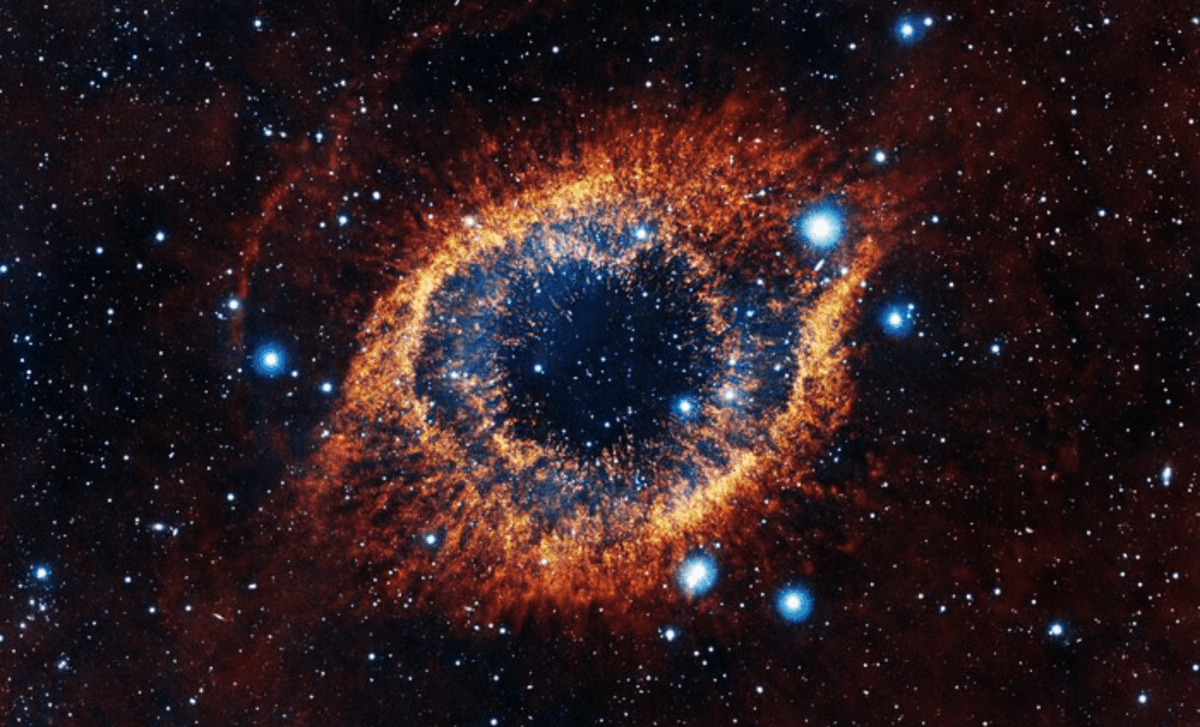
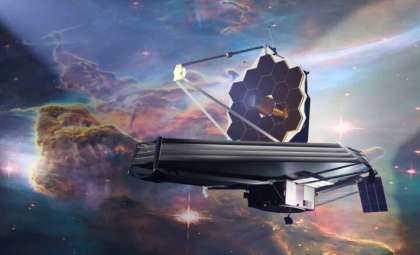
Located within the constellation Aquarius, a star nearing the end of its life is putting on one of the cosmos’ most stunning displays, now captured in remarkable clarity. The James Webb Space Telescope (JWST) has focused its near-infrared instruments on the Helix Nebula, a nearby and well-known planetary nebula, uncovering an intricate celestial dance of gas, dust, and light. Previously seen as a distant, colorful ring, this nebula now reveals a complex scene shaped by stellar forces over time.
An Unprecedented Perspective on a Renowned Nebula
NASA's recent release unveils a captivating new image of the Helix Nebula, situated about 650 light-years away in the Aquarius constellation. Captured through the JWST’s Near-Infrared Camera (NIRCam), this detailed view offers the closest look yet at a star expelling its outer layers during its dying stages.
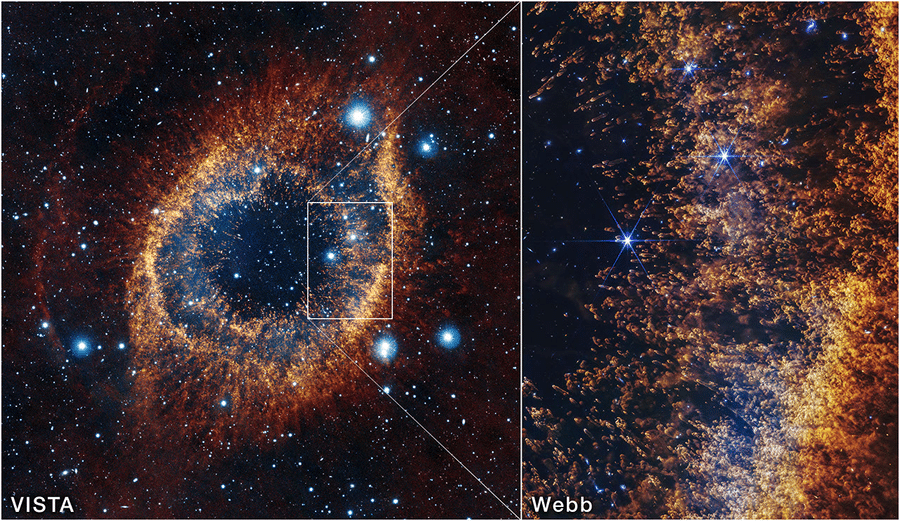
JWST’s NIRCam unveiled numerous comet-shaped knots, shockwave boundaries, and vast expansive layers of glowing gas that trace the star’s last evolutionary phases. These features emerge as fast, hot winds collide with cooler, slower shells of matter previously released. This interplay creates a vivid scene depicting destruction and renewal, where the dying star disperses raw materials essential for forming new worlds.

Often called the “Eye of Sauron” due to its distinctive circular shape, the Helix Nebula has fascinated astronomers for nearly 200 years. Now, Webb’s exceptional resolution has transformed our view of this cosmic landmark, exposing details unseen by earlier space telescopes such as Hubble and Spitzer.
Infrared Insights from Webb: Revealing the Unseen
The near-infrared capabilities of the James Webb Space Telescope enable astronomers to look through obscuring dust and uncover hidden structural elements invisible at visible wavelengths. Webb’s latest images illustrate a breathtaking temperature gradient, from the intense ultraviolet-blue gases near the central white dwarf to the cooler red areas where molecular hydrogen forms in dense clumps.
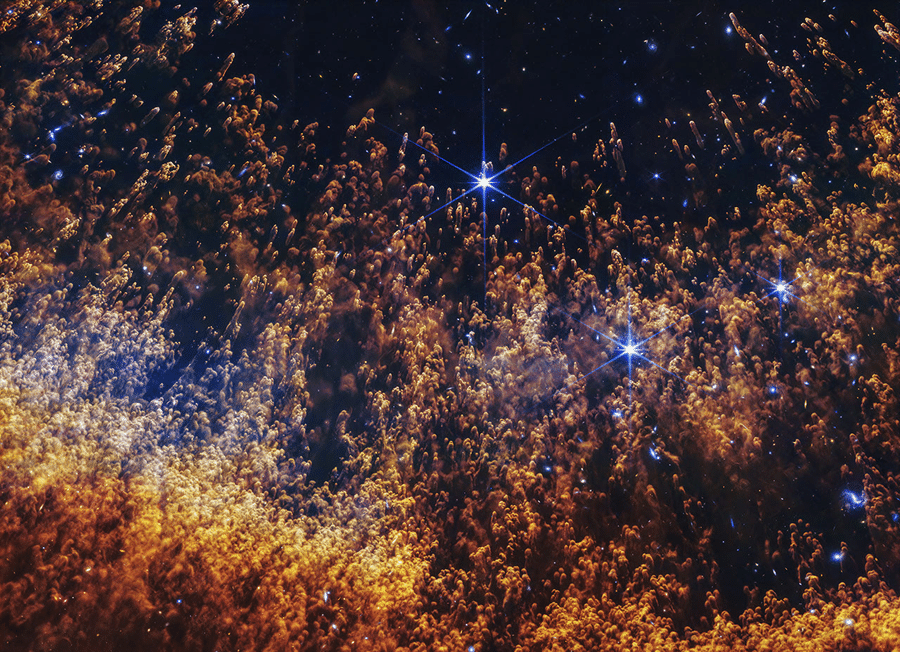
The vivid color coding illustrates a narrative of cosmic transformation. The scorching core emits powerful radiation that ionizes nearby gas, causing the inner shell to glow. Further out, as temperatures drop, molecules form hydrogen, carbon-bearing compounds, and dust grains—the fundamental components needed for future planetary systems. Webb’s detailed resolution reveals sheltered pockets where complex molecules could begin forming, supporting theories that planetary materials often originate from the death throes of stars.
The Helix Nebula’s stratified structure symbolizes both a conclusion and a fresh start: a star’s collapse fueling the birth of new cosmic cycles. Captured more clearly than ever, this process provides a glimpse of what may one day transpire when our Sun enters its giant phase billions of years from now.
From Hubble to Spitzer to Webb: Advancing Our Cosmic Vision
Astronomers have studied the Helix Nebula through various observatories, including NASA’s Hubble and Spitzer telescopes, along with ground-based tools like the Visible and Infrared Survey Telescope for Astronomy (VISTA). Each has revealed unique aspects of the nebula: visible light from Hubble, mid-infrared spectra from Spitzer, and now the near-infrared lens of Webb peeling back further layers.
Hubble’s visible-light images depicted the Helix as an ethereal swirl of turquoise and pink gas outlining an expanding shell. Spitzer shed light on the molecular makeup, detecting carbon-rich zones and early dust formation. Webb’s superior resolution and sensitivity synthesizes this information into a stunning, high-definition panorama, exposing how fierce stellar winds shape the nebula and revealing a tumultuous activity within its core unmatched by earlier views.
These breakthroughs reshape our understanding of the Helix Nebula and expand knowledge of stellar life cycles across the galaxy. By integrating Webb data with legacy observations, scientists can better model how Sun-like stars lose their envelopes, how dust grains emerge, and how new planetary systems might arise after a star’s death.
The Enduring Cosmic Influence of the Helix Nebula
Webb’s newly revealed images emphasize an essential cosmic truth: the universe continually recycles its components. The glowing shells of the Helix Nebula, remnants of a star once resembling our Sun, will slowly disperse over tens of thousands of years, enriching the interstellar medium with vital elements such as carbon, oxygen, and nitrogen. These are key to forming planets, atmospheres, and eventually supporting life.
By charting the nebula’s temperature variations and chemical composition, researchers track how simple atoms combine into complex molecules, bridging stellar death to the formation of emerging solar systems. Every pixel in Webb’s image narrates a cycle where one star’s demise seeds the genesis of countless others.
The James Webb Space Telescope, a collaborative project of NASA, the European Space Agency (ESA), and the Canadian Space Agency (CSA), is revolutionizing astronomy. Its infrared perspective continues to reveal hidden phases of star life cycles, greatly enriching our cosmic understanding.
- Categories:
- Space




0 comments
Sign in to Comment