
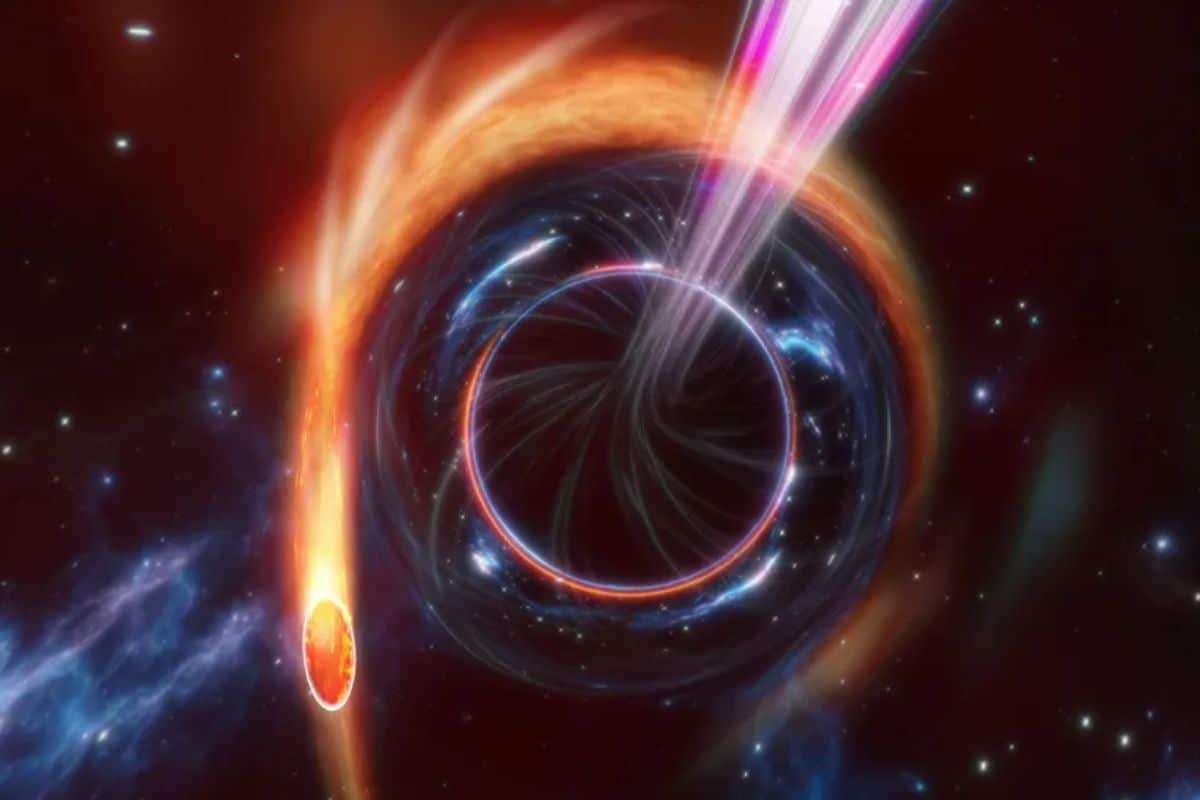
An enormous supermassive black hole within the galaxy SDSS1335+0728, approximately 300 million light-years away from Earth, has unexpectedly erupted with a series of extraordinarily powerful X-ray bursts.
Initially detected in late 2019 and continuously observed by space observatories from NASA and ESA, this black hole—now called Ansky—is releasing bursts of radiation that defy previously known astrophysical patterns.
An Unusual Revival in the Cosmos
The first sign of Ansky's reactivation came in late 2019 when it emitted distinctive X-ray signals. Subsequent studies using NASA’s Swift X-ray telescope, along with ESA’s XMM-Newton, Chandra, and additional missions, confirmed that this previously quiet black hole had entered a remarkably active phase.
This activity features quasiperiodic eruptions (QPEs), brief, repeating X-ray flashes believed to result from the black hole devouring nearby matter, but Ansky exhibits levels of energy and repetition unlike any seen before.
Unmatched Intensity and Duration of Bursts
“The X-ray bursts emanating from Ansky are roughly ten times longer and more intense than typical QPEs,” explained Joheen Chakraborty from the Massachusetts Institute of Technology (MIT).
“Each eruption emits about a hundredfold more energy compared to previous observations.” Furthermore, Ansky’s eruptions follow the longest interval recorded between bursts, approximately 4.5 days.

No Evidence of Stellar Tides
While QPEs often correspond with tidal disruption events, where a black hole tears apart a star and consumes the resulting debris, no such evidence appears near Ansky, adding to the enigma surrounding this black hole’s behavior.
“We previously assumed QPEs arose from smaller objects spiraling into massive black holes,” stated Erwan Quintin, an X-ray astronomer with ESA. “However, Ansky’s activity suggests a different mechanism is at work.”
Potential Links to Gravitational Wave Detection
The extraordinary nature of Ansky has significant implications for upcoming ventures such as LISA (Laser Interferometer Space Antenna), a collaborative ESA/NASA mission designed to observe gravitational waves from space.
“These recurrent X-ray bursts could be connected to gravitational waves that the future LISA mission might detect,” Quintin added. “Coordinated X-ray and gravitational wave observations will be essential to unravel the puzzling phenomena of massive black holes.”
Expanding the Frontiers of Black Hole Research
The powerful eruption patterns and unprecedented timing from Ansky are testing the boundaries of current scientific models. “Our theoretical frameworks are being stretched by these findings, prompting us to rethink how such intense X-ray emissions are generated,” Chakraborty remarked.
The research community now seeks extended observation efforts to collect further data needed to decode Ansky’s behavior. These groundbreaking results were published in Nature Astronomy in March 2024, marking a significant advance in the study of active galactic nuclei (AGN) and their complex dynamics.
- Categories:
- Space




0 comments
Sign in to Comment