

On October 14, 2024, NASA launched its Europa Clipper spacecraft aboard a SpaceX Falcon Heavy rocket from Florida’s Kennedy Space Center.
This mission is dedicated to exploring Europa, one of Jupiter’s intriguing moons, which is believed to conceal a vast ocean beneath its icy crust—an environment that might be hospitable to life. After over ten years of preparation, the mission marks a major advance in the quest to determine the potential for life beyond Earth.
Investigating a Hidden Ocean
The Europa Clipper initiative is a pioneering venture aimed at probing one of the most fascinating bodies in our solar system. Slightly smaller than the Moon, Europa has captured scientific attention because of strong evidence suggesting it houses a deep ocean beneath its frozen surface. This ocean likely interacts with the moon’s rocky interior, potentially creating conditions suitable for life. Data from earlier missions, including NASA’s Galileo spacecraft, hinted at a salty ocean that might contain more water than all of Earth’s oceans combined.

NASA Administrator Bill Nelson emphasized the mission’s significance: “Exploring Europa will broaden our understanding of whether life could exist beyond our solar system amid countless moons and planets surrounding other stars.” Europa Clipper will perform 49 close flybys, swooping within 16 miles (25 kilometers) of Europa’s surface, employing nine scientific instruments to conduct near-global mapping. This approach protects the spacecraft from Jupiter’s intense radiation, enabling it to sustain its instruments for extended research.
A key focus will be verifying the existence of water plumes potentially erupting from fractures in Europa’s ice. Its ice-penetrating radar is designed to detect these plumes and measure the ice’s thickness, which could reveal vital clues about the ocean beneath and how it exchanges materials with the surface—essential for assessing Europa’s potential to support life.
Tackling Radiation and Technical Hurdles
Europa Clipper’s voyage faces major challenges, especially from Jupiter’s harsh radiation environment, which is roughly 20,000 times more intense than Earth’s. To protect its sensitive equipment, the spacecraft is shielded within a radiation vault crafted from titanium and aluminum. Its mission plan includes brief, intense flybys every two to three weeks, allowing it to collect critical data while spending most of its orbit in safer zones, minimizing radiation damage.
A significant engineering test in May 2024 revealed some spacecraft components required additional validation for Jupiter’s radiation levels, threatening delays. Nevertheless, the team conducted necessary assessments promptly to maintain the schedule. Europa Clipper program scientist Curt Niebur reflected, “This past year was the most challenging to finalize Europa Clipper, but we remained confident in the mission’s value.”
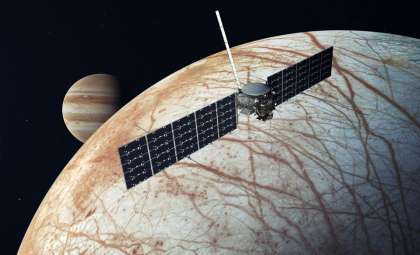
Powering the mission are the largest solar panels ever flown on a NASA interplanetary craft, extending 100 feet (30.5 meters) when deployed, to capture the limited sunlight reaching Jupiter. Scientific instruments include high-resolution cameras, spectrometers for surface analysis, a magnetometer to investigate ocean properties, and a mass spectrometer for examining particles in Europa’s tenuous atmosphere or plumes. Deputy project scientist Haje Korth highlighted their importance: “Data from the mass spectrometer and dust detector will reveal if Europa’s environment possesses the essential chemistry to sustain life.”
A Lengthy Voyage Ahead
Europa Clipper is expected to reach Jupiter in April 2030 after traversing approximately 1.8 billion miles (2.9 billion kilometers). The spacecraft will use gravity assists from Mars in 2025 and Earth in 2026 to boost its speed and conserve fuel, a vital strategy for interplanetary journeys.
Upon arrival, Europa Clipper will complement the European Space Agency’s Juice mission launched in 2023. While Juice surveys Jupiter’s larger moons like Ganymede and Callisto, Europa Clipper will focus intensively on Europa, a leading candidate in the search for extraterrestrial life. Together, the missions will provide a comprehensive overview of Jupiter’s system and its prospects for habitability.
Robert Pappalardo, Europa Clipper’s project scientist at NASA’s Jet Propulsion Laboratory, stressed the mission’s impact: “We aim to uncover Europa’s secrets, from its rocky interior and ocean beneath the ice to its thin atmosphere and space environment.” Findings will deepen our understanding of ocean worlds both in our solar system and beyond.
Global Cooperation and What’s Next
The Europa Clipper project embodies years of collaboration among NASA centers, international partners, and industry specialists. Since receiving approval in 2015, over 4,000 people have been involved. The spacecraft was developed at the Johns Hopkins Applied Physics Laboratory with support from NASA’s Jet Propulsion Laboratory and other U.S. institutions.
As NASA’s largest planetary spacecraft, Europa Clipper holds the promise to transform our knowledge of hidden ocean worlds. Its capability to investigate beneath the ice may pave the way for future missions, potentially including landers that could directly search for life signatures on Europa’s surface. NASA’s associate scientist Nicky Fox captures the excitement: “We eagerly anticipate the groundbreaking science Europa Clipper will deliver for generations.”
The mission’s ultimate objective is to assess Europa’s habitability. While it won’t detect life outright, the data gathered will guide upcoming efforts in the search for life. As Dr. Pappalardo stated, “Discovering an oasis on Europa with accessible liquid water and organic materials would be a game-changer—perhaps the ideal location for a future lander to hunt for life beneath the surface.”






0 comments
Sign in to Comment