

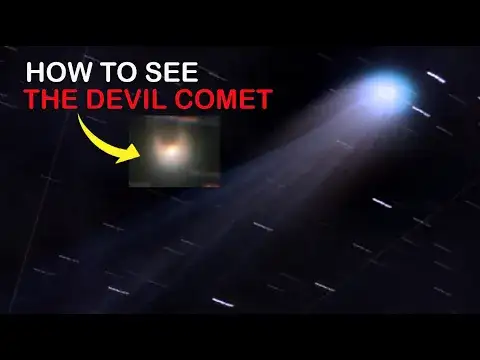
A groundbreaking report featured in Nature Astronomy presents strong evidence that certain comets have delivered water similar to that found on Earth, potentially playing a crucial role in establishing our planet’s life-supporting environment. Researchers concentrated on Comet 12P/Pons-Brooks, a Halley-type comet renowned for its intense gas emissions, earning it the moniker “Devil Comet.”
The Unique Journey of Comet 12P/Pons-Brooks From the Solar System's Outskirts
Comet 12P/Pons-Brooks is an imposing icy object approximately the scale of Mount Everest, completing an orbit around the Sun roughly every 71 years. Classified among Halley-type comets, it is an ancient traveler from the far reaches of the solar system, tracing elongated paths beyond Neptune. These icy bodies originate from distant reservoirs like the Oort Cloud or the Kuiper Belt, preserving primordial substances dating back to the solar system’s infancy.
Dubbed the Devil Comet because of its striking horn-shaped gas eruptions, 12P has fascinated observers with both its spectacular appearances and its newfound scientific significance. It made its recent approach in spring 2025, coinciding with visibility during the April total solar eclipse — its closest flyby since 1954.

Detecting Terrestrial-Like Water Beyond Earth
Utilizing the capabilities of the Atacama Large Millimeter/submillimeter Array (ALMA) in Chile and NASA’s Infrared Telescope Facility (IRTF) stationed in Hawaii, the team conducted detailed observations of water vapor enveloping 12P. Their focus was on analyzing the deuterium-to-hydrogen (D/H) ratio — a characteristic marker that helps differentiate the origins of water in space.
Remarkably, the D/H ratio detected in the Devil Comet closely mirrors that found in Earth’s oceans. This represents the first confirmation of such similarity in a Halley-type comet and stands as one of the most precise isotopic matches recorded between cometary water and Earth’s water.
Innovative Techniques Trace Water to the Comet’s Core
For the first time, researchers successfully distinguished between ordinary water (H₂O) and deuterated water (HDO) within the comet’s coma, the gaseous atmosphere surrounding its icy core. This approach enabled the team to pinpoint water emissions stemming from the comet’s interior rather than from surface-level reactions or sunlight interaction.
NASA astrophysicist Martin Cordiner, who spearheaded the investigation, emphasized that this detailed mapping demonstrates the water’s origin deep within the comet’s nucleus, ruling out surface contamination or gas-phase chemistry. This finding bolsters the idea that these ancient frozen bodies might have delivered genuine, unmodified water to our young planet.
Co-author Stefanie Milam from NASA elaborated on the significance: "Mapping both H₂O and HDO enables us to confirm whether the water vapor derives directly from the comet's internal ices, rather than forming through chemical reactions in the surrounding gas cloud."
Unraveling the Origins of Earth's Water
Early Earth likely started as a largely arid world, with extremely high temperatures prohibiting water retention. For many years, scientists have theorized that Earth's oceans were supplied by the impacts of water-containing debris such as comets or asteroids during the planet’s formative years.
However, earlier evidence often challenged this idea, as isotopic measurements did not closely align with terrestrial water. The discovery regarding 12P alters that narrative. "This is the most convincing proof yet," commented Cordiner, "that comets have contributed to making our planet hospitable for life."
Given the exceptional D/H isotopic similarity and verified internal water source, 12P/Pons-Brooks reinforces the concept that comets could have imported not only water but also complex organic molecules critical for life’s emergence on Earth.
Beyond a Spectacular Celestial Sight
This revelation carries profound significance beyond a single comet’s journey. It suggests that Halley-type comets, remnants from the solar system’s earliest epochs, may have exerted a more substantial influence on Earth’s environment than once thought.
The findings open new paths in studying planetary development through targeted investigations of comet groups exhibiting comparable D/H signatures. They also invigorate plans for upcoming missions such as ESA’s Comet Interceptor and NASA’s concept CAESAR project, which aim to analyze comet samples directly.
- Categories:
- News











0 comments
Sign in to Comment