
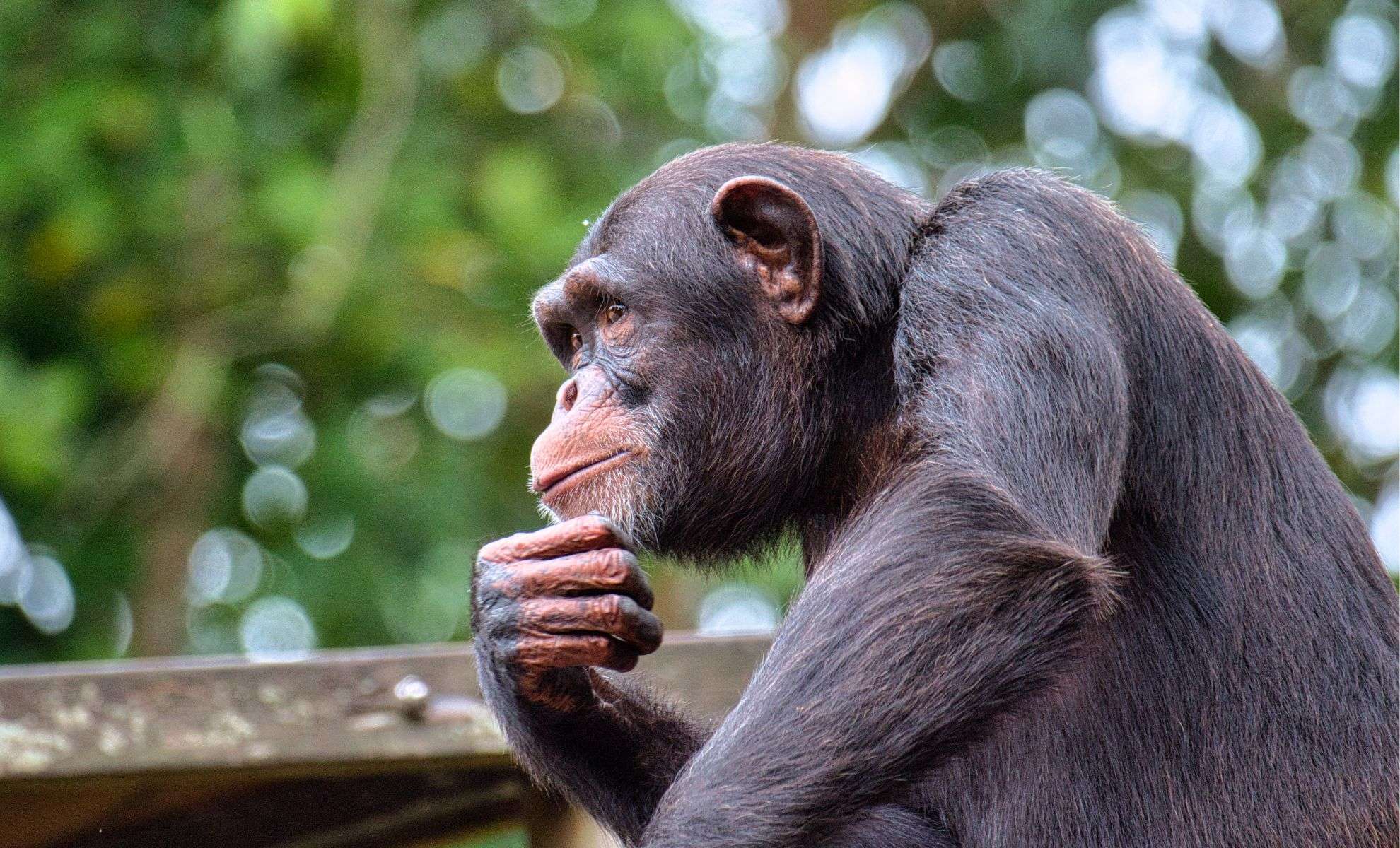
Groundbreaking research has sparked renewed interest in the vocal abilities of chimpanzees, indicating that under certain circumstances these primates might produce sounds resembling human speech.
Insights emerged from a thorough review of archival footage, revealing chimpanzees articulating words such as “mama” and “papa.” These discoveries question the longstanding assumption that speech is an exclusively human skill and may transform our understanding of great apes' mental and vocal abilities.
Insights From Historical Video Archives
A team of specialists in linguistics and psychology from Sweden, the United Kingdom, and Switzerland examined decades-old recordings of chimpanzees to assess their potential to replicate human speech patterns.

One remarkable case involved a chimpanzee named Johnny at the Suncoast Primate Center in Florida, who was observed vocalizing “mama” when a caretaker incentivized him with a red Twizzler.
This incident, captured on video 16 years ago, was interpreted as part of a reinforcement learning approach. Researchers noted that Johnny “understood that saying ‘mama’ would earn him treats within his dietary limits.”
Another significant discovery came from footage dating back to 1962, showcasing a chimpanzee named Renata in Italy. In this material, Renata consistently vocalizes “mama” when touched on the chin, a behavior the scientists identified as reinforcement learning. This rare evidence suggests chimpanzees have the vocal muscle control needed to form consonant and vowel sounds.
Ongoing Discussion Over Apes’ Speech Abilities
The possibility that chimpanzees can generate speechlike sounds has been a longstanding subject of scientific debate. Historically, it was believed that anatomical and neurological differences prevented primates other than humans from developing true speech.
Nonetheless, this new evidence suggests chimpanzees can imitate basic human words when appropriately prompted. The researchers emphasized that “the vocal production abilities of great apes have been undervalued. Chimpanzees possess the fundamental neural components required for speech.”
These findings lend support to the theory that early human language may have evolved from similarly simple vocalizations, as demonstrated by chimpanzees articulating words like “mama” and “papa.” This points toward an evolutionary connection regarding the emergence of spoken language shared with great apes’ ancestors.
Broader Impact and Prospects for Future Study
The significance of these discoveries urges a reevaluation of what separates human communication from that of our primate relatives. While chimpanzee vocal attempts do not reach the complexity or clarity of human language, the researchers describe these sounds as “word-like in essence.”
This suggests a foundational speech ability with potential implications for understanding both chimpanzee cognition and the roots of linguistic evolution.
Future research will aim to determine how effectively great apes can learn to produce more intricate vocalizations and to unravel the underlying neurological and anatomical mechanisms involved in these abilities.
The scientific team pointed out that “chimpanzees can produce potential ‘first words’ of spoken language,” underscoring the opportunity to deepen understanding of communicative and cognitive similarities between humans and primates. Such investigations hold promise for uncovering the evolutionary pathways that contributed to the development of human speech.
Demonstrating that chimpanzees might possess elementary speech capacity challenges existing perspectives and opens new research directions. These findings could enrich our appreciation of the shared cognitive and communicative traits between humans and our closest primate relatives, illuminating language’s evolutionary origins.













0 comments
Sign in to Comment