

For decades, scientists have theorized about a massive, unseen planet lurking in the distant reaches beyond Neptune, subtly influencing the trajectories of frozen objects at the solar system’s edge. A groundbreaking telescope now offers the potential to confirm this mysterious world’s existence.
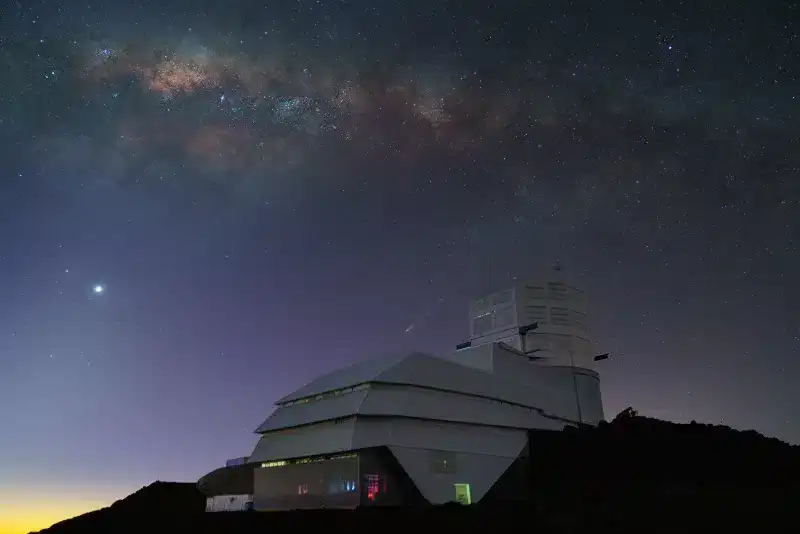
Situated atop a secluded mountain in Chile, the Vera C. Rubin Observatory is set to conduct the most detailed sky survey ever attempted. Among its exciting objectives, the quest to detect Planet Nine—a proposed giant planet thought to reside in the far-flung solar surroundings—has gained widespread attention. Recent coverage of this endeavor was featured on NPR.
The Hidden Giant That Challenges Astronomers
The concept of Planet Nine has intrigued researchers for years. Astronomical observations reveal unusual clustering in the orbits of trans-Neptunian objects—icy bodies orbiting far beyond Neptune—hinting at the gravitational pull of a massive planet yet to be directly observed.

One prominent advocate of this hypothesis is Mike Brown, the astronomer renowned for his role in reclassifying Pluto as a dwarf planet. Over the past decade, he and his team have contended that only a planet-sized presence can account for the peculiar orbital patterns seen in these distant celestial bodies.
Despite intensive efforts using sophisticated telescopes, this mysterious planet has so far evaded detection.
A Revolutionary Instrument to Explore the Cosmos
The outlook may soon improve with the Vera C. Rubin Observatory gearing up for commencement of full operations next year. Equipped with the largest digital camera ever created for astronomical research, it boasts unparalleled capacity to rapidly image vast swaths of the sky repeatedly. Its goal is to monitor changes and movements of celestial entities over time.
“Because the telescope is so large, it can detect incredibly faint objects,” explained Bob Blum, Rubin Observatory’s operations head. By analyzing a series of images taken over successive nights, astronomers aim to spot small positional shifts indicative of a distant planet gradually making its way through space.
Closing in on a Cosmic Enigma
Though Planet Nine’s precise whereabouts remain uncertain, scientists estimate it could possess a mass between five and ten times that of Earth, orbiting hundreds of times farther from the Sun. This would render it exceptionally dim and slow-moving, contributing to why it has remained out of sight until now.
Optimism runs high amongst the team. Planetary scientist Scott Sheppard expressed confidence that Rubin’s advanced observing capabilities may boost the chances of discovery to around 70 to 80 percent. This promise lies not only in identifying the planet directly but also detecting smaller objects whose paths hint at its gravitational influence.
Beyond the Search for Planet Nine
While uncovering Planet Nine is a highlight, Rubin Observatory’s contributions extend much further. It will also track near-Earth asteroids, investigate dark matter’s elusive properties, and create an unprecedented time-lapse “movie” of the night sky, showing how stars, galaxies, and other celestial phenomena evolve.
Still, the possibility of adding a brand-new planet to our solar system captivates both scientists and the public. Should Planet Nine be confirmed, it would be the first planet discovery since Neptune’s in 1846—revolutionizing our understanding of solar system formation and dynamics.
With the Vera Rubin Observatory set to embark on its celestial sweeps, the central question shifts from if Planet Nine exists to when humanity will finally glimpse this hidden member of the solar family.
- Categories:
- News










0 comments
Sign in to Comment