

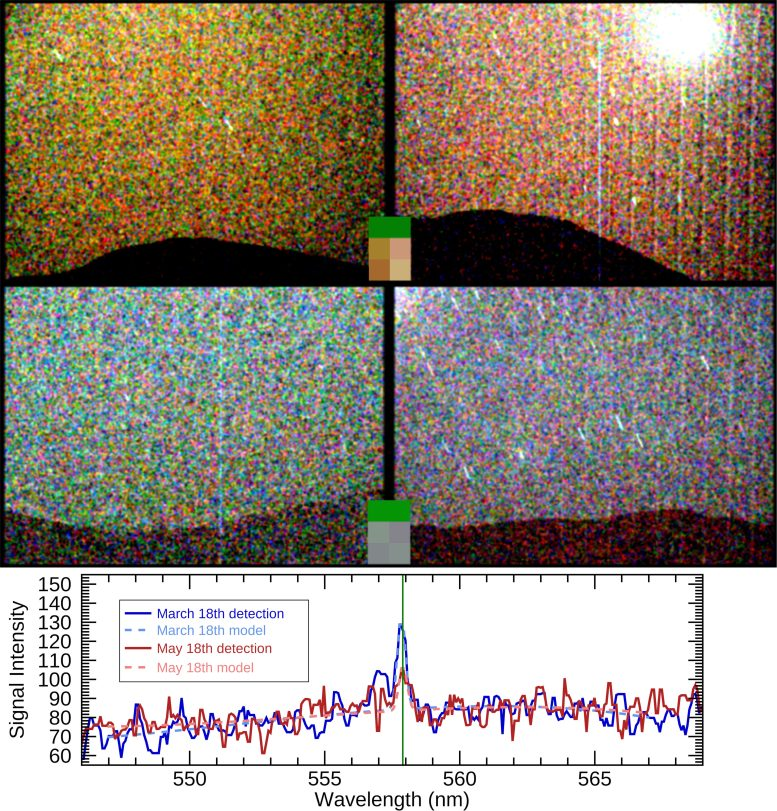
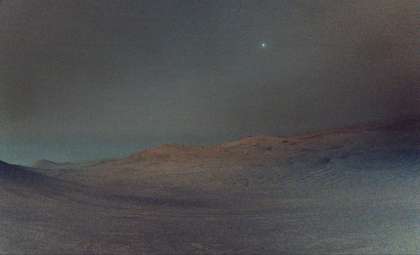
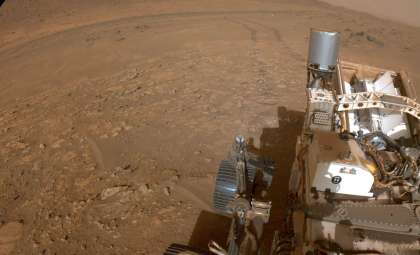
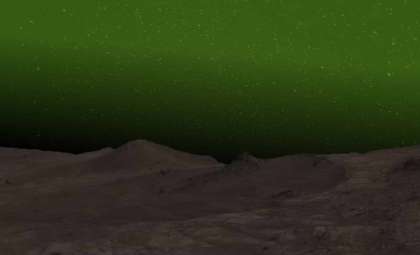
NASA’s Perseverance rover has once again recorded visible green auroras on Mars, marking the second time this fascinating phenomenon has been observed. This achievement deepens our knowledge of how the Martian atmosphere interacts with solar activity, shedding light on the complex effects of solar winds on the Red Planet. Building on previous discoveries shared through the American Astronomical Society, the rover’s latest findings not only showcase these dazzling planetary light shows but also offer crucial information that could help predict space weather hazards for upcoming Martian missions. Perseverance’s ability to anticipate and capture these elusive auroras represents a significant advancement in space weather forecasting on Mars.
Understanding Auroras on Mars
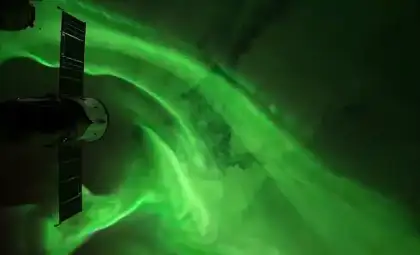
On Earth, auroras occur when charged particles from solar winds collide with our planet’s magnetic field, funneling energy toward the poles. Mars, however, lacks a global magnetic shield, causing auroras there to manifest differently. When high-energy particles streaming from the Sun, often during coronal mass ejections (CMEs), impact Mars’s atmosphere, they cause oxygen atoms to emit a characteristic green glow. Unlike Earth’s well-defined polar auroras, Martian auroras appear as widespread, faint glows across the planet’s nightside.
Perseverance first captured a Martian aurora image in 2024, marking a milestone in exploring planetary atmospheres. Dr. Elise Wright Knutsen, the mission’s science leader, highlighted the success of their predictive methods by stating, “The fact that we captured the aurora again demonstrates that our method for predicting aurorae on Mars and capturing them works.” This repeat observation confirms the growing ability to forecast what was once an unpredictable event.

The Difficulty of Anticipating Martian Auroras
Forecasting auroras on Mars remains a complex endeavor. Unlike on Earth, where geomagnetic activity data helps predict aurora events, Mars’s lack of a global magnetic field means its auroras don’t follow straightforward patterns. Additionally, Perseverance’s observation schedules must be set three days ahead after a CME is detected heading toward Mars, making accurate timing difficult. Researchers must carefully evaluate the solar wind’s strength and velocity to judge the likelihood of an aurora occurring.
Between 2023 and 2024, Knutsen’s team attempted eight aurora observations, successfully detecting the phenomenon twice. “The last three non-detections are more curious,” Knutsen explained. “Statistically, there is also a degree of randomness to these things, so sometimes we’re just unlucky. This perhaps isn’t that surprising, since predicting the aurora on Earth down to minute precision isn’t an exact science either.” These unpredictable aspects highlight the challenges in understanding solar-driven phenomena and the necessity for continued research to improve forecasting accuracy.
Solar Winds and Their Influence on Martian Auroras
The auroras that Perseverance has recorded are connected to bursts of high-energy particles within the solar wind, expelled during intense solar events known as CMEs. These events vary widely and cannot be pinpointed precisely in advance, which requires a trial-and-error approach to capturing Mars’s glowing nights. The intensity and speed of a CME greatly affect whether enough energetic particles reach the Martian atmosphere to create visible auroras.
Using data from Perseverance’s Mastcam-Z and SuperCam, along with complementary observations from orbiters like NASA’s MAVEN and ESA’s Mars Express, Dr. Knutsen’s group has refined their methodology. These instruments provide detailed analysis of solar wind properties and their correlation with the aurora’s appearance, helping to unravel the dynamic space weather environment around Mars.
- Categories:
- News




0 comments
Sign in to Comment