

NASA’s Perseverance rover is currently confronting one of its most demanding tasks—a steep, slippery ascent along the western slope of Jezero Crater on Mars.
The mission goal for this challenging climb is to reach the crater rim by early December, where the rover will examine newly exposed rock formations that may reveal secrets of Mars’s distant past.
As Perseverance gains elevation, it must navigate loose sandy dust topped by a fragile surface crust, resulting in traction difficulties. Engineers at NASA’s Jet Propulsion Laboratory (JPL) have devised innovative tactics to help secure the rover’s footing.

In the course of this maneuver, Perseverance snapped a sweeping panoramic image of Jezero Crater, highlighting vital landmarks from its three-and-a-half-year expedition and offering stunning views of the Martian landscape.
Perseverance’s Challenge: Climbing Unstable, Steep Slopes
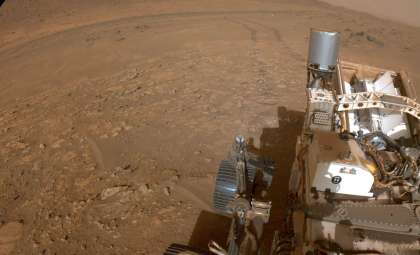
Ascending Jezero Crater’s wall has proven arduous for Perseverance. The rover is negotiating a gradient close to 20 degrees, a steep incline complicated by a thin, brittle crust and fine loose dust covering the terrain. This combination has caused Perseverance’s wheels to slip often, severely limiting progress. On one challenging day, the rover covered only about 20% of its planned travel distance due to slippage. According to Camden Miller, a rover operations planner at JPL, “For every two steps forward Perseverance takes, we were taking at least one step back.”
To improve its traction, the JPL team has experimented with driving backward, navigating across the slope’s gradient, and following the more stable, rock-lined northern side of the route known as “Summerland Trail.” Miller remarked, “No Mars rover mission has tried to climb up a mountain this big this fast,” underscoring the mission’s ambitious scale. Although progress is slower than hoped, the science team remains optimistic, viewing the summit as key to uncovering fresh scientific insights.
The Panoramic Capture: A Vivid Portrait of Jezero Crater
During a break in its uphill traverse, Perseverance took advantage to shoot a panoramic image of Jezero Crater’s rugged, expansive terrain. This panorama showcases both the path the rover has covered since arriving in early 2021 and significant sites including the Octavia E. Butler landing site, Kodiak Butte, and the ancient river delta system within the crater. JPL explained that this image helps scientists put the rover’s route and sample collection into geological context.
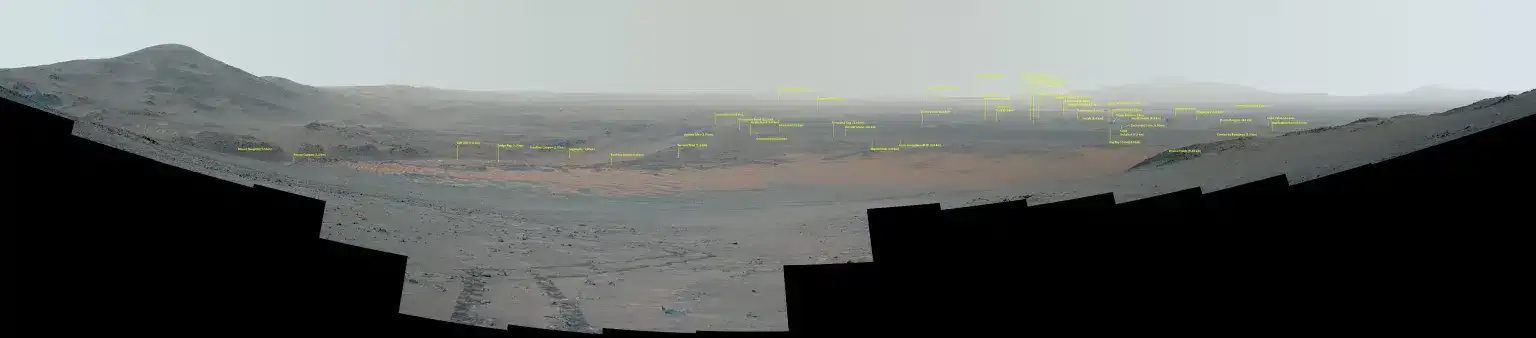
This sweeping vista is more than a scenic record—it assists researchers worldwide in reconstructing the timeline and nature of geological processes that shaped Jezero Crater over billions of years. It also highlights the challenges overcome and the milestones achieved throughout Perseverance’s mission, emphasizing its vital role in unraveling Mars’s mysteries.
Investigating Mars’s Past at the Crater Rim
Once the rover reaches the crater’s edge, it will head to destinations like “Lookout Hill” and “Witch Hazel Hill” to examine fresh outcrops exposed by orbiters. These light-colored bedrock areas are thought to contain carbonate minerals—potential markers of ancient water presence and clues to Mars’s prehistoric environment. By studying these sites, scientists aim to deepen knowledge of the Red Planet’s geological timeline and the environmental conditions that could have supported early microbial life.
Comparing these rocks to samples from locations such as Cheyava Falls in the “Bright Angel” cluster is expected to clarify how Mars’s climate transformed over time. Since arrival, Perseverance has gathered 24 samples comprising rock, soil, and atmosphere, each adding vital pieces to the complex puzzle of Jezero Crater’s history. Project Scientist Ken Farley from JPL emphasized, “These samples will help us piece together Mars’s geological puzzle and determine if life ever existed on our planetary neighbor.”
Advancing Mars Exploration Through Perseverance’s Mission
As Perseverance perseveres up the slope and collects crucial samples, it lays the groundwork for upcoming Mars exploration endeavors. NASA’s Mars Sample Return program, planned for the 2030s, aims to retrieve these specimens and bring them to Earth for comprehensive analysis. The ascent of Jezero Crater’s rim and inspections of previously unreachable rock formations are key components driving this overarching mission to evaluate Mars’s potential habitability.
This climb not only tests the rover’s engineering capabilities but also showcases the ingenuity and adaptability of NASA’s mission teams. Their innovative problem-solving ensures Perseverance remains on course to continue unlocking the secrets of the Red Planet.
- Categories:
- Astronomy ,
- News ,
- Nasa







0 comments
Sign in to Comment