
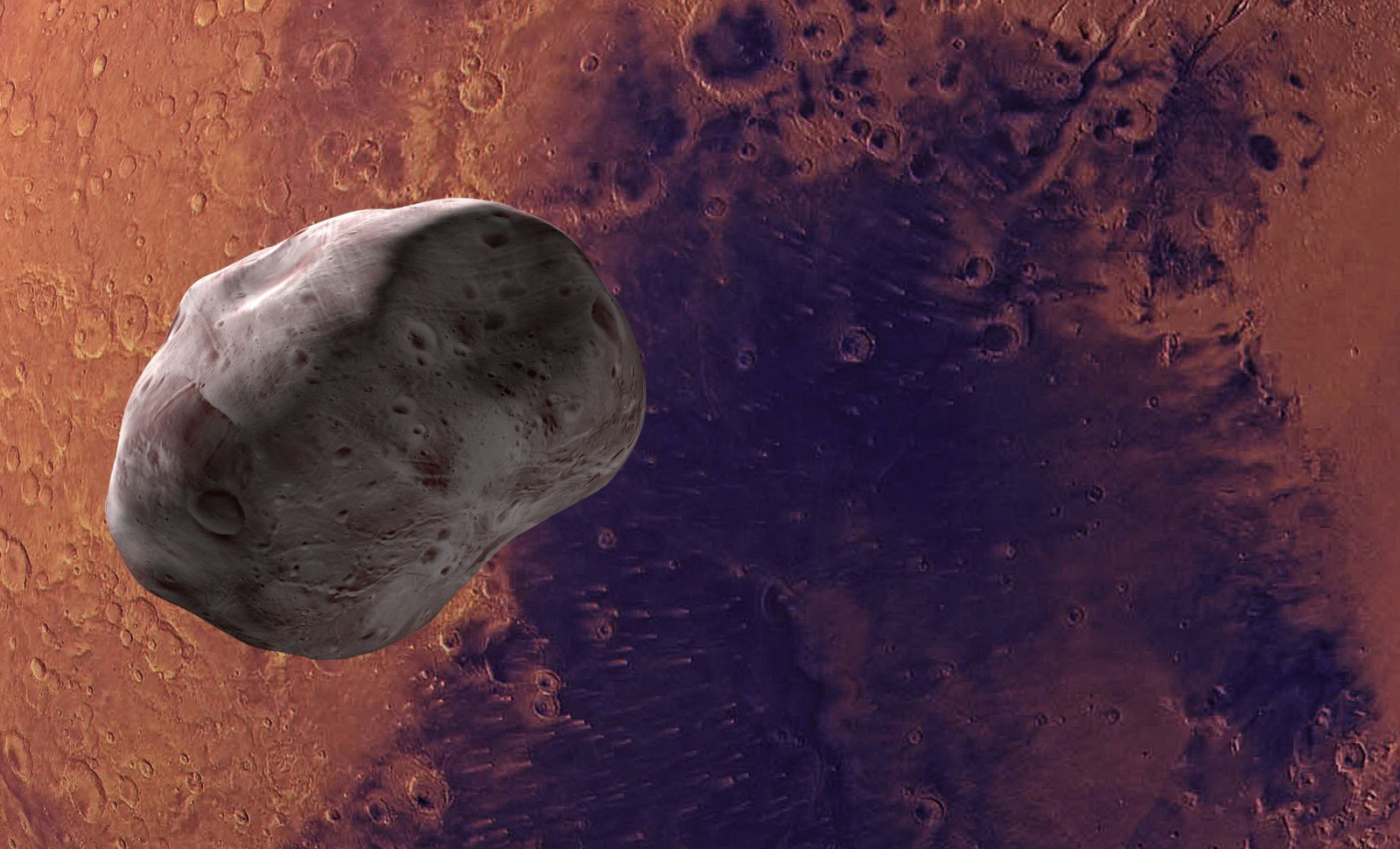
Mars’s moon Phobos is now believed to be on a quicker and more explosive path to destruction than previously expected. Emerging studies reveal that its breakup could involve forceful ejections of debris, dismantling the moon well before it reaches the Roche limit.
As the larger and nearest satellite of Mars, Phobos has fascinated researchers due to its puzzling origin and its unavoidable end. Orbiting extremely close to the Red Planet, its destiny has traditionally been seen as a gradual inward spiral, eventually crossing the Roche limit where tidal stresses disintegrate celestial bodies.
The Waning Orbit of Phobos
Phobos’s orbit is slowly contracting because of tidal interactions with Mars, which drain its orbital energy and draw it closer. Scientists Harrison Agrusa and Patrick Michel from the Observatoire de la Côte d’Azur indicate that this inward drift may cause the moon’s disintegration sooner than expected.

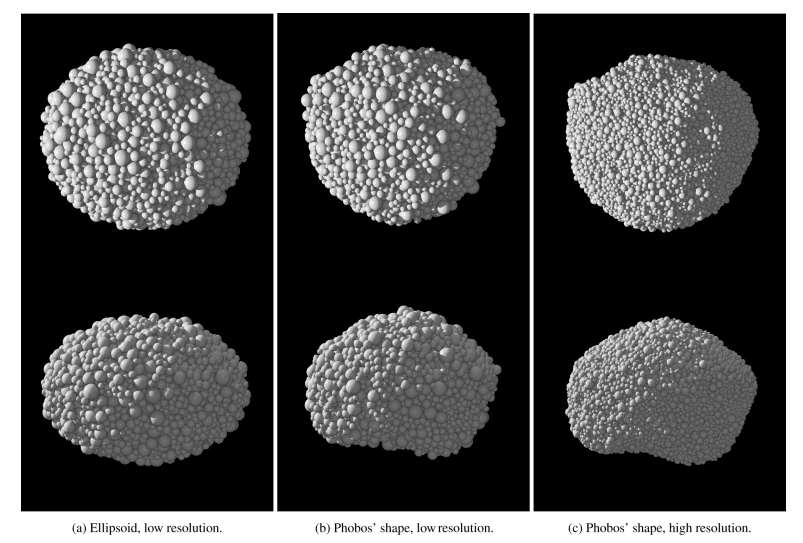
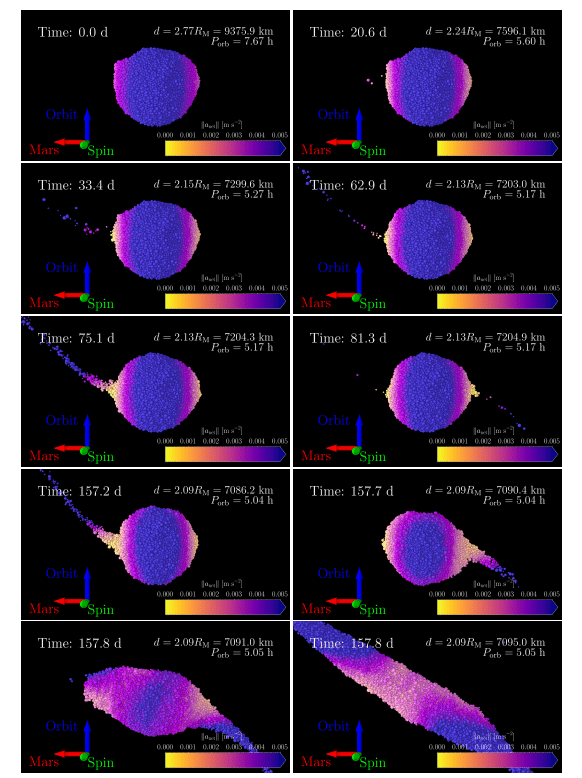
Citing BBC Sky at Night, Phobos’s makeup is crucial: it isn’t a solid rock but a loose aggregation of debris. This rubble-pile nature heightens its vulnerability to Mars’s tidal pull. As it descends closer, fragments of its surface begin detaching at roughly 2.25 times Mars’s radius (2.25RM), well ahead of the Roche limit.
The Inevitable Breakup of Phobos
The recent study published in Astronomy & Astrophysics details that the moon’s surface material will begin shedding off in chunks due to tidal stresses. Initial debris loss is predicted near 2.25RM, followed by larger erosions at 2.15RM and 2.13RM. Approaching 2.09RM, Phobos’s unstable structure will cause it to fragment completely.
The resulting debris will stay in Mars’s orbit, ultimately bombarding Phobos’s remaining surface at high speed, hastening its demise. Scientists describe this violent scenario as a “sesquinary catastrophe,” where the satellite is obliterated by its own fragmented material.
Remaining Questions
The precise response of Phobos’s interior to these forces, as well as the exact timing of its breakup, remains uncertain. This underscores the importance of the upcoming Japanese Martian Moons eXploration (MMX) mission, set to launch in 2026. MMX will probe Phobos’s internal properties, offering crucial insights to refine predictions about its future.
This mission is poised to deepen our understanding of Mars’s larger moon, elucidating how tidal dynamics are shaping its eventual destruction in unprecedented detail.
Phobos, one of Mars' two moons, transiting in front of the Sun as seen by NASA's Perseverance rover on April 2, 2022. pic.twitter.com/yDjfSimFWN
— Astropics (@astropics) May 2, 2026
- Categories:
- Astronomy










0 comments
Sign in to Comment