
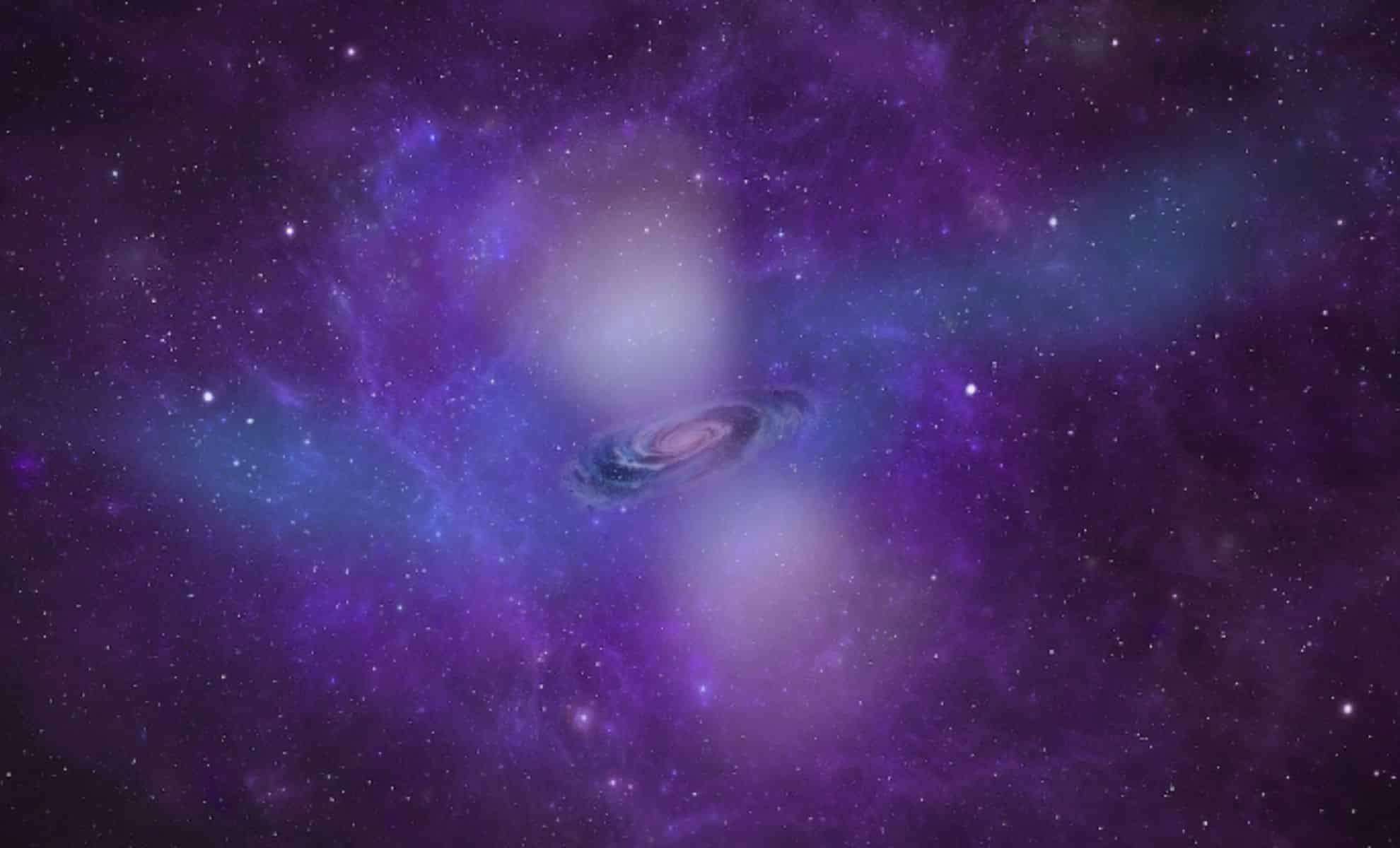
Recent findings indicate that our home galaxy, the Milky Way, and its nearest large neighbor, the Andromeda galaxy, may already be engaging in a cosmic interaction well before their anticipated collision billions of years into the future.
Published in Nature Astronomy, this study suggests that the two galaxies’ extensive envelopes of gas and dust, known as their circumgalactic mediums (CGMs), are likely overlapping. This discovery disrupts previous assumptions about the timing of galactic mergers and deepens our understanding of how galaxies influence one another across vast distances.
Significance of the Circumgalactic Medium
Each galaxy, including both the Milky Way and Andromeda, is encased in a large halo of gas and particulate matter called the circumgalactic medium (CGM), which holds up to 70% of the galaxy’s detectable mass. This region plays a vital role in the transfer and recycling of elements necessary for star formation and other critical galactic activities. Although the CGM is challenging to observe directly, scientists have studied it by examining how it absorbs light from luminous background objects such as quasars.

Thanks to recent improvements in observational technology, researchers can now explore the CGM with greater clarity. Lead author Nikole Nielsen from Swinburne University noted, “We are uncovering the limits of a galaxy’s influence, pinpointing where it merges into the surrounding cosmic environment and eventually connects to the broader universe’s cosmic web.” These insights have enabled scientists to map the boundary between a galaxy’s main body and its surrounding gas envelope for the first time.
Signs of Galaxy Overlap
The research reveals that the circumgalactic mediums of the Milky Way and Andromeda have likely begun to intersect. Earlier models assumed interactions would not start until their direct collision roughly 4 billion years from now. However, the mingling of their outer gas halos indicates that this interaction commenced more subtly and much earlier.
“There is strong evidence that the CGMs of the Milky Way and Andromeda are already overlapping and interacting,” explained Nielsen. This initial contact is imperceptible to human vision but signifies that the galaxies’ outer layers are beginning to affect one another ahead of the eventual convergence of their stars and cores.
Clarifying Galactic Limits
A key advancement from this study is a better grasp of where a galaxy’s edge lies. Using the W. M. Keck Observatory in Hawaii, astronomers examined the outskirts of a remote spiral galaxy up to 100,000 light-years from its center, observing the shift between the interstellar medium inside the galaxy and the surrounding circumgalactic medium.
“Within the CGM, gas is heated by sources beyond typical galactic activity, likely from the faint emissions of nearby galaxies and shocks,” said Nielsen. This observation helps scientists refine the divide between galaxies themselves and the larger cosmic web they inhabit.
CGM’s Influence on Galaxy Growth
The circumgalactic medium serves as more than just a boundary; it is a central player in galactic evolution. By controlling gas inflows and outflows, the CGM impacts star formation and the lifespan of galaxies. Nielsen highlighted, “Understanding the CGM’s appearance around different galaxy types reveals how shifts in this reservoir can drive changes within the galaxy.”
The findings offer new perspectives on how galaxies progress through developmental phases, some continuing star creation while others halt, with the CGM potentially holding the key to these evolutionary pathways.
Impact on the Future Milky Way-Andromeda Merger
Although the dramatic collision between the Milky Way and Andromeda remains billions of years away, discovering their circumgalactic mediums are already overlapping reshapes how astronomers understand the initial stages of galactic merging. This interaction may reveal behaviors of galaxies before their luminous cores and star systems ultimately collide.
Emma Ryan-Weber, professor at Swinburne University, highlighted the milestone: “It is the very first time that we have been able to take a photograph of this halo of matter around a galaxy.” Continual observations of early galaxy interactions promise to deepen insights into the mechanisms shaping galactic evolution.
The early mingling of the Milky Way and Andromeda’s halos suggests their merger is already in progress, even as the complete collision lies in the distant future. Investigating these subtle dynamics will be vital as astronomers explore cosmic collisions that drive the universe’s large-scale structure.
- Categories:
- Astronomy ,
- News ,
- Space ,
- Physics






0 comments
Sign in to Comment