
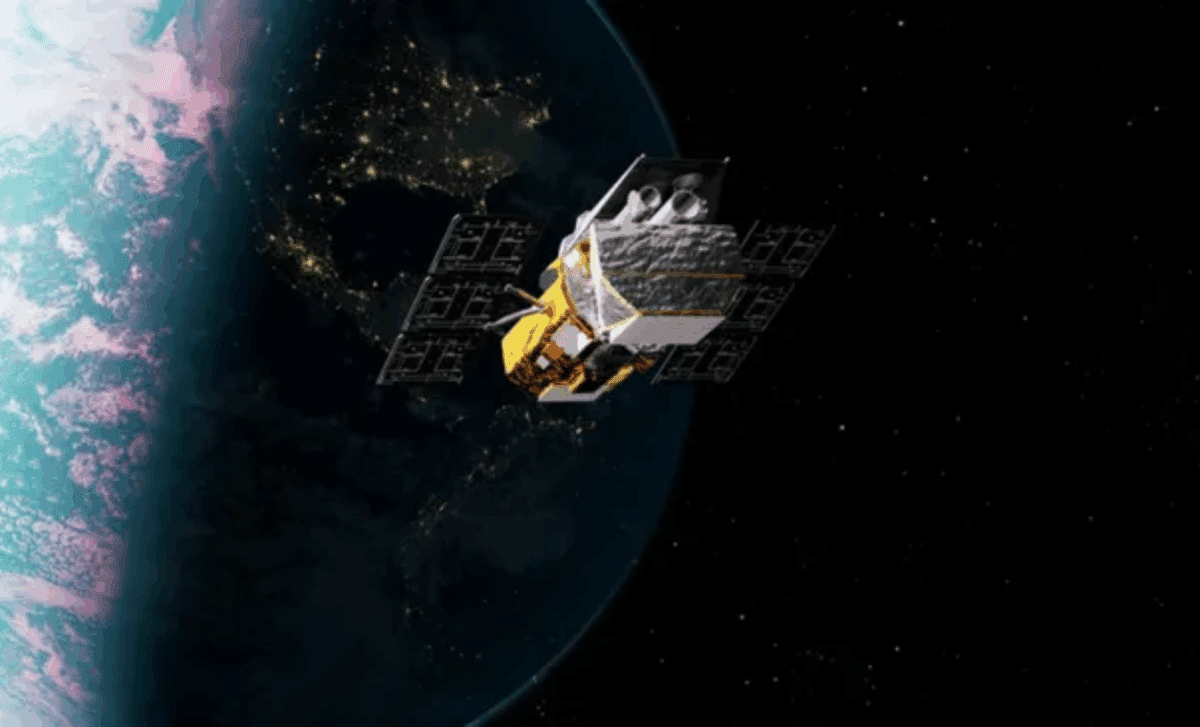
An innovative partnership between NASA and Katalyst Space Technologies aims to prevent the Neil Gehrels Swift Observatory from descending uncontrollably as its orbit deteriorates. Scheduled for launch in 2026, this groundbreaking mission will utilize the air-launched Pegasus rocket to elevate Swift’s altitude, thereby extending its scientific contributions. This initiative is critical as the observatory faces a looming threat of re-entry in the near future.
Swift Observatory Faces Imminent Orbital Decay
Since its 2004 launch, the Neil Gehrels Swift Observatory has been orbiting Earth, capturing valuable data on gamma-ray bursts. Over time, atmospheric drag has reduced its altitude from about 373 miles down to 249 miles. Lacking onboard propulsion, the observatory’s orbit continues to degrade, risking eventual re-entry. With no replacement in sight, NASA has enlisted Katalyst Space Technologies for an unprecedented private sector satellite rescue operation. Katalyst will deploy a spacecraft to raise Swift’s orbit, preserving its ability to investigate cosmic explosions. This mission marks a significant milestone, highlighting private industry’s expanding role in government space projects. According to Space.com, Katalyst aims to balance Swift’s urgent requirements with cost-effectiveness.
Pegasus Rocket: The Mission’s Launch Solution
The mission’s success hinges on the Pegasus rocket, a unique air-launched vehicle crafted by Northrop Grumman. This rocket is deployed mid-flight from an aircraft at 39,000 feet, enabling it to deliver the rescue craft into orbit. Ghonhee Lee, CEO of Katalyst Space Technologies, emphasized,

“It’s the only launch vehicle that can meet the orbit, the schedule and the cost to achieve something unprecedented with emerging technology.”
With a history of 45 successful launches since 1990, the Pegasus rocket can transport up to 1,000 pounds to low Earth orbit. Northrop Grumman’s Kurt Eberly noted,
“We have to do some final integration and test, and we have to develop the trajectory and the guidance for the RAAN [right ascension of the ascending node] steering and software, but that’s really it.”
Thanks to its proven reliability, the Pegasus XL configuration is trusted to execute this mission with high accuracy.
Executing a Complex Orbital Boost
The challenge extends beyond launch: Katalyst’s spacecraft will need to rendezvous with Swift, which wasn’t designed for servicing. Advanced robotic arms will be employed to carefully secure the observatory, utilizing high-definition imaging to guide the procedure. The mission includes precise orbital adjustments, demanding meticulous planning.
Preparations are underway, with the team committed to the launch timeline.
“We’re treating this launch date as a firm commitment,” said Kieran Wilson, Katalyst’s vice president of technology. “We’ll kind of continuously evaluate where Swift stands in its orbital decay and figure out what sort of adaptations we might need to pursue, whether it’s launching to a different altitude, whether it’s targeting slightly different insertions.”
Katalyst remains ready to adapt plans to ensure Swift receives the critical orbit boost it requires.
Opening Doors for Future Space Servicing Endeavors
This ambitious project not only aims to extend Swift’s operational time but also signals a new era for satellite servicing. Whereas past missions of this type took years to plan, Katalyst’s rapid approach demonstrates that responsive missions can be achieved swiftly. As Kieran Wilson pointed out,
“If we’re able to do this for NASA in just eight months, I do think that opens up a new set of responsive missions in the future.”
Such advancements may redefine how private firms and government agencies work together in orbit maintenance.
Should the mission succeed, Swift could enjoy an extension of roughly two decades of service.
“That lasted it 22 years the first time,” Wilson said. “We expect [the boost] to provide a similar amount of on-orbit longevity this time around.”
This accomplishment could revolutionize satellite upkeep, setting a precedent for future missions using similar robotics and propulsion technology.
- Categories:
- News













0 comments
Sign in to Comment