
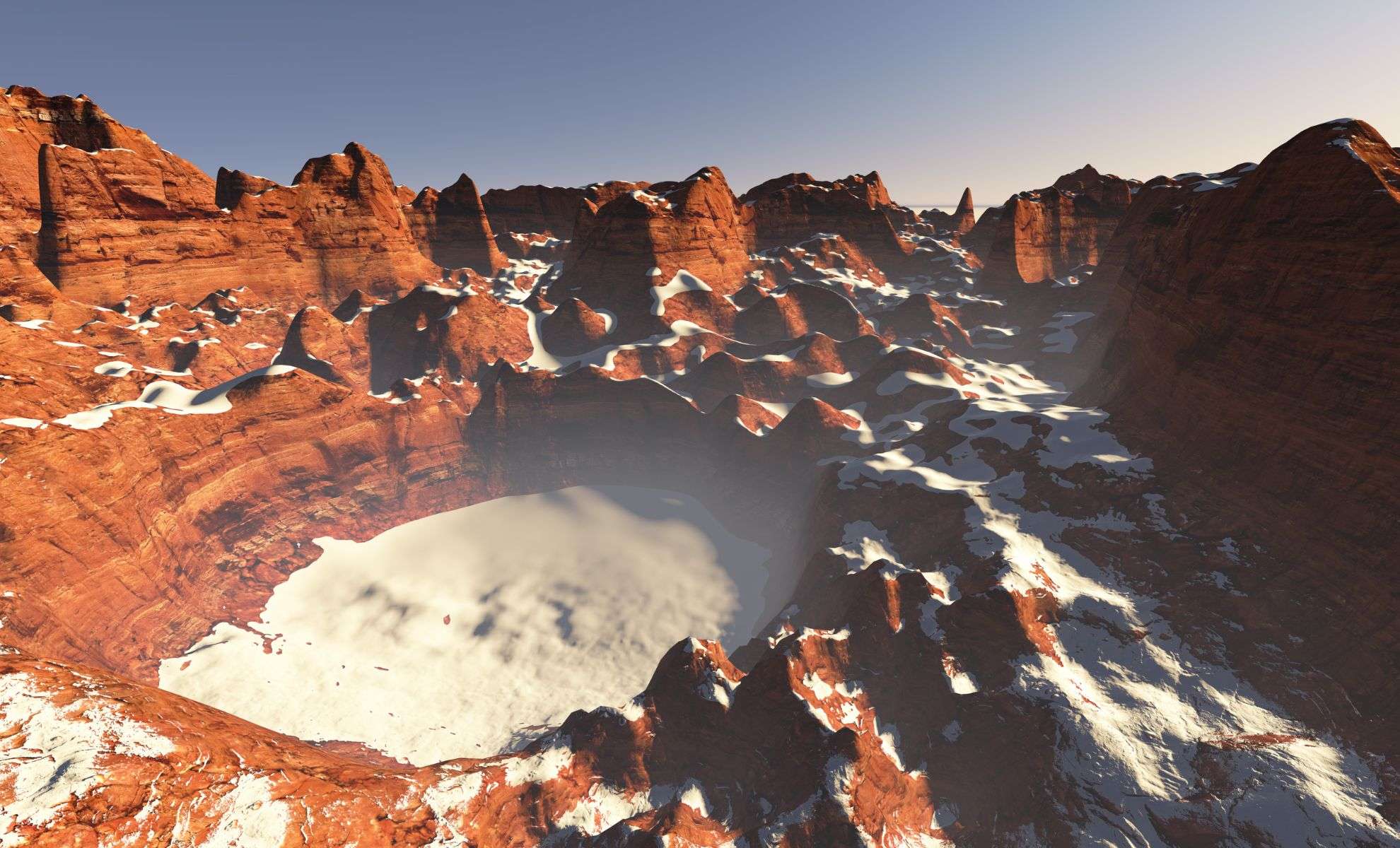
Buried beneath Mars’ surface, ancient biological materials might remain intact for tens of millions of years thanks to protective layers of ice. Recent research led by NASA indicates that pure Martian ice could safeguard organic molecules for up to 50 million years, highlighting its significance in the quest to find evidence of extinct life on the Red Planet.
The investigation, carried out by scientists from NASA Goddard and Penn State University, demonstrates that icy environments on Mars offer far better preservation conditions for biosignatures than previously believed. These insights are valuable for future exploratory missions aiming to detect traces of once-living microbes or chemical markers linked to life.
While earlier studies concentrated mainly on rocks and surface sediments, this work emphasizes the special shielding abilities of solid water ice. The typically harmful effects of cosmic rays on organic compounds are greatly diminished when these compounds are locked within pure ice.

Laboratory Simulations Mimic Martian Environment and Show Remarkable Preservation
Scientists simulated Mars-like conditions in the lab using Escherichia coli bacteria as a stand-in for biological material. Samples were embedded in pure ice at –60°F and subjected to radiation levels similar to those on Mars over tens of millions of years. Remarkably, over 10% of the bacterial amino acids withstood the intense radiation. Penn State geoscientist Christopher House, co-author of the paper, explained:
“Fifty million years is far greater than the expected age for some current surface ice deposits on Mars.”
The findings suggest that organic molecules could persist in ice located near Mars’ surface. Conversely, when organic samples were mixed with Martian soil or minerals, they deteriorated much faster. The minerals and soil components appeared to intensify radiation’s destructive effects, accelerating the breakdown of biological material.
Organic Matter Breaks Down More Quickly in Soil and Clay Mixtures
The published study in Astrobiology reveals that although pure ice greatly protects organics from radiation, when combined with Martian soil or minerals, the breakdown speeds up. Radiation interacting with these complex mixtures generates highly reactive radical molecules that travel freely and damage organic compounds.
Within pure ice, however, these radicals become trapped in place, drastically reducing their ability to harm biological structures. Lead researcher Alexander Pavlov from NASA Goddard stated:
“While in solid ice, harmful particles created by radiation get frozen in place and may not be able to reach organic compounds.”
His team also examined minerals like montmorillonite, a widespread Martian clay, finding that instead of shielding organics, these substances contributed to the formation of thin liquid films. These layers allowed radicals to move more readily, speeding up their damaging interactions.
This discovery highlights why solid ice offers a superior preservation medium compared to clay-rich dirt or rock surfaces, which may have been overestimated as prime life detection locations in earlier research.
Cold, Dry Conditions Enhance Preservation of Organics on Mars
Temperature was found to be a vital factor influencing how long amino acids survive. Under colder conditions similar to those on Europa, organic molecules degraded much more slowly than at the warmer temperatures typical of Mars. Increased warmth boosts the activity and mobility of oxidants created by radiation, which hastens their reactions with biological compounds.
Interestingly, the research challenges previous ideas that water always speeds up decay. In pure ice, radiation-generated radicals remain immobilized, but when ice mixes with minerals and some water, those radicals gain the ability to spread via thin liquid films and break down organics more effectively. As noted by Earth.com, this adds complexity to earlier assumptions connecting water presence to faster molecular degradation.
- Categories:
- News




0 comments
Sign in to Comment