

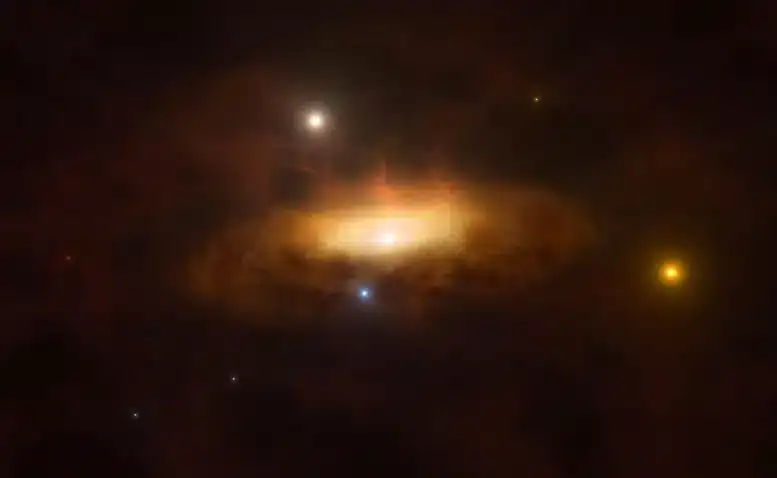
A remarkable phenomenon has been detected in the galaxy SDSS1335+0728, where its central supermassive black hole has recently sparked to life, leading to extraordinary increases in luminosity since late 2019.
This sustained brightening event opens a rare window for astronomers to examine the transformation of a dormant galactic nucleus into an active one, providing critical insights into the influence of supermassive black holes on their surrounding galaxies.
Unprecedented Luminosity Changes in Galaxy SDSS1335+0728
SDSS1335+0728, situated in the Serpent Bearer constellation, has exhibited significant brightening, most likely triggered by the ignition of its central supermassive black hole. The initial detection was made by the Zwicky Transient Facility (ZTF) at the Palomar Observatory, Caltech. Unlike typical fluctuations arising from supernovae or tidal disruptions, the galaxy’s brightness has been steadily intensifying for over four years, hinting at an ongoing and sustained mechanism.

Data gathered from various observatories, including the European Southern Observatory’s Very Large Telescope (VLT) in Chile, have verified these changes. The galaxy now emits amplified ultraviolet, optical, infrared, and more recently, X-ray radiation. “We have cataloged millions of active galactic nuclei, and thanks to next-generation sky surveys like ZTF, about 700 have shown major brightness variations,” stated Matthew Graham, Caltech astronomy professor and ZTF project scientist. “Yet, until now, we have not captured a galactic nucleus in the actual process of awakening.”
The continuous brightening of SDSS1335+0728 offers an extraordinary chance to observe the early stages of a supermassive black hole powering up. Monitoring changes across multiple wavelengths allows researchers to explore the interactions between the black hole and its nearby environment. This real-time observation is pivotal for revealing how galactic nuclei shift from dormant to active phases.
Understanding the Activation of Active Galactic Nuclei
The ignition of the supermassive black hole in SDSS1335+0728 presents a unique view into a galaxy evolving into an active state. As matter spirals into the black hole, enormous energy is unleashed, illuminating its surroundings and affecting the host galaxy on a significant scale. Ongoing observation efforts are shedding light on the mechanisms driving these transitions and their galactic consequences.
This awakening leads to heightened emissions across diverse wavelengths, offering a holistic perspective on active galactic nuclei. Scientists are particularly interested in how this black hole’s activation modulates gas dynamics and star formation rates within the galaxy. Insights gleaned here contribute to broader understanding of galaxy life cycles and the pivotal role supermassive black holes play in their evolution.
Matthew Graham noted, “Since most galaxies harbor a supermassive black hole, it’s likely that many undergo similar phases. Detailed analysis of this system will enhance our comprehension of black hole activity and aid in discovering other such events.” This underscores SDSS1335+0728’s importance as a benchmark for astronomical research, with findings applicable to other galactic centers and enriching our grasp of cosmic development.
Techniques and Hurdles in Monitoring SDSS1335+0728
Advanced observational instruments and methodologies have been essential in capturing the phenomena seen in SDSS1335+0728. The Zwicky Transient Facility’s continuous sky scanning capabilities were vital in identifying the early stages of the black hole’s ignition.
Complementary to ZTF, the Very Large Telescope (VLT) in Chile has contributed detailed, multiwavelength high-resolution data. Its coverage in ultraviolet, optical, infrared, and X-ray wavelengths permits scientists to form a complete picture of the evolving galaxy. Additionally, data from other global telescopes support this international collaborative study of a rare event.
Despite technological progress, probing active galactic nuclei remains challenging due to the vast distances and complex physical processes involved. The fluctuating brightness and spectral emissions require meticulous, prolonged observation to differentiate among possible origins and construct accurate models defining the underlying dynamics.
Looking Ahead: Research and Cosmic Implications
SDSS1335+0728 exemplifies the value of continuous astronomical monitoring. Future work aims to contrast its activity with that of other active galactic nuclei, identifying shared and unique traits to refine theories around black hole ignition and its influence on host galaxies.
“There’s nothing distinctly unusual about this galaxy; we simply observed it at a rare awakening phase,” explained Graham. “As most galaxies contain supermassive black holes, many are likely to experience such periods. Deeper examination of this example will advance our understanding and enable discovery of similar cases.”
Insights from the reactivation of SDSS1335+0728’s black hole also enhance knowledge of large-scale cosmic structures. Understanding the interactions between supermassive black holes and their host galaxies elucidates forces driving galaxy formation and evolution. This research stresses the critical role of precise observations and advanced simulations in unlocking the cosmic mysteries governing galactic life cycles.
- Categories:
- Astronomy ,
- News ,
- Space




0 comments
Sign in to Comment