
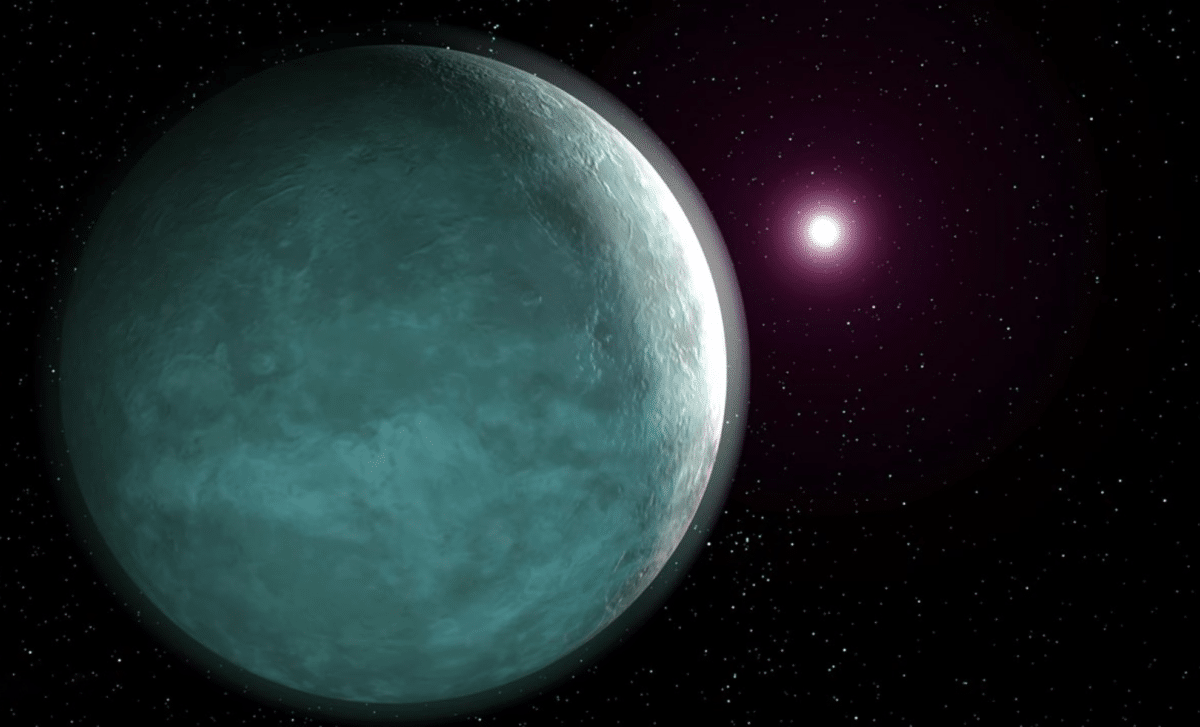
A Neptune-sized exoplanet has captivated astronomers by moving in the opposite direction of its star’s spin, marking one of the most extraordinary planetary orbits detected so far. This unusual behavior, detailed in The Astrophysical Journal Letters, points to the possible presence of an unseen massive planet shaping this system. The observation sheds light on how planetary orbits can be dramatically altered by gravitational forces long after their initial formation.
An Exceptional Planet Challenging Conventional Planetary Motion
It is commonly accepted that planets orbit their stars in the same direction the stars rotate, a result of their formation process within spinning disks of gas and dust. While several massive “hot Jupiter” exoplanets have been found with misaligned or even reversed orbits, such a trait in a smaller, warm Neptune-class planet like TOI-1710 b is highly unusual and difficult to elucidate.
TOI-1710 b exhibits a nearly 180-degree tilt relative to its star’s rotation, categorizing it in a retrograde orbit. Instead of a typical minor misalignment, this planet circles in the reverse direction, suggesting it experienced a significant gravitational event that likely reshaped this system’s structure.

Such a drastic orbital reversal normally signals interactions with other massive bodies within the system. The finding is more than a curiosity: it offers a rare glimpse into the powerful forces at play that can reshape planetary orbits over millions or billions of years.
Evidence Points to an Unseen Massive Planet
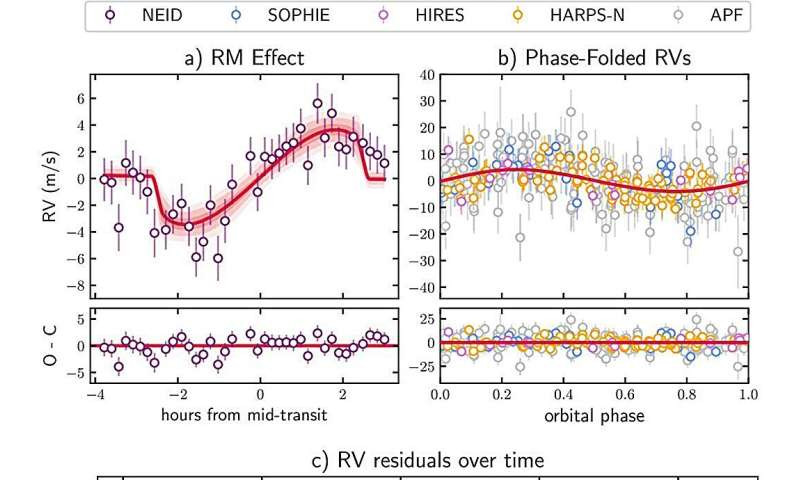
Published in The Astrophysical Journal Letters, the study integrated measurements from NASA’s TESS, the NEID spectrograph, and supplementary observatories to trace the planet’s orbital shape and subtle shifts in the star's velocity over time.
These stellar velocity trends were especially telling. Instead of a steady state, the host star demonstrated a consistent radial velocity drift that couldn’t be attributed solely to the known planet, strongly implying a far more massive, distant companion's presence.
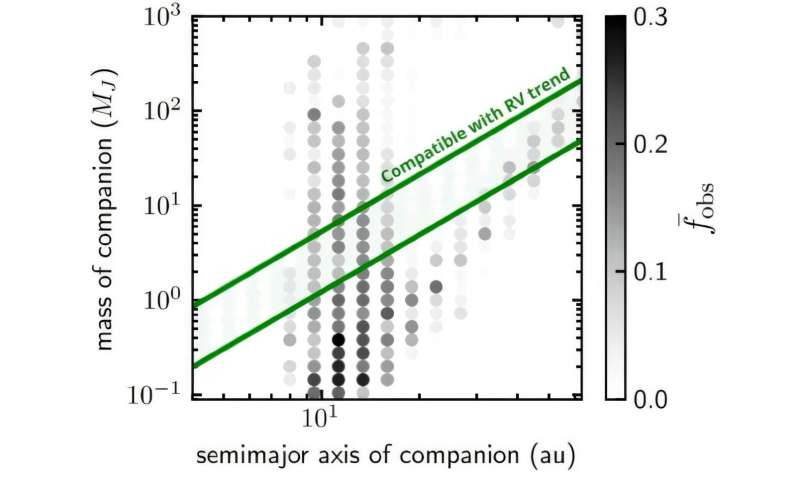
Simulations tested various models capable of generating the retrograde orbit seen. The most plausible matched the data when including an undiscovered gas giant about five times Jupiter’s mass orbiting roughly 15 astronomical units from the star. This giant would serve as a gravitational conduit, relaying influences from a more remote stellar companion to the inner Neptune-like planet — nudging its orbital plane while keeping its nearly circular path intact.
Further modeling revealed only a limited range of orbital distances for this hypothetical giant aligned with the extreme retrograde orbit of TOI-1710 b. This correlation strengthens the argument for a hidden giant, though additional data is needed for confirmation.
A Remote Stellar Partner May Have Triggered This Orbital Shift
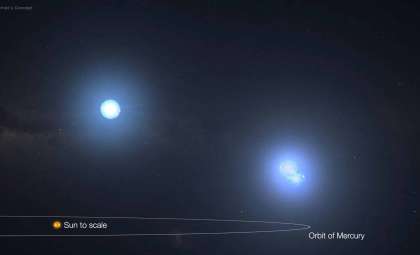
The TOI-1710 system isn’t just a star and one planet: it also includes a distant M-dwarf companion approximately 3,600 astronomical units away, a candidate for gravitational influence over planetary orbits.
However, its enormous distance diminishes its direct effect, making it insufficient alone to cause the observed 180-degree flip in the inner planet’s orbit.
Here, the hidden giant planet assumes a crucial role. Acting as a gravitational intermediary, this giant could channel and amplify the subtle perturbations from the remote stellar companion, gradually shifting the inner planet’s orbit into its current retrograde tilt over long timescales.
Astronomers describe this as an inclination cascade: a layered set of gravitational interactions rather than a single force driving the entire effect. Although theorized in a few other systems, examples involving Neptune-sized planets remain scarce. If verified, TOI-1710 b would stand as a prime example of this intricate gravitational interplay.
- Categories:
- News





0 comments
Sign in to Comment