
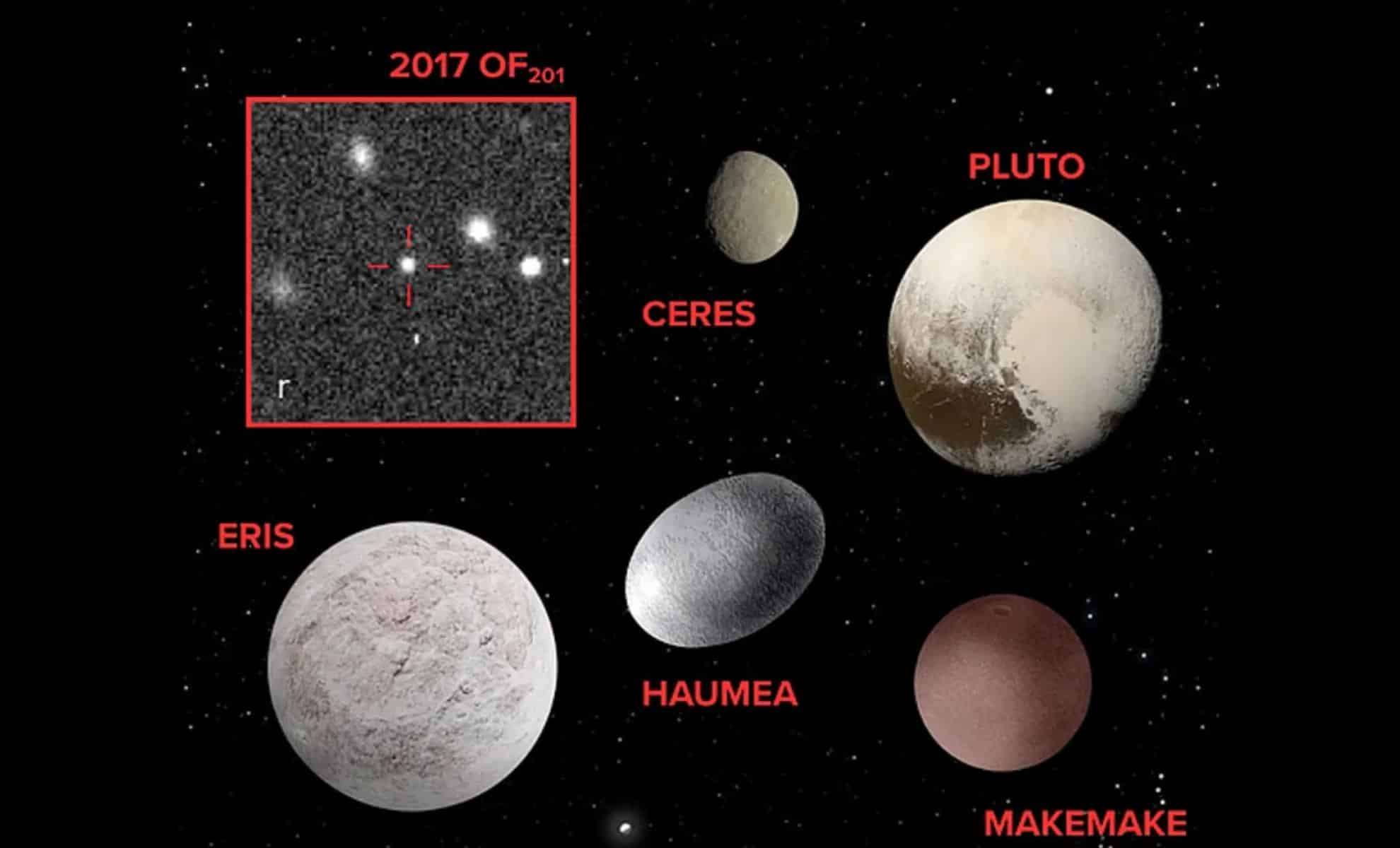
A newly identified icy body has officially joined the catalog of known solar system members, exhibiting an unusual orbit that may shed light on one of the most puzzling enigmas in space science. Detailed in a recent study on arXiv, this distant entity, named 2017 OF201, is more than just another object beyond Neptune. It is a trans-Neptunian object (TNO) that could qualify as a dwarf planet, completing a solar orbit roughly every 25,000 years. Unveiled by the International Astronomical Union’s Minor Planet Center on May 21, 2025, this finding has the potential to transform our perception of the far reaches of the solar system and pose significant challenges to the debated Planet 9 theory.
A Massive, Hidden Object on the Solar System’s Edge
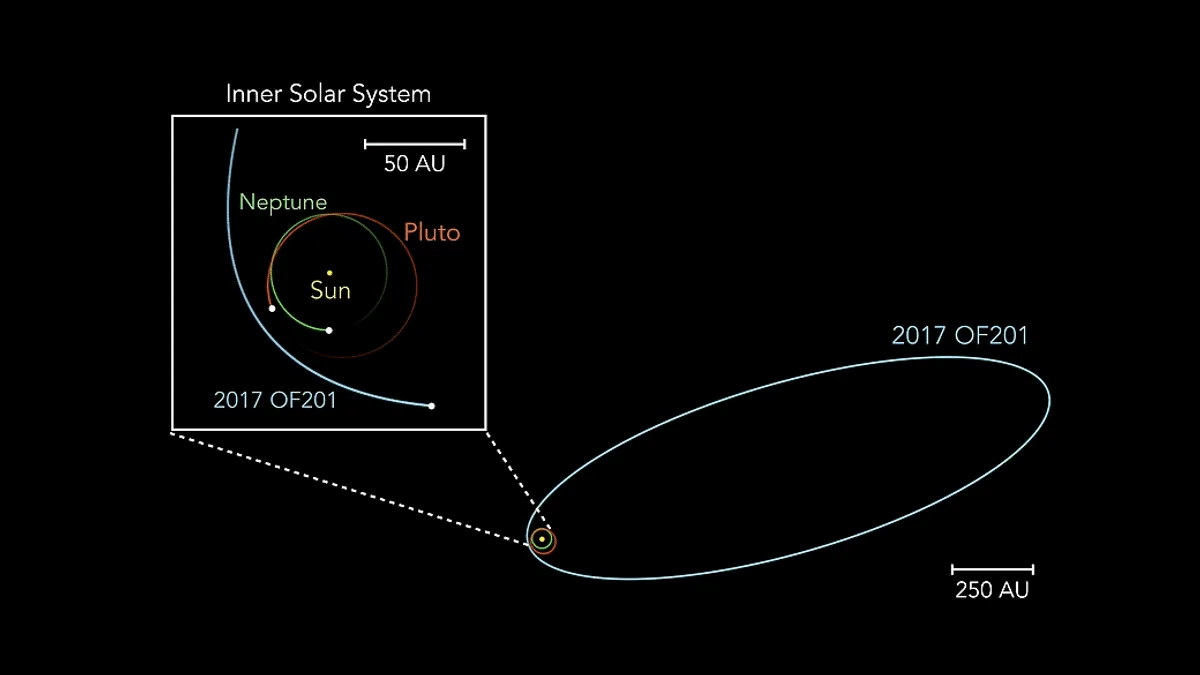
Measuring approximately 700 kilometers (435 miles) across, 2017 OF201 is about one-third the size of Pluto, yet it follows a far more extended elliptical orbit. This frozen world travels between a closest point to the Sun, or perihelion, at about 44.5 astronomical units (AU) and an extreme aphelion exceeding 1,600 AU, an astonishing distance considering Earth’s orbit equals 1 AU. Such a wide orbit means it remains practically hidden most of the time. “2017 OF201 spends only 1 percent of its orbital time close enough to us to be detectable. The presence of this single object suggests that there could be another hundred or so other objects with similar orbit and size; they are just too far away to be detectable now,” explained Sihao Cheng from the Institute for Advanced Study, who led the team behind the discovery.
How Old Data and Modern Tools Unearthed a Cosmic Stranger
Even with cutting-edge telescopes available today, 2017 OF201 was found using archival data—existing survey records accessible to the public. “Although recent telescope technology has expanded our cosmic horizons, there is still much to uncover about our immediate celestial neighborhood,” Cheng noted. The discovery emphasizes that despite numerous advances, our solar system holds many secrets yet to be revealed. The extreme orbit and brief observation window made spotting this object a combination of technical expertise and fortunate timing.

Implications for the Planet 9 Theory
Discovering 2017 OF201 not only adds to the tally of solar system bodies but also complicates the Planet 9 hypothesis, which proposes a hidden massive planet influencing the orbits of certain TNOs. Many known extreme TNOs show orbital clustering, but 2017 OF201 stands apart from this trend. “Many extreme TNOs have orbits that appear to cluster in specific orientations, but 2017 OF201 deviates from this,” said Jiaxuan Li of Princeton University, co-discoverer of the object. Should further such outliers surface, they could challenge the very foundation of the Planet 9 scenario, hinting instead that the current clustering observations might be statistical anomalies resulting from limited data.
Opening the Doors for All Sky Enthusiasts
Perhaps the most remarkable takeaway is the nature of the discovery itself. “All the data we used to identify and characterize this object are archival data that are available to anyone, not only professional astronomers,” Li said. “This highlights that pioneering breakthroughs aren’t restricted to those controlling the largest telescopes. Researchers, students, and citizen scientists worldwide can contribute significantly, underscoring the importance of open scientific data.” In a field often defined by high-cost instruments and elite establishments, this finding underscores that the next major discovery could come from anyone armed with curiosity and digital resources.
- Categories:
- News










0 comments
Sign in to Comment