

Quantum teleportation—a process that transfers a particle's quantum state without moving the particle itself—has been a pivotal subject in quantum science. Recently, a team led by Xiaolong Su of Shanxi University achieved a groundbreaking feat by teleporting five quantum states simultaneously, a finding published in Science Bulletin. This progress addresses earlier constraints that permitted only single-state teleportation, significantly pushing forward the capabilities of quantum communication. Enabling multiple quantum states to be teleported in parallel enhances the potential for more efficient, scalable quantum networks, promising profound impacts on future computational power and data security.
What This Means for Quantum Communication Advancements
Quantum teleportation serves as a foundation for next-generation secure communication and computing technologies. By transferring quantum states via entanglement, information can be transmitted without physically relocating the particles involved. Prior methods, however, restricted this transfer to a single quantum state at a time, limiting scalability and broader application.
The research team behind the Science Bulletin publication demonstrated the ability to teleport multiple sideband qumodes—individual frequency channels encoding quantum information—simultaneously. This multi-state transfer expands the communication bandwidth, marking a practical leap forward in realizing quantum networks that can handle more complex and voluminous data streams.

Parallel Teleportation of Multiple Qumodes
The study’s key innovation is the simultaneous teleportation of five quantum states. This was achieved by finely tuning the phases of two classical communication channels, alongside adjustable frequency controls, allowing dynamic determination of the number of qumodes teleported per session. This offers enhanced versatility compared to fixed-channel approaches previously used.
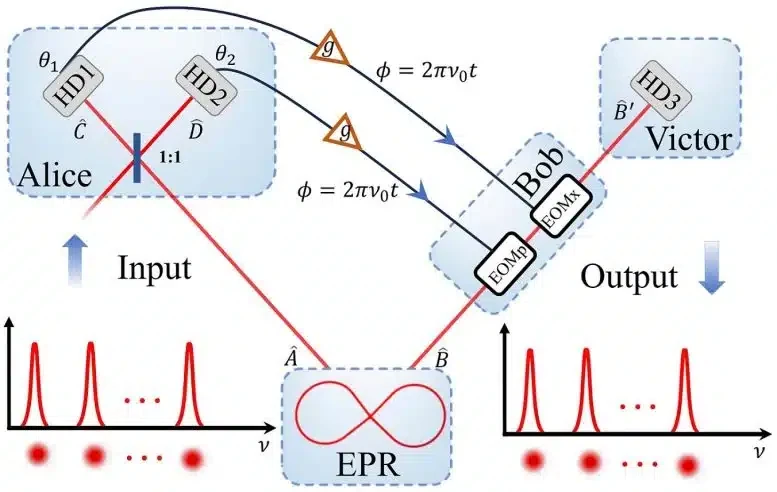
By meticulously adjusting communication channel phases, the group achieved reliable teleportation of up to five sideband qumodes within a 24 MHz bandwidth. Their method was deterministically controllable, resulting in a fidelity of about 70% for the teleported states—demonstrating scalability without sacrificing precision. This breakthrough represents a significant step toward practical applications of quantum teleportation in real-world communication systems.
Exceeding the Quantum Non-Cloning Limit
A major highlight of the experiment was surpassing the non-cloning limit, a fundamental quantum rule that forbids creating exact copies of unknown quantum states. The team’s findings confirm that quantum teleportation authentically transfers quantum information beyond what classical schemes can replicate, preserving the unique properties of the teleported states.
This milestone serves as a key confirmation of the genuine quantum nature of quantum teleportation. Handling multiple quantum states simultaneously pushes the limits of what quantum mechanics can achieve in communication technology.
Implications for the Future of Quantum Communication Systems
As quantum networks continue to grow, their demand for processing large volumes of quantum data across multiple channels simultaneously intensifies. The approach introduced by this research directly meets those demands, enabling transmission of greater quantum information without compromising state fidelity. Increasing the quantum information density within a given physical system offers a substantial boost to network capabilities.
This progress holds transformative potential for global communications infrastructure, especially regarding secure communications where quantum encryption plays a critical role. Because of its scalability, this technique can improve a range of communication platforms—from satellite-based to terrestrial quantum links—strengthening their security and efficiency. Particularly for secure data transfer, this could usher in widespread adoption of quantum encryption that is nearly impervious to hacking.
Advancing Quantum Computing and the Quantum Internet
The advancements in quantum teleportation presented here also bear significant promise for quantum computing development. As quantum processors evolve, fast and reliable quantum state transfer between devices becomes increasingly vital. This breakthrough paves the way for enhanced quantum computation speeds and accuracy through efficient quantum communication channels.
Beyond computing, scaling quantum teleportation capacity is a foundational step toward realizing the quantum internet—a global, secure network leveraging quantum principles for data transmission. The potential applications range from ultra-secure communications to significantly improved computational functionalities, impacting industries such as cybersecurity and artificial intelligence.
- Categories:
- Physics











0 comments
Sign in to Comment