
A groundbreaking study featured in Astronomy & Astrophysics has uncovered a remarkable interstellar feature: a plasma-filled tunnel bridging the Local Hot Bubble surrounding our solar system with far-reaching cosmic areas. This revelation, obtained through observations by the eROSITA X-ray telescope aboard the Spectrum-Roentgen-Gamma (SRG) spacecraft, provides unprecedented insights into the turbulent surroundings enveloping our solar neighborhood.
Exploring the Local Hot Bubble in Greater Detail
The Local Hot Bubble (LHB) is an enormous low-density cavity filled with intensely heated gas spanning approximately 1,000 light-years. This expansive region encircling the solar system was likely sculpted by multiple supernova explosions occurring around 14 million years ago. These violent events expelled interstellar gas and dust, leaving behind plasma at temperatures of about a million Kelvin, which emits soft X-rays detectable by instruments such as eROSITA.
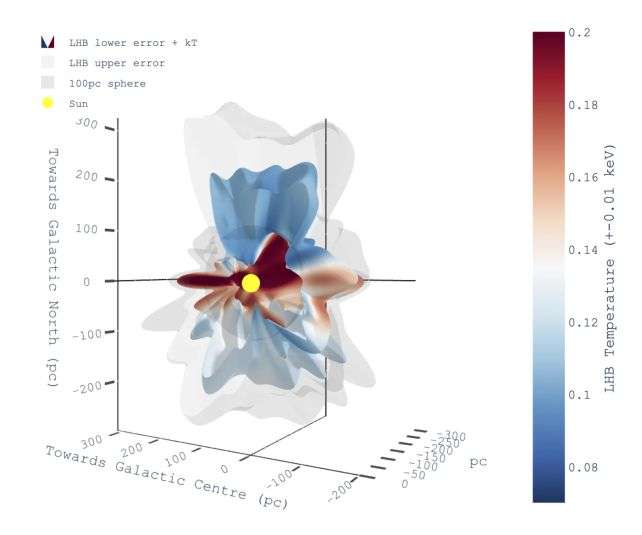
Creating an accurate map of the bubble from our vantage point has been challenging. “It's comparable to trying to outline the contours of your aquarium while standing inside it,” explained lead author Michael Yeung from the Max Planck Institute for Extraterrestrial Physics. To tackle this, Yeung and his collaborators segmented the sky into more than 2,000 zones, examining the soft X-ray emissions from each section to reconstruct the most precise 3D model of the LHB ever developed.

The results revealed that the bubble is far from spherical, exhibiting more expansion in directions perpendicular to the galactic plane rather than parallel to it. Additionally, they identified a distinct temperature gradient between hemispheres, with the Southern Hemisphere averaging 121.8 ± 0.6 eV versus 100.8 ± 0.5 eV in the Northern Hemisphere. Previous observations missed this variation due to limitations of earlier detectors like those used on the ROSAT satellite.
Discovery of an Unexpected Plasma Corridor Toward Centaurus
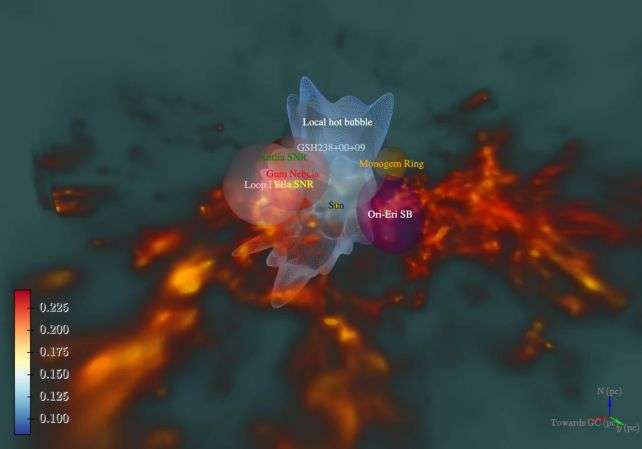
Among the study’s most astonishing discoveries is a tunnel-like plasma passage extending from the LHB’s boundary toward the Centaurus constellation. This channel appears to carve through cooler, denser interstellar matter, hinting at a link to another adjacent low-density void beyond our Local Hot Bubble.
"The existence of an interstellar plasma tunnel toward Centaurus, which forms a gap in the cooler interstellar medium, was previously unknown," remarked Max Planck astrophysicist and co-author Michael Freyberg. This passageway may connect the LHB with neighboring cavities such as the Gum Nebula, suggesting that our Local Hot Bubble is part of an extensive web of interconnected interstellar bubbles and tunnels.
This discovery aligns with a concept proposed in 1974, which theorized that supernova remnants form a galaxy-wide network of bubbles linked by hot ionized gas corridors. These structures could serve as pathways for cosmic rays, magnetic fields, and interstellar matter, influencing the transport of energy and particles throughout the Milky Way.
Advancing Our Understanding of the Galactic Environment
Beyond the Centaurus tunnel, Yeung and colleagues detected patches within the LHB containing plasma with little to no dust. These low-dust regions appear to form interconnected routes, further reinforcing the picture of the Milky Way as a porous, ever-evolving structure rather than a uniform medium.
The team also assessed the bubble's emission measure, linked to plasma density and volume, uncovering an inverse relationship with local dust density. This means areas with fewer dust particles tend to show stronger X-ray emissions, supporting the idea of a complex system of interconnected cavities.
Measurements indicate the LHB's average thermal pressure stands at approximately 10,100 cm⁻³ K, which is considerably lower than pressures found in typical supernova remnants or stellar wind bubbles. This points to the LHB possibly being open toward higher galactic latitudes, allowing energy and plasma to flow outward and potentially merge with other neighboring interstellar bubbles.
- Categories:
- Physics



0 comments
Sign in to Comment