

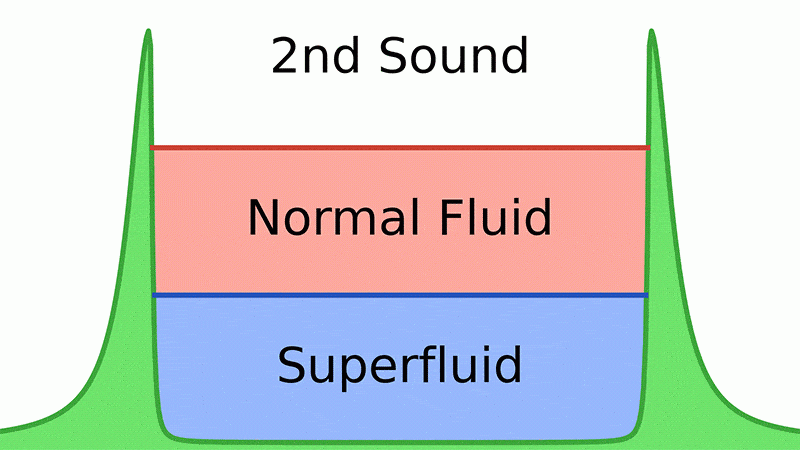
Typically, heat radiates outward from a source until it gradually evens out. Yet in certain unusual materials, heat acts differently—it oscillates back and forth, flowing like a wave.
This rare effect, called “second sound”, has fascinated physicists for years. Recently, a team at MIT succeeded in capturing an image showing heat traveling as a wave, offering a fresh perspective on the dynamics of temperature in motion.
A Thermal Ping-Pong Rather Than Gradual Spread
The research, detailed in the Department of Physics, unveils new insights into heat flow in superfluid quantum gases. Assistant professor Richard Fletcher describes this unique phenomenon with an analogy that challenges the usual view of heat movement:

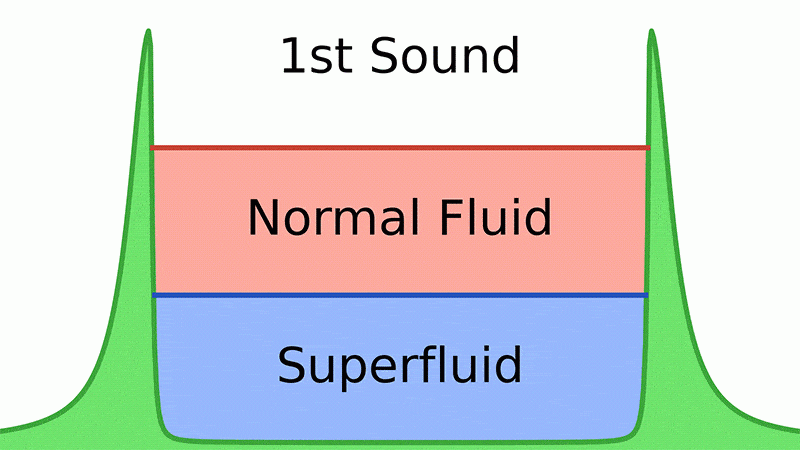
“Imagine heating one side of a tank of water until it’s nearly boiling,” Fletcher said in an MIT press release. “Normally, heat would gradually spread out. But with second sound, instead of diffusing, the heat jumps back and forth, while the surface of the liquid appears completely still.”
Put simply, in these ultra-cold environments, heat doesn't just radiate outward—it rebounds and travels in pulses, akin to a relentless ping-pong match, only with energy in motion.
Superfluidity: Atoms Defying Conventional Behavior
The key to this phenomenon lies in superfluidity, a state that emerges when gases are chilled to nearly absolute zero (−459.67°F / −273.15°C). At these temperatures, atoms lose their individual behavior and move collectively in a frictionless fluid. In this state, heat doesn’t simply spread—it propagates in waves.
“Second sound is one of the key signs of superfluidity,” said lead author Martin Zwierlein. “But until now, in ultracold gases, it was only visible as a faint disturbance. The true nature of this heat wave had never been fully confirmed.”
This effect represents a fundamental shift in understanding how heat transfer operates under extreme quantum conditions.
Innovative Method to Detect Heat Waves Without Heat Radiation
Capturing this elusive heat wave required new technology because conventional infrared sensors fail at temperatures near absolute zero, where thermal radiation is minimal.
The MIT scientists employed radio frequency waves and utilized a cloud of lithium-6 fermions to correlate subtle radio frequency changes with temperature variations.
This approach allowed them to essentially “hear” the heat wave moving through the medium, circumventing the need to observe it directly.
This advance is not simply a technical milestone but opens doors to exploring the nature of some of the universe’s most puzzling states of matter.
Implications Across Science and Technology
Though this discovery may seem like an abstract curiosity, it holds potential significance for several fields.
In materials science, a deeper understanding of heat wave behavior in superfluids could drive innovations in next-generation cooling technologies.
It may also prove crucial for the development of future quantum devices, where controlling heat with precision is vital to device stability and function.
On an astronomical scale, these principles might shed light on the heat transfer mechanisms within neutron stars and other highly extreme cosmic conditions.
This research reveals that our traditional concepts of heat are incomplete—and that temperature can manifest in surprisingly complex ways within the quantum realm.













0 comments
Sign in to Comment