
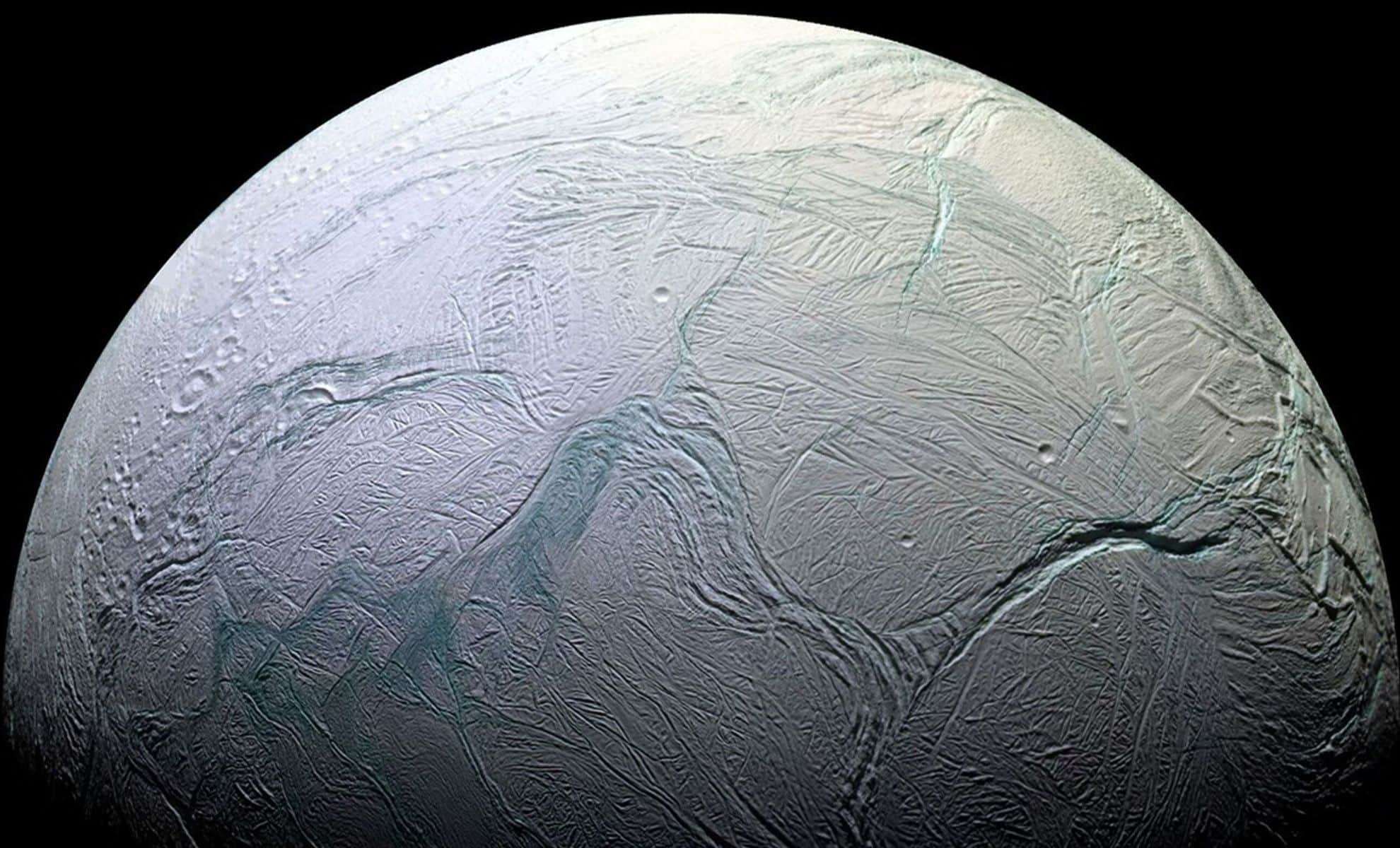
Enceladus, one of Saturn’s intriguing icy satellites, has captivated researchers with its spectacular geysers that erupt water vapor, ice particles, and organic compounds into space. First observed by NASA’s Cassini mission, these jets hinted at a hidden ocean beneath its frozen crust, sparking excitement about its potential to harbor life. However, recent research proposes an alternative source for these plumes: a semi-molten region of saline ice within the moon’s crust, which may reshape our understanding of Enceladus’ habitability and that of other icy worlds.
A fresh perspective on the origin of Enceladus’ jets
A new paper published in Geophysical Research Letters introduces a novel explanation for the formation of Enceladus’ geysers. Spearheaded by Professor Colin R. Meyer from Dartmouth College, this study argues that frictional heating caused by the movement of ice layers generates enough heat to melt saline pockets inside the crust, rather than the geysers erupting directly from the subsurface ocean.
“Cassini’s passage through one of these plumes detected organic molecules, hinting at the presence of life, which makes them significant for astrobiology,” Meyer remarks. “Understanding the processes that drive these eruptions is vital to assessing whether Enceladus can support life.”

The research indicates that gravitational interactions with Saturn induce stresses in the ice shell, triggering melting in certain areas and creating a “mushy zone” consisting of a mix of ice and salty liquid. This brine escapes via fractures, producing the towering jets documented by Cassini.
The role of Enceladus’ icy exterior in plume formation
Earlier hypotheses assumed a direct connection between Enceladus’ plumes and its global subsurface ocean, suggesting that materials ejected into space originated deep beneath the surface. However, Meyer’s team highlights two main challenges to this view:
- Maintaining open fractures — It’s unclear how cracks could stay open continuously through the thick ice shell to let ocean water flow out.
- Transport feasibility — The mechanism by which ocean water would ascend the fractures without freezing or blockage remains unexplained.
Instead, the study proposes that tidal forces from Saturn deform Enceladus’ icy crust, causing frictional heating that melts pockets of salty ice within. Meyer explains, “Saturn’s gravitational pull stresses the ice shell, causing it to rub and generate heat, which melts trapped brine.”
This salty brine reduces the ice’s melting temperature, enabling localized melting that sustains the plumes without a direct link to the subsurface ocean.
Implications for Enceladus’ potential to harbor life
Even with this fresh perspective on the plume origins, Enceladus remains a leading candidate in the search for extraterrestrial biology. Cassini’s findings include water vapor, carbon dioxide, methane, ammonia, nitrogen, salts, and silica within the plumes — all essential ingredients for life.
“In such scenarios, the fractures may still serve as pathways for exchanging materials between frozen pockets and the deeper ocean,” Meyer notes. This suggests that while the jets might not emanate directly from the ocean, they could still carry organic matter and biosignatures to the surface for detection.
- Categories:
- News








0 comments
Sign in to Comment