

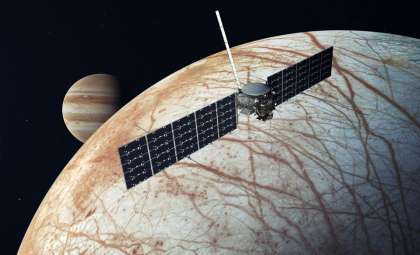
NASA’s Europa Clipper spacecraft has recently transmitted its initial star field image, marking a key achievement as it journeys toward Europa, one of Jupiter’s moons. Unveiled by NASA this week, the picture is a composite mosaic created from three separate exposures taken on December 4, 2024. These snapshots, acquired just two months after launch, reveal distant stars located between 150 and 300 light-years away, capturing only about 0.1% of the sky visible to the spacecraft.
This inaugural image goes beyond a beautiful cosmic snapshot—it plays a vital role in Europa Clipper’s navigation capabilities. The spacecraft relies on star trackers which use these stellar patterns to precisely determine its position and orientation throughout the intense 1.8-billion-mile expedition toward Jupiter.
Star Trackers: The Eyes Behind Europa Clipper’s Navigation
To achieve highly accurate guidance through deep space, Europa Clipper is outfitted with two compact star tracker cameras. Continuously photographing the stellar backdrop, these instruments cross-check observed star positions against a preloaded stellar catalog.

“Without a clear understanding of our spacecraft’s exact orientation, accurately aiming science instruments at Europa, or directing our antennas for Earth communications, would be impossible,” explained Mana Salami, a systems engineer at NASA’s Jet Propulsion Laboratory.
By constantly verifying its attitude relative to the stars, Europa Clipper ensures that once it arrives at Europa in April 2030, its instruments will be perfectly oriented for data collection.

Unlocking the Mysteries of Europa
Europa Clipper is among the most daring robotic space missions ever launched, aiming to explore if Europa’s hidden ocean beneath an icy crust could harbor conditions favorable for life. The probe will conduct nearly 50 flybys of Europa, examining:
- The thickness of Europa’s ice layer and how it interacts with the ocean beneath.
- The moon’s surface makeup to identify elements essential for life.
- The geological processes shaping Europa, including signs of subsurface water plumes.
Upcoming Maneuvers: Harnessing Gravity to Accelerate
Before reaching its destination, Europa Clipper will leverage gravitational assists to boost its speed. Its first gravity assist will occur in March 2025 during a close flyby of Mars. Subsequently, it will perform another gravity assist maneuver near Earth to launch itself directly toward Jupiter.
Each phase of the mission brings us closer to answering a profound question—is life beyond our planet possible? As Europa Clipper advances, it will continue gathering remarkable stellar imagery to maintain perfect alignment, positioning itself to unveil the secrets beneath Europa’s enigmatic icy surface.
Vous avez dit :
- Categories:
- News










0 comments
Sign in to Comment